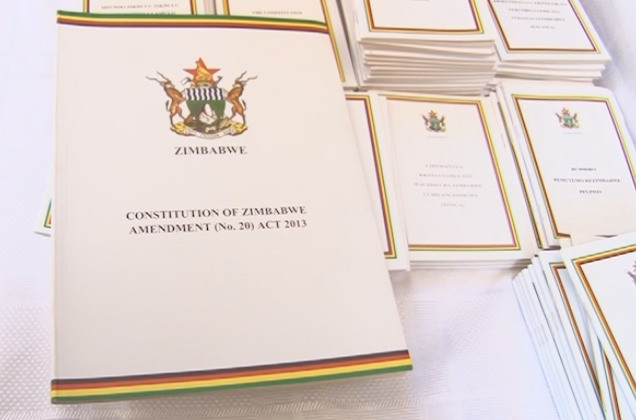
ZIMBABWE is at a crossroads following the gazetting of far-reaching proposals to amend the Constitution without a referendum, with critics accusing President Emmerson Mnangagwa’s government of initiating a constitutional coup.
Speaker of the National Assembly Jacob Mudenda gazetted the proposed controversial constitutional amendments on Monday, a week after they were tabled in Cabinet.
One of the controversial clauses which have divided public opinion amid heightened political temperatures deals with the extension of Mnangagwa’s tenure from 2028, when it constitutionally expires, to 2030.
Under the proposed laws, a president will be elected by Members of Parliament, a shift away from national elections where the country’s ruler was subjected to popular vote by citizens.
Sources claim the proposed amendments are a bid to block Mnangagwa’s deputy, Constantino Chiwenga, from succeeding him.
Chiwenga oversaw the overthrow of the late former President Robert Mugabe in 2017 and Mnangagwa taking over when he was the army general.
Mnangagwa’s 2018 and 2023 wins in the presidential elections were contested by opposition leader Nelson Chamisa, who argued that the polls were rigged.
Critics of the proposed constitutional amendments say Zanu PF is sceptical of winning the 2028 presidential elections.
- Big send-off for Cont Mhlanga
- Massive ZRP vehicle theft scam exposed
- Zanu PF bigwigs face axe in purge
- Village Rhapsody: Health workers’ grievances need permanent solution
Keep Reading
What they said:
Lawyer and Bulawayo mayor David Coltart
“The bottom line in the entire 2030 issue is that Zanu PF fears facing the electorate in 2028. That is what this is all about.
“They have watched the debacle in Tanzania and Uganda in the last few months, where incumbents were forced to use extreme measures to hold on to power.
“They know the same fate awaits them and so want to avoid an election at any cost.”
Opposition politician Jameson Timba
“Keeping term limits on paper while changing how power is renewed does not preserve 'constructionalism', it bypasses it. The issue is not section 91.
“The issue is whether the people still choose their leaders at predictable intervals. If sovereignty is altered, only a referendum can legitimise it.”
Constitutional law specialist Advocate Thabani Mpofu
“Constitutionally, the President has two terms and the term limit provision only limits itself to only those two terms.
“The amendment does not seek to increase the terms. It maintains the two terms, but alters the duration of one of the terms.”
Top scholar and lawyer Justice Alfred Mavedzenge
“Dear Attorney-General. Why have you omitted section 95(2) on your list of term limit provisions for the President?
“As chief legal adviser, are you not aware of section 95(2)(b), which says the President’s term of office is limited to five years?
“By way of contrast, the Constitution abounds with a myriad of provisions that unquestionably constitute specific term-limit provisions.
“First and foremost, there is section 95(2) which expressly stipulates that the term of office of the President is five years.”
Top lawyer and banker Tawanda Nyambirai
“... I struggle to see how the proposed changes could be effected without triggering a referendum under section 328 of the Constitution.
“While section 158 may not itself be a ‘term-limiting provision’ as contemplated in section 328, it certainly provides substantial constitutional grounds for challenging any extension of tenure.
“As for Parliament, section 143 is unequivocally term-limiting. Absent some genuine constitutional innovation, it is difficult to see how it could be amended without a referendum...”
Diaspora Vote Initiative
“We emphasise 2028 elections because even if the proposed constitutional amendments pass following a referendum, amendments that alter term limits should not benefit current officeholders.”
Zimbabwe Lawyers for Human Rights
“The proposed amendments threaten to erode and fundamentally undermine the core principles of constitutionalism and risk entrenching excessive executive power.
“Zimbabwe Lawyers for Human Rights is deeply concerned that the net effect of these proposed amendments would concentrate decisive power in the hands of legislators and the Executive, limiting public participation in the affairs that concern them.
“Such changes undermine the principle of popular sovereignty, which lies at the core of the values of the 2013 Constitution and contravene the fundamental principles of representative democracy, the rule of law and the separation of powers.
“The transfer of key electoral administrative functions, including voter registration and delimitation, from the Zimbabwe Electoral Commission to other entities poses a serious risk to the integrity and credibility of the electoral process in Zimbabwe.
“Furthermore, the executive appointment process of all judges threatens the independence of the Judiciary and undermines public confidence in the justice delivery system of the country.”
Conversely Mnangagwa’s loyalists have unequivocally thrown their weight behind the proposed constitutional amendments without the need for a referendum.
This is what they have said:
Dereck Goto
“A constitution is not a relic preserved behind glass; it is a governing instrument built to operate in the present.
“It exists to organise power, correct defects and respond to changing realities.
“Amendment, in itself, is neither betrayal nor taboo — it is part of constitutional design.”
Politician Temba Mliswa
“It’s important to state that Zanu PF, as a party, is advancing this initiative, not President Mnangagwa.
“It becomes a personal attack to single out one individual for something which has been ratified by the party and will actually outlast him. He has even stated his own wish to step down.
“The amendments are designed to bolster stability and policy continuity. By extending the terms of the President and Parliament from five to seven years, we allow for the fruition of long-term national development projects.”
Addressing a Press conference yesterday, Zanu PF spokesperson Christopher Mutsvangwa said: “We expect that the Bill will be passed and we are happy that there is consensus between all the parties in Parliament as to what concerns this Bill.
“Yes, there are some discordant voices, but they are discordant voices which are outside Parliament and most of them are the usual crowd which has an inborn attitude against Zanu PF.”
Mnangagwa has previously said he was not interested in having his term of office extended. The proposal to extend Mnangagwa’s tenure first came into the public domain at a 2024 Zanu PF conference held in Bulawayo.
At the conference, then party legal secretary Patrick Chinamasa told Zanu PF delegates that any attempt to extend Mnangagwa’s tenure beyond 2028 needed a referendum.
Justice minister and current Zanu PF legal secretary, Ziyambi Ziyambi, said there was no need for a referendum.