THE ZIMBABWEAN government — in power since late 2017 — has been riding on the slogan “Leaving no one and no place behind”, in pursuit of its highly-ambitious goal to achieve a middle-income economy status by 2030.
But this mantra will not find takers among thousands of villagers in Mashonaland West province, whose livelihoods are set to be negatively impacted by a controversial Chinese cement project that the presidency has foisted on them despite spirited resistance.
Thrown under the bus
It turns out, through an investigation, that the presidency threw the villagers under the bus by giving its blessings to a project that will displace hundreds, affect water supply and cause excessive environmental damage, among other violations.
The High Court has ordered a stop to the venture, which appears to have continued unabated.
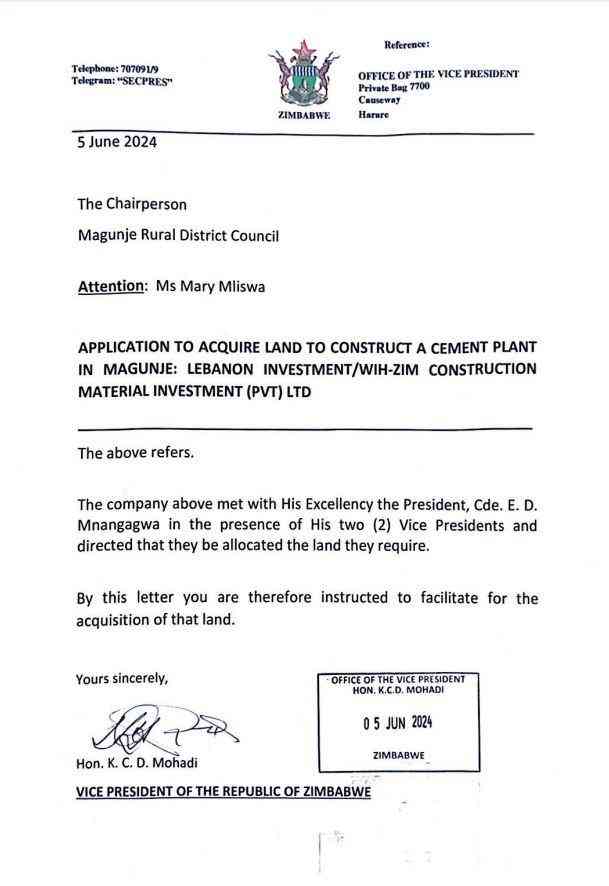
It was one of the co-Vice-Presidents, Kembo Mohadi, who wrote to the Hurungwe Rural District Council under whose jurisdiction the cement project is being developed, instructing the local authority to cede 135 hectares of land to a Chinese mining company.
- Veld fire management strategies for 2022
- Stop harassing media for reporting truth
- Veld fire management strategies for 2022
- News in depth: Mnangagwa’s push for $12 billion mining industry imperils communities
Keep Reading
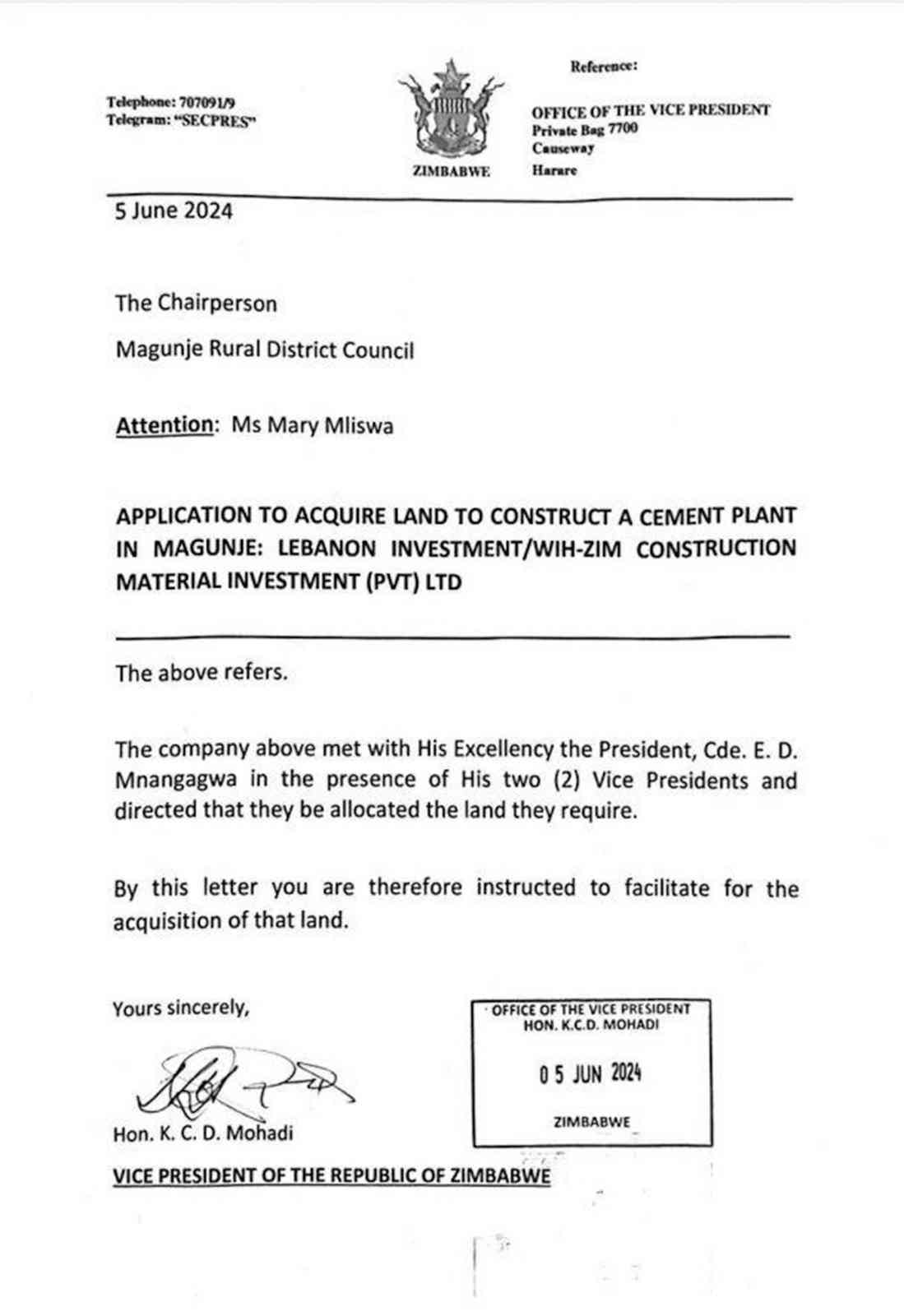
In the June 5, 2024, letter addressed to the rural council’s chairperson, Mary Mliswa-Chikoka, Mohadi says it was President Emmerson Mnangagwa who ordered that the sprawling piece of land be handed over to WHI-ZIM Construction Material Investments (Pvt) Ltd, a Chinese company.
The cement production project spans wards 10 and 11 of Magunje.
WHI-Zim Construction is a Chinese-controlled joint venture between Labenmon Investments and West International Holdings, but is commonly referred to by the former name.
The letter, signed by Mohadi, shows that representatives of the company met with Mnangagwa, Mohadi and the other Vice-President, Constantino Chiwenga.
After that, the President directed that WHI-Zim Construction be given the land despite fierce opposition from villagers, civil society and some key traditional leaders.
It emerged, though, that the presidential order was made before due process — such as public consultations with concerned stakeholders and an environmental impact assessment — was undertaken.
“The company above met with His Excellency the President, Cde ED Mnangagwa, in the presence of his two Vice-Presidents and he directed that they be allocated the land they require. By this letter, you are, therefore, requested to facilitate the acquisition of that land,” Mohadi wrote.
The Chinese company said its aim was to build a 2,7 million-tonne per annum plant, in addition to a 100MW power plant, in an investment estimated to top US$1 billion.
The signing ceremony for the project was held in January last year.
Hardly a month after the letter, the Chinese company started pegging off the land earmarked for the project.
As a result, scores of villagers were cut off from the pastures and farmland they had derived livelihoods from for generations.
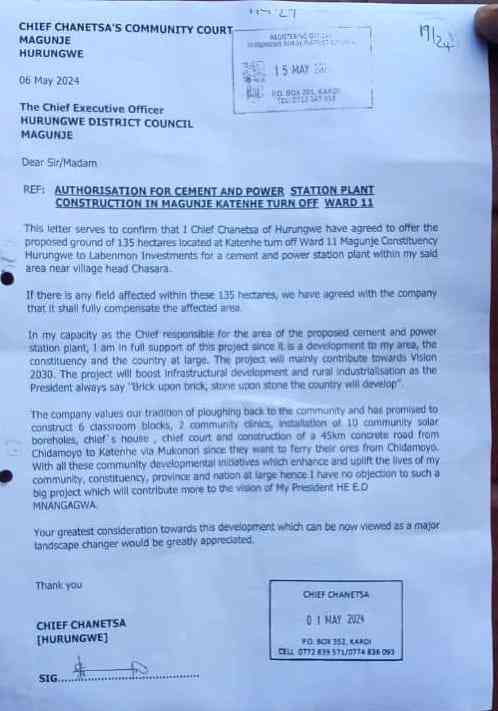
It also emerged that Mohadi’s letter was meant to reinforce the one written by Chief Chanetsa, who in May last year directed the Hurungwe District Council to allocate the land to the Chinese company.
The traditional leader’s letter is dated May 6, 2024, a month before Mohadi’s.
In his letter, Chanetsa claimed that villagers facing displacement will be compensated, but there is no detail on how that will happen.
“This letter serves to confirm that I, Chief Chanetsa of Hurungwe, has agreed to offer the ground of 135 hectares located at Katenhe turn-off ward 11, Magunje Constituency, Hurungwe, to Labenmon Investments for a cement and power station plant within my said area near village head Chasara,” he wrote.
In the letter, the traditional leader said Labenmon Investments would construct six classroom blocks, two clinics and a 45-kilometre concrete road, and drill 10 solar-powered boreholes as part of its corporate social responsibility programme, “which enhances and uplifts the lives of my community, constituency, province and nation at large”.
But Chanetsa apparently bragged about his power to allocate land in the villages that the project straddles.
Two neighbouring chiefs, Nematombo and Dendera, insist that parts of the land fall under their respective jurisdictions.
On July 25, 2024, Nematombo wrote to the Environmental Management Agency (Ema)’s director-general, Aaron Chigona, complaining that Chief Chanetsa had overstepped his authority by allocating the land to Labenmon.
He also noted that there were no consultations held with affected villagers.
“I became aware of this project after I was invited for a full council meeting on June 21, 2024, and yet the land in question, where Chasara and Kapere villagers are located, is under my jurisdiction (sic).
“I raised this point in the full council meeting and was dismissed by the council chair, Mary Mliswa, in the presence of my subjects,” he wrote.
“I am seeing activity in my jurisdiction, and again, I have not been informed if the purported investor has officially been allocated land in my jurisdiction and with all these flawed processes,” read the letter.
Chief Nematombo fears that displacements in the area will worsen food insecurity among the affected villagers as the project will adversely impact on water supply from Magunje Dam.
“I am also concerned about our health as a community, and we have Magunje Dam in my jurisdiction, which is a source for over 10 000 inhabitants at Magunje growth point and about 5 000 in surrounding areas . . . It’s the flawed processes and the environmental conditions that concern me,” he wrote.
Chief Dendera also complained to Ema around the same time.
“I am very concerned about my subjects’ food security as 18 villages under my jurisdiction benefit from Magunje Dam,” he wrote.
Villagers from Chasara and Kapere in wards 10 and 11 who spoke during the investigation expressed fear that discharges from the cement project may lead to pollution of the nearby Kemureza Dam, which the project relies on for water.
It is also likely to damage the flora and fauna in the area and acutely reduce grazing land and farming plots, they said.
Thousands affected
Kemureza Dam supplies water to around 10 000 people and the cement project is located about 1,4 kilometres upstream of Magunje Dam.
About 80 families face displacement as a result of the project and there are no solid plans in place for their relocation.
The villagers accuse Chief Chanetsa of railroading the project to please the Chinese and politicians.
However, Chanetsa was adamant that sufficient consultations were done — despite villagers’ protests — adding that “people from my area are happy with this project”.
Labenmon Investments' lawyer, Fortune Murisi, claimed that there was adequate consultation and endorsement before the project took off.
"Villagers were adequately consulted, and there are several letters and minutes that confirm that position. The Rural District Council was involved and that is the responsible authority,” Murisi said.
He, however, was flat-tongued on the fact that the High Court had issued a judgment stopping the expansion of the project as currently planned.
In February this year, the High Court in Chinhoyi barred Labenmon Investments from extending the project into the grazing area owned by Chasara and Kapere villagers, following an urgent application by locals.
In their court application, the villagers argued that Labenmon had not compensated or relocated them from their ancestral land and also raised concern over how Ema conducted an EIA.
The High Court order prohibited WHI-ZIM from continuing operations pending the outcome of investigation into the breach of the EIA certificate, but the company has defied the directive.
Before the presidency’s intervention, Labenmon Investments had been offered 50 hectares of land, northeast of Magunje growth point, an investigation shows.
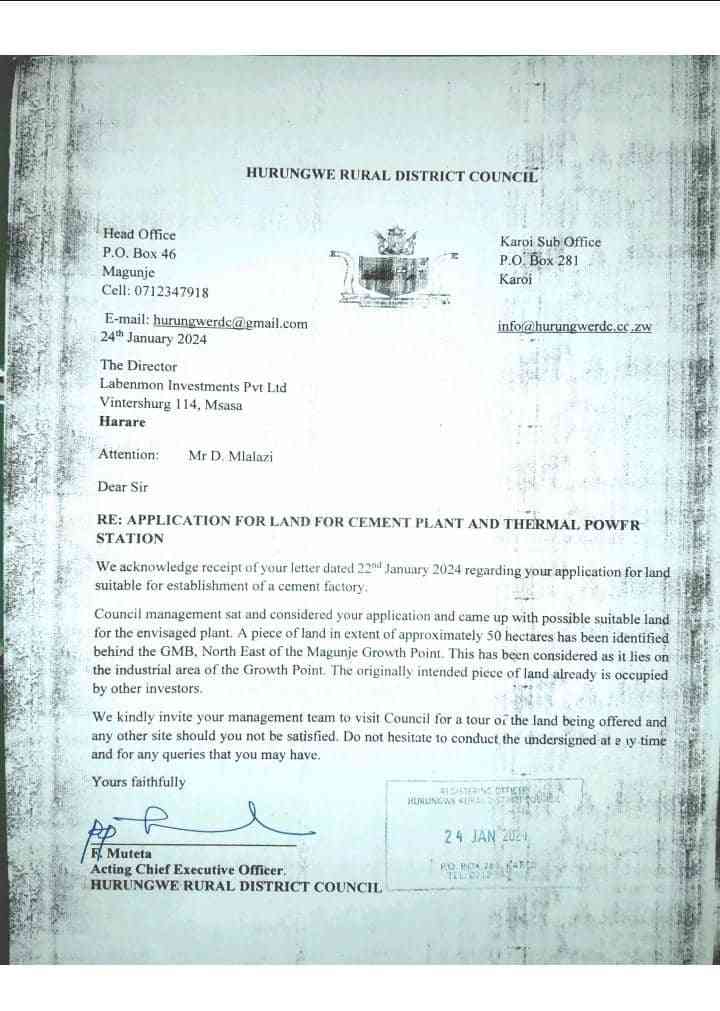
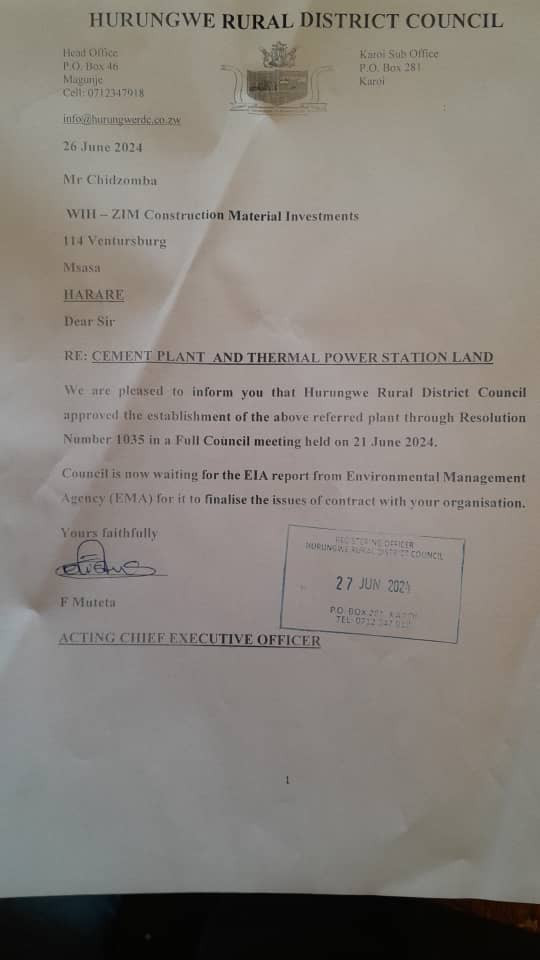
The then acting Hurungwe local authority boss, Felistus Muteta, in January last year, wrote to Labenmon Investments confirming land allocation in an industrial stretch behind the Grain Marketing Board complex.
The letter also noted that the Chinese firm will be offered an opportunity to choose an alternative place if it was not satisfied with the land it was allocated.
Labenmon Investments said the land was too small for the cement project.
Muteta declined to comment, referring all questions to Hurungwe District Council’s chief executive officer, Luke Kalavina, who did not answer calls and questions sent to him.
The district development coordinator for Hurungwe District Council, Andrew Tizora, said he could not comment on the matter since it was before the courts following the High Court interdict.
Mliswa-Chikoka declined to speak on the matter as well and referred questions to Kalavina.
A group of villagers in July last year engaged Tizora to reconsider the site of the cement project due to environmental, health and social concerns, as well as non-consultation of locals.
“The Environmental Impact Assessment is not yet public, but the project has started. This is not in the spirit of devolution, which seeks to enhance residents' participation in the management of local affairs and development as provided for in section 265(1) of the Constitution as read with the Devolution and Decentralisation Policy of 2020 and the Ema Act,” read the letter from the Zimbabwe National Organisation of Associations and Residents Trusts, an apex body representing all residents and associations in Zimbabwe.
“Our plea on behalf of Magunje and Hurungwe district residents is for sustainable development. The proposed project was offered land at an industrial site by the local authority, but it was pushed to communal land, which is in proximity to a major water source, in total disregard of the recently adopted Magunje master plan,” it said.
Flawed process
Documents show that Ema issued a certificate to Labenmon Investments under reference number L10000034346 before the company submitted its reports on environmental impacts associated with its projects.
The Zimbabwe Lawyers for Human Rights (ZLHR) contends that Ema violated section 100(2)(c) of the Environmental Management Act (Environmental Impact Assessment and Ecosystems Protection Regulations, 2007) by failing to invite Labenmon Investments and interested parties to a consultative meeting before the issuance of the EIA certificate.
It also emerged that public consultations ahead of land allocation to Labenmon Investments were held in Chinhoyi, which is located about 120 kilometres from Magunje.
Villagers, who will be affected by the cement manufacturing project only became aware of the issuance of the EIA certificate through a newspaper article published by the State-controlled media.
In September 2024, villagers petitioned the Zimbabwe Human Rights Commission (ZHRC), a constitutional body, over likely water contamination from the cement project.
The petition came a month after Ema had dispelled fears of pollution of the Kemureza Dam.
Ema spokesperson Amkela Sidange said the EIA was done above board.
“The project referred to was issued an Environmental Impact Assessment certificate. The review of the EIA report and the subsequent issuance of the certificate were conducted under the Environmental Management Act (CAP 20:27), as read with Statutory Instrument 7 of 2007.
“The EIA report had documentation of public consultations with both the affected and interested parties. To ensure a comprehensive review, the agency invited representatives from these groups to validate if their views and opinions were correctly captured,” Sidange said.
She added that representatives of “various ministries, departments and agencies” were also consulted, but acknowledged that the investor had subsequently violated some of the regulations.
“However, the project in question faced non-compliance with the terms and conditions outlined in the Environmental Impact Assessment certificate, thus resulting in litigation being instituted.”
Investigations show that in September last year, villagers from Magunje wrote to the then Environment, Climate and Wildlife minister Sithembiso Nyoni expressing reservations over how the EIA certificate was issued to the Chinese investor.
In its report following complaints by villagers, the ZHRC urged the Zimbabwe Republic Police “to enforce the provisional order under Case No HCCC15/25, which stipulates a halt to operations by WHI-ZIM until all grievances are addressed”.
ZHRC had launched an investigation following complaints raised by villagers from Magunje’s wards 10 and 11 over freedom from arbitrary eviction, environmental rights, right of access to information, right to administrative justice and property right.
The human rights body said the affected residents’ rights “to proper consultation, fair compensation and environmental safeguards appeared to had been overlooked or inadequately addressed”.
It recommended that the Local Government and Public Works ministry issues a moratorium instructing the Chinese firm “to halt any further operations until administrative actions” have been implemented.
Council was tasked to provide documentation outlining the boundaries of Magunje Dam, as well as make publicly available all decisions
and processes relating to the cement plant.
ZHRC also recommended that Ema conducts a “comprehensive assessment” of the environmental sensitivity of the Magunje Dam area, focusing on its ecological significance and identifying potential risks linked to nearby industrial activities.
The commission suggested that the minister of State for Provincial Affairs and Devolution (Mashonaland West) must “facilitate community consultations to ensure that the voices of residents are heard regarding the proposed cement plant”.
Rights violations
Interviewed villagers revealed human rights violations, alleging that Labenmon was enjoying protection from local police.
“People have been arrested and tortured on charges of encroaching onto the Labenmon area, a place that we have always known to be ours,” said a villager, who requested anonymity.
Three women were taken into custody and charged with malicious damage to property for trying to gain access to their gardens, which had been burned down, it was reported.
Investigations also revealed serious violations of the conditions of the EIA certificate by Labenmon Investments.
The EIA directed the company to “ensure there is no pollution of Kemureza Dam” and that “compensation and relocation of all the affected households should be done and finalised before commencement of works”.
Magunje villagers last year wrote to the Parliamentary Portfolio Committee on Lands, Agriculture, Water, Fisheries and Rural Development, noting that they did not sign consent affidavits of land occupation as required and added that consultations were not done with villagers from the affected areas.
“The chief allocated the land in total violation of the laid down procedure of allocation of land set (out) in the Traditional Leaders Act (29:17) section 26 on allocation of communal land,” they stated.
They also noted that the project had been sited too close to the dam as it fell within a 1,4km radius.
The villagers also called for the Chinese investors to be summoned and explain “how they got the proposed site”, but there was no evidence that these requests were heeded.
However, the portfolio committee, chaired by Chivi South MP, Felix Maburutse of the ruling Zanu PF, visited the site in November last year to gather views from villagers.
Maburutse declined to comment on the committee’s findings.
Media point person in Mohadi's office Weston Makoni referred questions to an official from the Information and Publicity ministry who identified herself as Kerita Chinoda.
But Chinoda referred the media queries back to Makoni, who ignored subsequent calls and texts, just like presidential spokesperson George Charamba.