REPORTS that a member of the Constitution Defenders Forum — a grouping opposed to President Emmerson Mnangagwa’s proposed tenure extension through a constitutional amendment — was abducted on Tuesday night, severely tortured and later dumped in police cells should alarm every Zimbabwean.
What allegedly happened in Glen Norah is not an isolated act of brutality, but a chilling message.
It says there is no room for alternative thinking.
It says dissent is dangerous.
It says constitutional debate comes at a personal cost.
If true, the incident confirms what many have long feared: that in Zimbabwe, exercising one’s constitutional rights can invite violence.
The 2013 Constitution guarantees freedom of expression, freedom of association and protection from inhuman or degrading treatment.
Yet those rights mean little if citizens are beaten into submission for holding opposing views.
- Ebola outbreak officially over in DR Congo
- South Africa confirms first monkeypox case, not linked to travel
- Tedros re-elected as head of World Health Organization
- BCC, TTI sued over parking management
Keep Reading
The gulf between what is written in the Constitution and what is practised on the ground remains painfully wide.
Torturing someone in this day and age simply because they disagree with a political proposition belongs to a darker era — one we claim to have left behind.
It belongs to the Stone Age of governance, not to a modern constitutional democracy.
Debate over constitutional amendments should be exactly that — a debate.
Citizens are entitled to support or oppose changes to the supreme law without fear of abduction or assault.
If a leadership is confident in its position, it persuades. It does not persecute.
It is particularly troubling that Zimbabwe is not a party to the United Nations Convention against Torture and Other Cruel, Inhuman or Degrading Treatment or Punishment (UNCAT).
Despite clear constitutional prohibitions against torture, the country remains one of the few on the continent that has neither signed nor ratified the convention.
The omission speaks volumes.
Ratifying UNCAT would not magically end abuse, but it would signal a binding international commitment to prevent, criminalise and punish torture.
It would create stronger mechanisms for accountability and send a message that Zimbabwe stands firmly against cruelty in all its
forms.
Instead, allegations of abduction and torture continue to surface whenever political tensions rise.
Torture — or even the threat of abduction — must never be deployed as a tool to silence citizens.
When violence becomes the language of political engagement, it reveals weakness, not strength.
It suggests a leadership insecure about its ability to win arguments in a free and fair contest of ideas.
If the constitutional amendments are truly in the national interest, they should withstand scrutiny.
They should survive robust debate.
They should persuade citizens on merit.
Silencing critics through force implies the opposite — that the proposals cannot survive open discussion.
Zimbabwe’s liberation struggle was framed as a long walk to freedom.
Decades later, the promise of that freedom still feels unfulfilled.
The rights to speak, to organise and to oppose remain fragile.
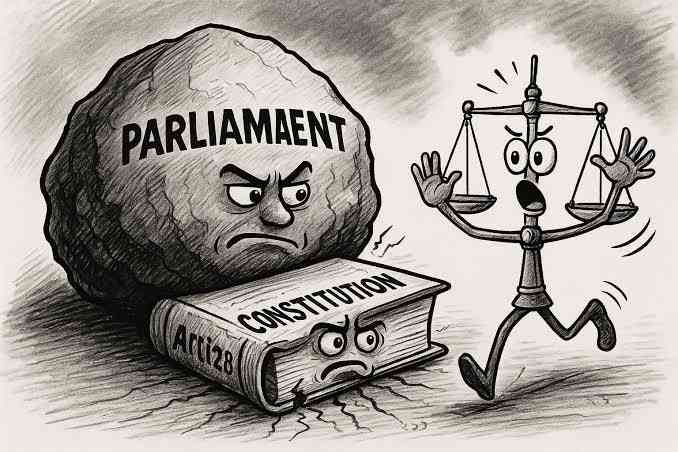
A Constitution is not merely a document.
It is a covenant between the State and its citizens.
When citizens are punished for defending it, the covenant is broken.
The path to genuine constitutionalism is, indeed, a long walk.
But it cannot be travelled in fear.
It must be walked in freedom.