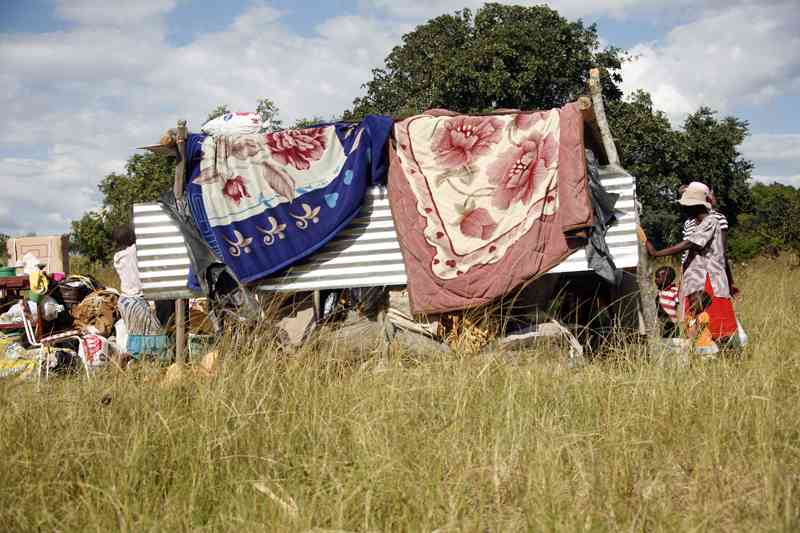
IN Mazowe, 21 families are once again staring eviction in the face — not because they broke the law, but because they are powerless.
After being chased from one farm, they sought refuge on another, only to be confronted by the same reality that haunts millions of Zimbabweans: land security depends not on legality, but on who holds power.
The families accuse Vice-President Kembo Mohadi’s son, Mafinyadira, of orchestrating their first eviction and possibly the second.
Whether or not the claims are ultimately proven, the pattern is disturbingly familiar.
Arnold Farm, popularly known as Manzou Farm, has long been contested terrain.
At one point, former First Lady Grace Mugabe attempted to evict the same families — an attempt only stopped by the courts.
But even a court reprieve did not bring peace of mind.
It merely delayed the inevitable.
- Zanu PF bigwigs thrown under the bus
- Zanu PF bigwigs thrown under the bus
- Feature: Killings raise gender violence concerns in Zim
- Bulawayo a great, clean city: Mohadi
Keep Reading
For these families, “home” has become a temporary concept.
Their lives are lived in limbo, always aware that someone more powerful could wake up tomorrow and decide that the land is theirs.
This is the quiet cruelty of a system where influence matters more than law and survival depends on political proximity rather than constitutional protection.
Powerful individuals appear to be at liberty to do as they please — seize land, uproot families and override legal processes — with impunity.
And when such abuses are normalised, the message to ordinary citizens is chilling: the law exists, but it does not exist for them.
This same disregard for constitutional order is evident elsewhere.
In Manicaland, Chimanimani acting chief Tendai Saurombe faces a High Court challenge after making clearly partisan remarks in support of the ruling Zanu PF party.
Section 281 of Zimbabwe’s Constitution is clear: traditional leaders must be non-partisan and must not engage in political activities.
The law is unambiguous. Yet it was ignored.
Traditional leaders occupy a sacred position in society, meant to unite communities beyond political affiliation.
When chiefs openly align themselves with political parties, they weaponise culture and authority, undermining democracy and social cohesion.
Worse still, it signals that even constitutional prohibitions can be bent when political interests are at stake.
These two cases — evictions in Mazowe and partisan conduct by a traditional leader — are not isolated incidents.
They are symptoms of a deeper disease: selective obedience to the law.
Those with power violate it. Those without power suffer under it.
And when powerful countries such as the United States impose sanctions or travel restrictions on Zimbabwean officials, the leadership cries foul.
They accuse foreign governments of employing dirty tactics, of bullying, unfairly targeting the country.
But sanctions do not emerge from thin air.
They are responses — however imperfect or controversial — to a persistent pattern of governance failures, human rights violations and institutional decay.
When courts are undermined, when evictions are carried out without due process, when constitutional safeguards are openly violated, international scrutiny is inevitable.
The tragedy is that ordinary Zimbabweans bear the brunt.
Families are displaced. Communities are destabilised. Trust in institutions erodes.
If those in power truly want sanctions lifted, foreign criticism silenced and international confidence restored, the solution is not outrage or denial.
The solution lies in reform, respect for the Constitution and accountability, especially for the powerful.
The law must cease being a weapon wielded against the weak and a shield for the connected.
Until Zimbabwe demonstrates that no one is above the law — not politicians, not their children, not traditional leaders — the cycle of injustice will continue.
And so will the global consequences.
The question is no longer whether the law exists. It is whether it matters.