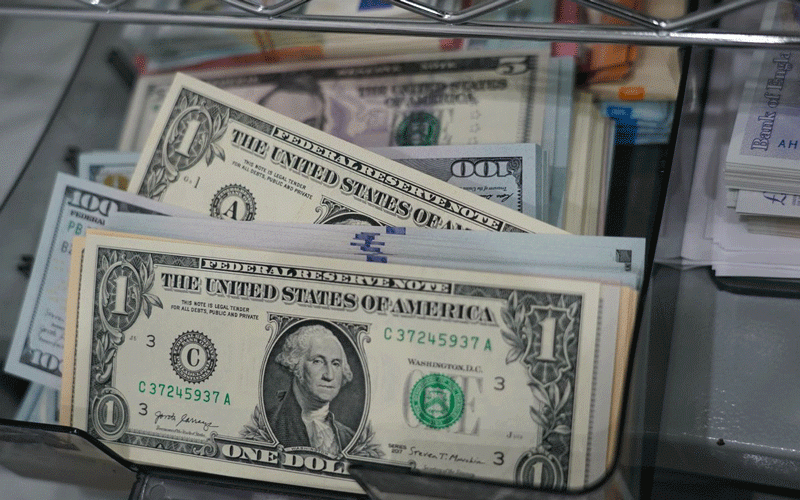
THE latest Confederation of Zimbabwe Industries (CZI) survey leaves little room for doubt: Zimbabwe’s de-dollarisation dream is failing to gain traction in the real economy. Far from reversing dollarisation, current trends reveal acceleration, with businesses and consumers alike voting with their feet in favour of the US dollar.
With 73% of firm-level transactions being settled in USD, according to CZI’s 2025 Third Quarter Business Insights report, the economy is sending a clear and unambiguous signal of deep-seated mistrust in the local currency framework. A sectoral breakdown reveals that dollarisation has intensified across most industries, with only the construction sector recording a marginal decline in USD sales to 70% from 71% in 2024.
Manufacturing — the backbone of value addition and industrial growth — recorded one of the sharpest increases. Transactions settled in USD rose by eight percentage points to 75% during the period under review, from 67% in the comparable period last year. The transport sector remains the least dollarised, though usage still climbed from 56% to 66%, likely due to the continued use of local currency by commuter omnibus operators to facilitate small, cash-based transactions and provide change.
Domestic sales point to a gloomy outlook for the local currency. During the first nine months of 2025, large-scale firms reported that 78% of their sales were settled in USD, approximately six percentage points higher than small firms. However, the relatively high levels of dollarisation across all firm sizes underscore a widespread market preference for the US dollar.
The survey further shows that domestic sales have become the primary source of foreign currency for firms operating in Zimbabwe. An estimated 84,2% of respondents relied on domestic sales to meet their foreign currency needs, up from 79% during the same period in 2024. This reliance highlights the extent to which dollarisation is now embedded in day-to-day economic activity.
These statistics confirm that dollarisation is broad-based. It is not confined to large corporates with easier access to offshore markets or foreign lines of credit. Small and medium-size enterprises, often assumed to be more flexible and locally oriented, are also heavily dollarised. This underscores a fundamental truth: the issue is not about firm size or sector, but trust.
Equally troubling is how firms are sourcing foreign currency. With banks and the interbank market supplying just 9% of firms’ forex needs — down from 14% last year — the formal financial system is increasingly failing to play its intermediation role. Export proceeds, at a mere 2,1%, point to a shrinking export base and declining competitiveness in regional and global markets. This is a dangerous trajectory. The only sustainable source of foreign currency is export growth, not the recycling of dollars within the domestic economy.
As a result, firms are being forced to rely heavily on domestic USD sales to meet both local and foreign obligations. While this may provide short-term relief, it is structurally unsound. An economy that generates foreign currency largely through internal circulation rather than production for export is effectively cannibalising itself, constraining investment, innovation and long-term growth.
- Mthuli Ncube abandons struggling consumers
- Fears of jobs carnage as crisis deepens
- Feature: The inevitable return of the greenback
- Fresh warning over bank rate hikes
Keep Reading
These realities lead to one central conclusion: the de-dollarisation plan is off course. Despite being backed by reported reserves of about US$1 billion, the Zimbabwe Gold (ZiG) currency remains a part-time currency, particularly in manufacturing. A similar trend prevails in the retail sector, where ZiG sales account for only 20–30% of transactions.
The lessons from the CZI survey are sobering. With the multi-currency regime set to run for another five years, de-dollarisation cannot be assumed to materialise on its own. Currency reforms cannot be legislated or wished into existence. They must be market-led and anchored on sustained fiscal discipline, policy consistency, a transparent and functional foreign exchange market and a deliberate strategy to rebuild export competitiveness.
Until these fundamentals are firmly in place, de-dollarisation will remain a hard sell — and the US dollar will continue to rule the roost.