Change has just not come to fashion, advanced phones and the introduction of Artificial Intelligence, it has also landed on the motor industry as a whole.
Come to think of it, if you walked into a dealership thirty years ago and asked for a car that could hit 60 miles per hour (mph) in under three seconds, the salesman would have assumed you had a Ferrari budget.
Back then, that kind of speed and acceleration felt like violence, and it was rare.
Due to the technology that was in place at that time, archiving this kind of acceleration meant that a powerful v8, v10 or v12 engine was sending power to the wheels.

Fast forward to the 21st century, and accelerating to 60 mph in under three seconds no longer turns heads, cars are getting faster.
It is not just the super-cars with thousands of horsepower that can accelerate to 60 mph under three seconds, luxury sedans and hatchbacks, even trucks, have played catch-up.
It is more likely to happen that a 30 year old Ferrari could lose to a family SUV, something which could not be imagined 30 years ago.
What has really changed that has given even a $30 000 vehicle the speed and performance which was worth $100 000 some years back?
- 9 000 farmer field schools on cards
- Harvest hay to prevent veldfires: Ema
- Public relations: How artificial intelligence is changing the face of PR
- Queen Lozikeyi singer preaches peace
Keep Reading
- Advanced Computer-Aided Design (CAD) and Computational Fluid Dynamics (CFD)
In the analogue era, engineers had to physically build a car and put it in an expensive wind tunnel to see if the idea worked.
With this level of technology, engineers no longer rely on trial and error when building cars from scratch.
Using CFD, they can simulate how air flows around, over and under the car and how fuel burns inside a cylinder with precision before the car is built.
This allows for micro-aero-shaping tiny components of the car, like side mirrors or suspension arms, to reduce drag, which then makes the car faster.
For example, the Bugatti Chiron doesn’t just have a powerful engine; its entire body is shaped by CFD to make sure that at 400km/h, the car doesn’t lift off the ground.
This, as a result, gives room for improvement without wasting time and also money. A design can be changed as many times as possible until the ultimate design is produced.
- The turbocharging revolution
A turbocharger uses energy from exhaust gases to put more air into the engine.
More air plus more fuel results in the production of more power.
Modern turbos use electric wastegates, which adjust the internal vanes of the turbo to provide boost even at low revs per minute (rpms).
This eliminates turbo lag (the delay before the power kicks in).
For example, the Mercedes Benz AMG A45 S uses a highly tuned turbo to extract 416 hp from a 2.0l engine, a power density that was rare 30 years ago.

- Rapid transmission shifts
A manual gear shift takes about 0,5 to 1,2 seconds, and during that time in a race, the opponent is already ahead.
The use of Dual-Clutch Transmissions (DCT) has given modern cars an edge over old ones.
A DCT has two clutches, one for odd gears and one for even.
Whilst in 2nd gear, the transmission already pre-selects the 3rd gear when the car is accelerating to give the car a quick shift from 2nd gear to 3rd.
DCT ensures that there is no interruption in the power delivery, which makes the car deliver power constantly, a vital requirement when talking about speed.
For example, a Ferrari 812 Competizione shifts in under 30 milliseconds, which is so fast that the acceleration curve looks like a straight line rather than a series of steps.
- Material science and weight reduction
Force equals mass times acceleration (F=ma).
To go faster, you have to increase the force or to reduce the weight of the car.
Modern vehicles are heavy due to safety regulations and also the technology loaded in them.
To fix this, engineers have moved from using simple steel to using carbon fiber and magnesium alloy is the way to go.
These materials are stiffer, which helps in handling, and the sweet spot is that they are much lighter than simple steel.
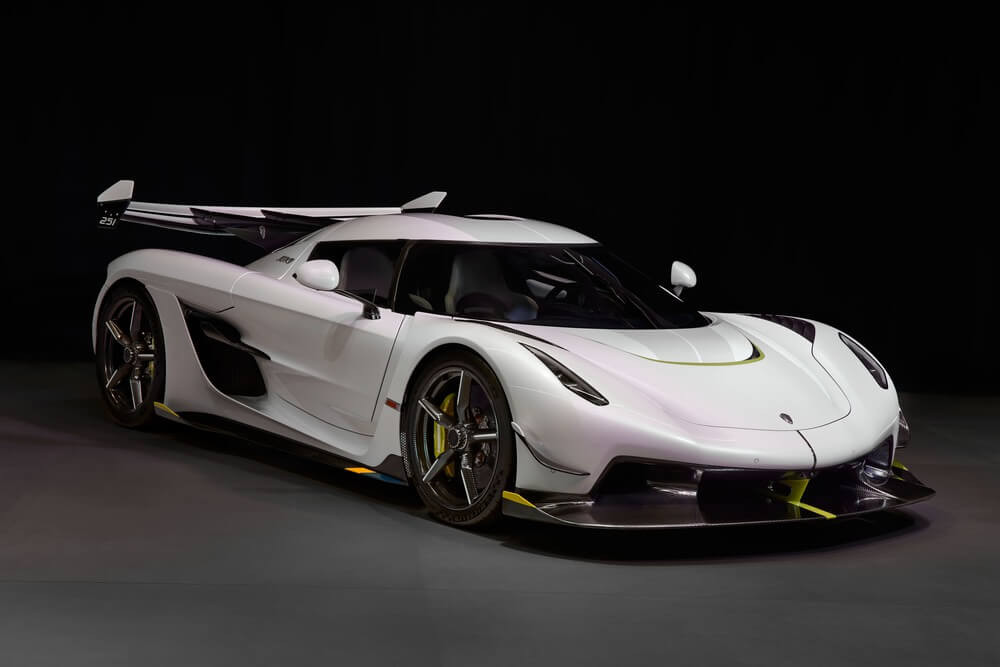
For example, the Koenigsegg Jesko uses a carbon fibre chassis that is the stiffest in the world, allowing suspension to work perfectly without the frame bending under massive speeds and also crucial for saving weight.