Since the dawn of independence, Africa’s political trajectory has been poisoned by a recurring betrayal: men who rose to power as liberators, hailed as messiahs of freedom, only to mutate into predators of democracy.
They draped themselves in the rhetoric of unity and liberation, but beneath the slogans lay a ruthless ambition, the determination to rule forever.
The cancer of scrapping term limits, first injected into the bloodstream of fragile republics by the so-called “founding fathers,” metastasised across the continent, corrupting the very DNA of governance.
What began as the arrogance of Kwame Nkrumah declaring himself President for Life in 1964 became a continental epidemic, spreading from Accra to Kampala, from Yaoundé to Kinshasa.
The precedent was set that constitutions were not sacred covenants with the people, but malleable instruments of incumbency.
Liberation movements mutated into monopolies, and the promise of freedom was strangled by the very men who once fought for it.
By the 1990s and 2000s, as the world celebrated the supposed “third wave of democracy,” Africa’s rulers perfected the dark art of constitutional sabotage.
They discovered that ballots could be weaponised not to renew legitimacy but to entrench it; that referendums could be staged not to empower citizens but to sanctify autocrats.
- Corruption Watch: Get scared, 2023 is coming
- Corruption Watch: Get scared, 2023 is coming
- Letters: Ensuring Africa’s food security through availability of quality seeds
- Is military's involvement in politics compatible with democracy?
Keep Reading
The result was a grotesque theatre of democracy: elections without choice, constitutions without limits, parliaments without independence, and in 2025, this theatre reached its most cynical climax, a parade of incumbents and military rulers, each clinging to power under the guise of legality, each mocking the very idea of generational renewal.
Africa’s tragedy is not simply that leaders refuse to leave; it is that they rewrite the rules to ensure they never have to.
This betrayal has robbed the continent of renewal, suffocated its youth, and reduced the ballot box to a ritual of control rather than an instrument of liberation.
The betrayal began at independence when Kwame Nkrumah, Ghana’s celebrated hero of liberation, intoxicated by power, declared himself President for Life in 1964, extinguishing the democratic promise he once embodied. Julius Nyerere in Tanzania, Kenneth Kaunda in Zambia, and Hastings Banda in Malawi marched down the same path, erecting one-party states under the sanctimonious banner of “unity.”
They claimed opposition was divisive, that fragile nations required singular leadership, but in truth, they feared rivals more than they loved democracy.
Their rhetoric of unity was a camouflage for authoritarian consolidation. These men, once hailed as liberators, left legacies corroded by repression.
They proved the tragic African pattern of heroes at dawn, villains by dusk. The continent’s founding fathers, entrusted with the sacred task of building nations, instead built cages, constitutional straitjackets designed to suffocate pluralism and entrench their own rule.
Robert Mugabe epitomised Africa’s descent from liberation to betrayal. Rising as a celebrated icon of freedom, he mutated into a predator of power, and in 1987, engineered the infamous Unity Accord that coerced Joshua Nkomo into capitulation.
This unequal pact cemented Zanu PF’s one-party dominance, suffocating pluralism and reducing Zimbabwe to a political cage.
For three years, the nation teetered on the brink of permanent one-party doom until Edgar Tekere’s audacious breakaway with the Zimbabwe Unity Movement in 1990 briefly jolted the system, reminding citizens that democracy could still be rescued from the jaws of monopoly.
What began as liberation degenerated into tyranny, with constitutional manipulation wielded as Mugabe’s weapon of choice.
His Zimbabwe became the textbook case of how liberation movements, once drenched in the rhetoric of sacrifice and freedom, mutate into authoritarian machines.
The ballot box was reduced to a theatre, a hollow ritual staged to sanctify incumbency.
The constitution was rewritten not as a covenant with the people but as a shield for the ruler, and the promise of freedom, the very dream for which blood was shed, was strangled by the same men who once fought for it.
The founding betrayal was not an accident of history; it was a deliberate strategy.
It set the precedent that power in Africa was not to be shared, not to be limited, not to be surrendered.
It taught generations of rulers that constitutions were malleable tools, not binding contracts; that “unity” meant silencing dissent; that liberation was merely the first act in a longer play of domination. The annals of Africa’s post-independence politics are littered with leaders who, intoxicated by power, dismantled constitutional safeguards to extend their rule indefinitely.
Each case is a study in betrayal, a demonstration of how incumbents weaponise constitutions to sanctify tyranny and suffocate renewal.
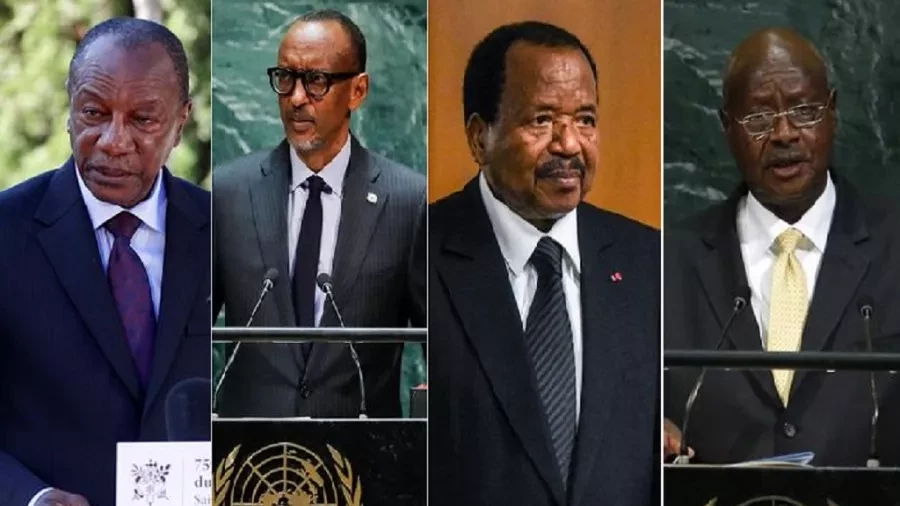
In Uganda, Yoweri Museveni, once hailed as a reformer, removed presidential term limits in 2005 and later abolished age limits in 2017.
His metamorphosis from liberator to autocrat illustrates the pathology of incumbency: the fear of accountability and the obsession with permanence.
In Cameroon, Paul Biya scrapped term limits in 2008, entrenching himself in power for over four decades.
His regime epitomises the slow suffocation of democracy, where longevity itself becomes the justification for continued rule.
In the Republic of Congo, Denis Sassou Nguesso manipulated the constitution in 2015 to remove both term limits and age caps, ensuring his dynasty of control could continue unchallenged. In Chad, Idriss Déby orchestrated a 2005 referendum to extend his rule, a cynical manoeuvre that entrenched his grip until his death on the battlefield in 2021, a stark reminder that autocracy often ends violently.
In Djibouti, Ismaïl Omar Guelleh removed term limits in 2010, transforming a small state into a personal fiefdom, where constitutional change served as a cloak for dynastic ambition.
In Rwanda, Paul Kagame staged a 2015 referendum that allows him to remain in power until 2034.
His case demonstrates how referendums, framed as democratic exercises, are in fact instruments of entrenchment, sanctifying autocracy under the guise of popular will.
In Côte d’Ivoire, Alassane Ouattara claimed that the adoption of a new constitution in 2016 reset the presidential clock, enabling him to run again in 2020. His manoeuvre exemplifies the cynical semantics of incumbents who treat constitutions as elastic texts, stretched to accommodate ambition.
In the Central African Republic, Faustin Archange Touadéra tampered with the constitution in 2024 to allow a third term, paving the way for his illegitimate continuation in 2025.
His actions underscore how fragile states are most vulnerable to constitutional vandalism.
In Burundi, Pierre Nkurunziza claimed that his first term did not count under the constitution, enabling him to run again in 2015.
His manipulation sparked unrest and violence, proving that constitutional trickery often destabilises rather than secures regimes.
In Guinea, Alpha Condé rewrote the constitution in 2020 to secure a third term, a betrayal that transformed a once celebrated democrat into yet another strongman clinging to power.
In Togo, the Gnassingbé dynasty, first Eyadéma, then his son Faure, has manipulated constitutional provisions since 2002 to perpetuate dynastic rule.
Their case illustrates how family succession masquerades as republican governance. In the Comoros, Azali Assoumani removed term limits via a 2018 referendum, demonstrating how even small island states are not immune to the continental contagion of incumbency.
These cases are not isolated aberrations; they form a pattern, a continental epidemic of constitutional sabotage.
The tactics vary, referendums, judicial reinterpretations, constitutional rewrites, dynastic succession, but the objective is always the same: to transform temporary leadership into permanent ownership.
Each act of manipulation corrodes legitimacy, blocks generational renewal, and deepens youth disillusionment.
The lesson is stark: Africa’s rulers have mastered the art of staying in power by dismantling the very safeguards designed to prevent it.
The presidency has been transformed into a throne, the constitution into a weapon, and democracy into theatre.
The arsenal of Africa’s incumbents is as cynical as it is predictable, a repertoire of deception masquerading as democracy.
They begin with the referendum, a supposedly sovereign exercise of the people’s will, but in reality, a tightly choreographed charade where the outcome is scripted in advance.
The ballot box is reduced to theatre, the citizen to a spectator, and the act of voting to a ritual of disenfranchisement.
When the referendum fails to provide sufficient camouflage, they turn to the constitution itself, rewriting and resetting term counts with the arrogance of men who believe the law is clay in their hands.
These mutilations are paraded as “reforms,” but in truth they are acts of vandalism against the very idea of republican governance, a desecration of the social contract, a calculated assault on the principle that power must be limited to remain legitimate.
Where constitutions prove stubborn, incumbents enlist the judiciary, bending judges into instruments of survival.
Courts are coerced, manipulated, or stacked with loyalists who dutifully reinterpret eligibility, transforming illegality into legality with a stroke of the pen.
The robe becomes a costume, the gavel a weapon, and justice itself a hostage to incumbency.
And when even this façade of legality falters, rulers fall back on their most brutal ally: the military.
Soldiers are deployed not to defend the nation but to defend the ruler, suppressing dissent, silencing protest, and reminding citizens that ballots are meaningless when bayonets guard the palace.
This is the anatomy of entrenchment: referendums as rituals, constitutions as playthings, courts as accomplices, and armies as enforcers.
It is not governance but suffocation, not renewal but perpetuation.
It is the systematic transformation of democracy into autocracy under the cynical disguise of legality, a theatre of betrayal where power is eternal, accountability is absent, and the people are reduced to props in a drama scripted by despots.
The motives behind Africa’s incumbents scrapping term limits are as crude as they are transparent. At the core lies power consolidation, the primal fear of losing influence, wealth, and immunity.
These men know that stepping down means exposure: prosecution for corruption, accountability for human rights abuses, or exile stripped of privilege.
To them, indefinite rule is not ambition but survival.
Wrapped around this survival instinct is the machinery of patronage networks.
Long-serving presidents preside over sprawling systems of corruption, distributing jobs, contracts, and resources to loyalists.
These networks are parasitic, feeding off the state and binding elites to the ruler.
Removing term limits ensures continuity of this racket, protecting cronies and preventing rivals from dismantling the system.
The ease with which incumbents manipulate constitutions is enabled by weak institutions. In much of Africa, constitutions are pliable documents, courts are compromised, and electoral commissions are toothless.
Judges are appointed to serve the ruler, not the republic.
Electoral bodies are designed to rubber-stamp outcomes, not safeguard fairness. In such a landscape, constitutional sabotage becomes effortless.
Behind this manipulation lurks a deeper fear of accountability.
Leaders cling to office not because they have vision, but because they dread the reckoning that awaits them outside the palace gates.
The presidency becomes a fortress against justice, a shield against the consequences of decades of plunder.
The rot spreads regionally through a domino effect. Museveni’s audacity in Uganda emboldened Kagame in Rwanda; Déby’s manipulation in Chad inspired Sassou Nguesso in Congo.
Each act of constitutional vandalism legitimises the next, creating a continental contagion of authoritarian entrenchment.
Finally, incumbents master the control of narrative.
They stage referendums and constitutional rewrites, presenting them as democratic exercises.
They claim, “new constitutions reset the clock,” as if legality were a game of semantics.
This veneer of legality is their most cynical weapon: it allows them to cloak tyranny in the language of democracy, to present theft of power as reform, and to convince the world that the people have spoken when, in truth, the people have been silenced.
This is why they do it: not to serve, not to govern, not to renew, but to survive, to protect their patronage and prebendalism networks, to evade justice, and to perpetuate a cycle of betrayal that has defined Africa’s political story since independence.
The consequences of term limit evasion are devastating, corrosive, and unmistakable.
At the heart of it lies governance dysfunction: states reduced to personal fiefdoms, institutions hollowed out, and constitutions mutilated to serve the whims of incumbents.
Autocracy flourishes where accountability dies, corruption metastasises into every vein of the public sector, and conflict becomes the inevitable by product of leaders who cling to power long after legitimacy has evaporated.
The betrayal is most acutely felt by Africa’s youth. For them, the ballot box has become a cruel ritual, not a mechanism of renewal, but a theatre of control.
Each election is staged as a performance, with outcomes predetermined and participation reduced to a hollow gesture.
Disillusionment festers, cynicism deepens, and the promise of democracy is mocked before their eyes.
A generation raised on the rhetoric of freedom now sees only the recycling of rulers, the recycling of lies, and the recycling of betrayal.
The political rot does not remain contained; it breeds coups and instability.
History shows a direct correlation: where incumbents scrap term limits, soldiers eventually step in, claiming to rescue the nation from tyranny.
From Guinea to Mali, from Burkina Faso to Niger, the pattern is clear: constitutional vandalism invites military intervention.
The continent oscillates between fragile waves of democratisation and brutal waves of authoritarian entrenchment, each cycle eroding trust, each cycle deepening despair.
Term limit evasion is not a minor constitutional tweak; it is the clearest marker of regression, the most visible scar of Africa’s democratic failure.
It signals to citizens that the law is meaningless, that leadership is permanent, and that the future belongs not to renewal but to repetition.
It is the betrayal that transforms liberation into tyranny, ballots into rituals, and presidents into monarchs.
The one-party state is the poisoned root from which Africa’s constitutional manipulations have grown, the original sin that continues to haunt the continent’s political life.
From Ghana to Tanzania, Zambia to Malawi, the founding generation cloaked their authoritarian ambitions in the rhetoric of “unity.”
They declared that opposition was divisive, that dissent was treason, that fragile nations could not afford pluralism, but this was never unity; it was a monopoly.
It was the ruthless determination to silence rivals, monopolise power, and criminalise the very idea of checks and balances.
Alternative voices were branded enemies of the state, and the act of questioning authority was treated not as a democratic duty but as betrayal.
These rulers centralised control over every lever of society.
Parliaments were reduced to rubber stamps, media outlets transformed into propaganda machines, unions co-opted or crushed, and civil society suffocated under surveillance and intimidation.
Elections existed, but only as hollow rituals, staged performances designed to ratify tyranny and confer a veneer of legitimacy on despotic rule. They were never contests of ideas, but coronations of incumbents, ceremonies of control dressed up as democracy.
Even after the wave of multiparty reforms in the 1990s, the legacy of one-party dominance refused to die. Many countries remain de facto one-party states, particularly those ruled by former liberation movements.
Tanzania’s CCM, Zimbabwe’s Zanu PF, and Mozambique’s Frelimo continue to dominate political life, wielding the machinery of the state as their private arsenal.
In these nations, the ballot box is not an instrument of renewal but a recycling mechanism for entrenched elites, a ritual that sustains monopoly rather than challenges it.
The link between one-party culture and the manipulation of constitutions is direct and undeniable.
Leaders raised in the tradition of monopoly politics instinctively view constitutions not as restraints but as tools to be bent, rewritten, and weaponised.
The one-party state taught them that power is permanent, that opposition is illegitimate, and that the law exists to sanctify incumbency.
Thus, the scrapping of term limits is not an aberration but the logical extension of a culture that has always equated leadership with ownership.
Contemporary examples expose the continuity of this betrayal. In the Central African Republic, constitutional tampering in 2024 paved the way for Faustin Archange Touadéra’s illegitimate third term in 2025, a grotesque parody of democracy. I
n Zimbabwe, whispers of a “2030 agenda,” rumours of constitutional amendments to extend the incumbent’s rule, echo the same cynical script.
The actors may change, but the play remains the same: constitutions rewritten, opposition delegitimised, and citizens reduced to spectators in a theatre of tyranny.
This is the enduring legacy of the one-party state: a continent where liberation movements mutated into monopolies, where unity was weaponised against pluralism, and where constitutions became instruments of betrayal rather than guardians of freedom.
It is the poisoned inheritance of independence, the architecture of authoritarianism disguised as nation building, and the most enduring obstacle to Africa’s democratic renewal.
Africa’s youth must awaken to their historic duty with uncompromising urgency.
They are the continent’s demographic majority, yet they are treated as political minors, patronised as “future leaders” while being denied the present.
They are mocked by constitutions rewritten to sanctify incumbency, excluded from decision-making, and brutalised when they dare to dissent, but they are not powerless.
They are the generation standing at the fault line of history, and their refusal to submit will determine whether Africa remains shackled to its past or claims its future.
The lesson is brutal but undeniable: Africa’s rulers have perfected the dark art of staying in power, but the continent’s youth must perfect the brighter art of removing them.
The African presidency has been transformed into a throne, not a term.
Liberation heroes have mutated into dynastic monarchs, their revolutions curdled into family businesses, their rhetoric of sacrifice hollowed into rituals of betrayal.
Constitutions, once imagined as guardians of freedom, have been vandalised into instruments of incumbency, rewritten not to serve the people but to serve the ruler.
This is the great betrayal of independence, the cancer of incumbency, the rot that has corroded Africa’s promise for six decades, yet history is not immutable.
The chains of incumbency can be broken.
The youth, digitally mobilised, globally connected, politically restless, are the antidote to this disease.
They are the generation that cannot be silenced by propaganda, cannot be pacified by empty slogans, cannot be deceived by constitutional trickery.
They must be the agents of change, the custodians of renewal, the architects of a new political order.
If Africa’s rulers have mastered the dark art of entrenchment, then Africa’s youth must master the brighter art of resistance.
They must bury the curse of scrapped term limits, dismantle the dynasties of betrayal, and reclaim the ballot box as an instrument of liberation rather than a ritual of control.
The future will not be handed to them; it must be seized, and when it is seized, the continent will finally witness the dawn of a new era, one where power serves the people, not the ruler, and where independence is no longer betrayed but fulfilled.
*Wellington Muzengeza is a political risk analyst and urban strategist offering incisive insight on urban planning, infrastructure, leadership succession, and governance reform across Africa’s evolving post‑liberation urban landscapes.
He is also available for speaking engagements, bringing thought‑provoking analysis and visionary perspectives to conferences, panels, and public forums.