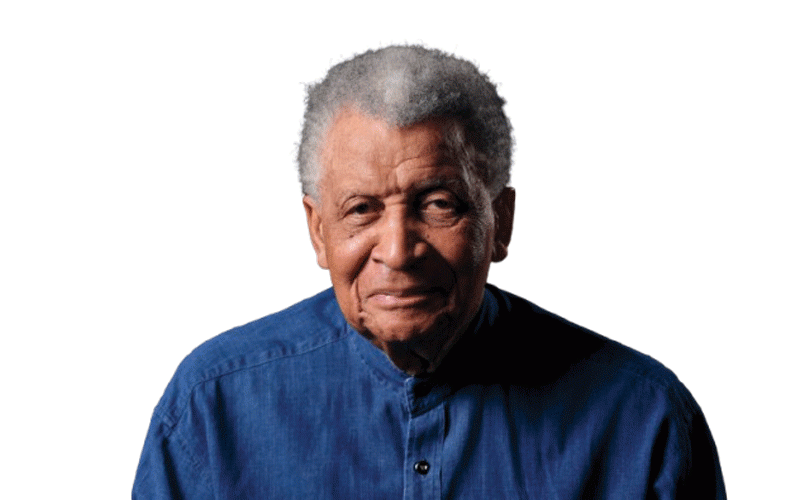
We were all pre-occupied with the tragic xenophobic attacks happening in South Africa to the extent that focus was almost lost on another event in that country, the sad loss of Abdullah Ibrahim, South Africa’s foremost Jazz legend.
Abdullah Ibrahim, who died on Monday, 15 June, at the age of 91, was one of South Africa’s most celebrated musicians — a pianist and composer whose work became intertwined with the country’s cultural history....
Not so long ago. The Jazz Community lost yet another legend, Hugh Ramapolo Masekela (4 April 1939 – 23 January 2018) who. was a South African trumpeter, flugelhornist, cornetist, singer and composer who was described as "the father of South African jazz. Masekela was known for his jazz compositions and for writing well-known anti-apartheid songs such as Soweto Blues and Bring Him Back Home.
He also had a number-one US pop hit in 1968 with the song Grazing in the Grass, which was later covered by various other artists.
Abdullah Ibrahim, who also helped define a genre of South African jazz music, died last week at the age of 91,
He "passed away peacefully, surrounded by his family in Germany, after a short illness,” according to a statement released on behalf of the family.
His "creations honoured the South Africa that shaped his political commitment and musical brilliance", President Cyril Ramaphosa said in his tribute.
Ibrahim, born Adolph Johannes Brand in 1934, grew up in Cape Town and began composing at the piano at the age of seven by picking out tunes on the keyboard.
- Zim headed for a political dead heat in 2023
- Record breaker Mpofu revisits difficult upbringing
- Tendo Electronics eyes Africa after TelOne deal
- Record breaker Mpofu revisits difficult upbringing
Keep Reading
He would go on to have a career that spanned eight decades and dozens of recordings.
These included the 1974 track Mannenberg, one of his most famous compositions, that later became linked to the struggle against white-minority rule in South African and apartheid, the system of legalised racism.
Ibrahim, who was initially known on stage as Dollar Brand, changed his name after converting to Islam in the late 1960s.
As a teenager, the pianist and composer played in a swing band, his own trio and then in a sextet called the Jazz Epistles, which also included another South African jazz great, Hugh Masekela.
As apartheid, which began to be legally enforced in 1948, became increasingly rigid, jazz music, which was seen as counter-cultural and encouraged racial mixing, was looked down on.
The political situation in South Africa led to the break-up of the band, and Ibrahim moved to Switzerland.
American jazz legend Duke Ellington heard Ibrahim and took him to the US.
Gradually, his distinctive style began to emerge - music that recalled the sounds of South Africa, and mixed his country's vocal and harmonic traditions with the rhythmic feeling and improvisation of jazz, according to a BBC Radio 3 profile.
Despite living outside South Africa, e never forgot his roots and made frequent trips to the country to perform and record.
His final live appearance came at the Cape Town International Jazz Festival three months ago, "where he once again captivated audiences with the artistry, grace and profound musical vision that defined his life's work".
In her tribute, his partner Dr Marina Umari said: "Abdullah passed away peacefully with South Africa and its people in his heart. His love for his country never wavered, no matter where in the world he found himself.
"He has enriched our lives with his musical gifts and his involvement in making the world a better place.”
* Feedback: [email protected]