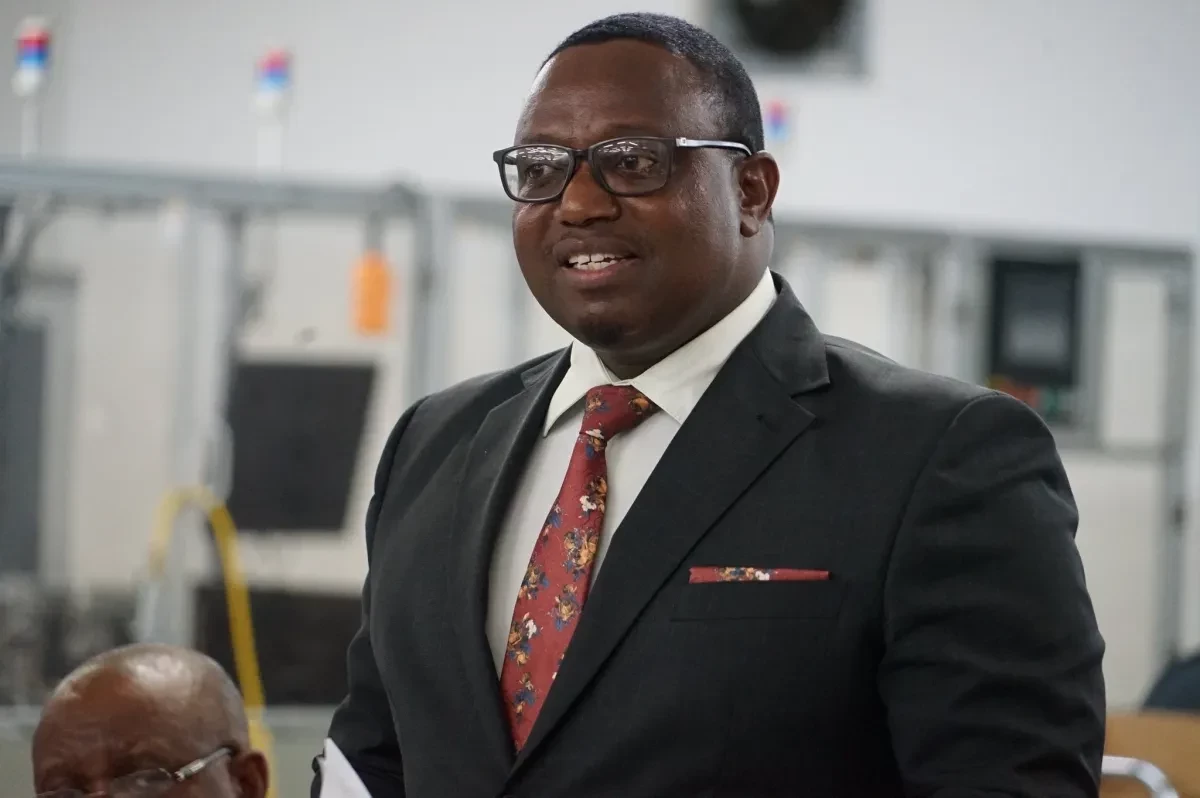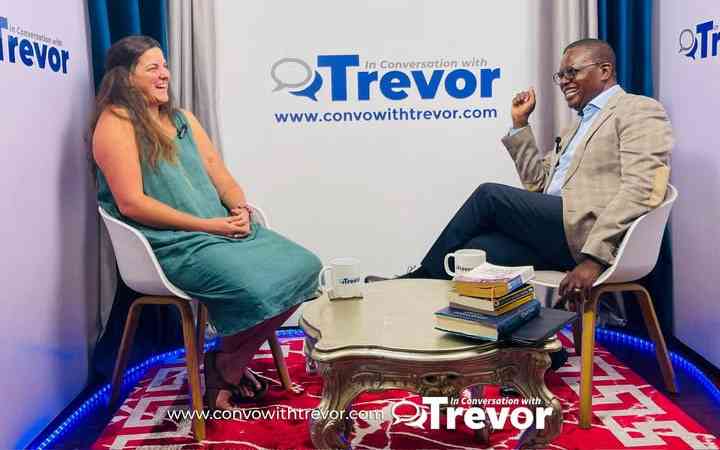
In this week’s In Conversation with Trevor, Alpha Media Holdings chairman Trevor Ncube (TN) hosted Robyn Terry (RT), a trauma-informed somatic nervous system coach whose journey from a Zimbabwean childhood to the United Kingdom was shaped by profound personal catalysts.
Moving from a traumatic birth ordeal to the integration of unresolved childhood abuse, Terry explored how "the greater the pain, the greater the expansion."
As she unpacked the "mind-body separation" inherent in trauma, she offered a powerful mirror to our "traumatised nation," arguing that understanding our nervous systems is the ultimate tool for reclaiming choice and finding the collective safety Zimbabwe desperately seeks.
Below are excerpts from the interview.
TN: Greetings, welcome to In Conversation with Trevor, brought to you by Heart and Soul Broadcasting Services.
Today, I'm in conversation with Robyn Terry, a trauma-informed somatic nervous system coach.
Your brother-in-law was sitting here the other day. And then somebody came to me and said, "You know, you really need to talk to Robin Terry." I said, "Why?"
- In Conversation With Trevor: Munyati: Sports, arts are viable careers
- In Conversation with Trevor: Bango: ‘Street wisdom’ shaped me
- In Conversation With Trevor : Diplomatic posting was a mistake: Chihombori-Quao
- I’ve been a victim of racism in classical music: Mhambi
Keep Reading
They said, "Because of the state of the nation where we are – the trauma, the anxiety, economic problems, political issues, that kind of stuff."
But what I want to know now is: you grew up in Zimbabwe.
How does this small-town girl end up doing this kind of work? Who were you, and why did you end up doing this kind of work?
RT: I am a product of colonialism. At the time I finished school, the state of our country was not in a great place, so I actually went to the UK.
I didn't go to university – I worked, worked my way up in London.
I met people from all over the world; it was an amazing time. I met my husband, we moved to Swansea, we had a daughter there, and we had a very bad birth.
It was very, very traumatic. After that – for me, one of the biggest catalysts of my life – I started looking beyond what is "mental health" and more about how trauma actually impacts us as humans.
I had to restart unpacking my own ways of how I was, the way I presented myself in the world, the way I parented my daughter, showed up for my marriage, my work, and my life.
Often we have these times – it's like a catalyst for huge expansion.
The greater the pain, the greater the expansion and growth you can have.
Through that, I started my journey of really understanding how trauma and the nervous system work. It led me down a beautiful road of learning, healing, transforming, and growing.
TN: Should we go to that trauma? I get the sense there is a place we must visit. You met your husband, you had a painful birth.
Should we talk about that? It appears that could be the genesis of who you've become.
RT: Yes. I was 42 weeks pregnant and got induced. I was very naive – because I had studied yoga and was a yoga teacher – so I just blindly trusted the system, as one does nowadays.
It turned into quite a physical ordeal. It ended in a very bad C-section, which was very poorly performed.
They took a lot of my digestive system out – which we didn't know, and it's not protocol – and then I got very severely sick afterwards.
I had something called paralytic ileus, where your digestive system shuts down.
Not only had I tried natural labour for a long time, had loads of drugs in the induction, been through the surgery itself which was terrible – my husband was also very traumatised by seeing it.
TN: She's doing fine?
RT: Yeah, she's great. She's the most magical little human.
TN: That's beautiful. And you have stayed with the trauma. Talk to me about how that trauma evidences itself as you go through your life.
RT: Because it was very body-based – and birth will always bring up trauma, especially for women, and it will always bring up sexual trauma – that trauma helped me understand something.
The after-effects, and the way that certainly the male doctors but not just the male doctors, the female nurses as well treated me, re-triggered a previous trauma I had gone through.
When I was 13, I was raped. That whole time in my life – I also changed school, there were vicious rumours going around, I lost interest in academia – it was unresolved.
That time was re-triggered after the birth. Trauma can happen 40 years ago, or it can have happened yesterday, and to your system, if you don't process and integrate it, it can still be happening.
TN: Does that make sense?
RT: It makes sense.
TN: Talk to me about it. This is a very sensitive place, so allow me to go to that painful place – the rape trauma and the shame associated with it, not being able to talk. I go there because it applies to somebody watching us, and I want it to be helpful.
RT: This is so prevalent in our world – women being raped or sexually assaulted or abused, and it's just hushed. "Let's not deal with it."
For me, when I talk about it, I don't like talking about being a victim or a survivor because it's so normal and common.
I'm actually not one for getting justice. I don't want to mention his name because it's not his story – it's my story.
And because of how successfully he gaslighted me, I really think something happened to him, you know!
It's not that there's a victim and a perpetrator – there are two victims.
That's how it works. Hurt people hurt people. Before we go into it, it's more a conversation that everyone needs healing, not just perceived victims.
There's something wrong with our culture, our society, the way we treat men, the way men aren't allowed to feel.
The patriarchal system hurts men as much as it hurts women, but in a different way.
For me, it's about how can we create a loving, safe environment for all humans to flourish, not just one category.
Looking back, I can see how that experience shaped and changed my trajectory in life, who I was, what I believed in.
After many years of unpacking, the worst part of those kinds of traumatic experiences is the mistrust and the mind-body separation you get within yourself.
For a long time, I questioned whether it actually happened.
TN: Correct me if I'm wrong: we are a traumatized nation.
RT: Absolutely.
TN: A traumatised nation since 1964, where we don't belong to each other, where there's no empathy, where we don't present ourselves as a whole, where we don't work towards a common good.
RT: That sounds very messy. I think mainly people are so afraid of conflict. Not war-zone conflict – conflict is really important for humans because it allows you to open up to other ways of thinking.
For a community to function, we need many different brains, many different people with many different beliefs.
That's how we progress, evolve, and work together. I wish people in Zimbabwe could understand that we should celebrate our differences, not ignore them, and not separate ourselves.
We're missing one of our greatest tools: the togetherness of being different.
TN: You say you're not a people-pleaser, and that this is a product of your experience. Explain why you think you didn't go the other way – timid, pandering – but instead went the other way.
RT: I did go into victimhood – I felt very much a victim – but I didn't feel like a passive victim. It's also part of how I was brought up: I'm the firstborn girl with two younger brothers.
TN: You said earlier – and I love this – "When we understand our nervous system, we reclaim choice." Unpack that for us.
RT: In our world, there's a lot of talk about mental health, positive thought, forced gratefulness. Yes, it's great to be grateful, but you can't just sit in the morning and write a gratitude list.
Gratefulness should be a practice of moving through your life and feeling, "Ah, look at the sun shining through that tree. I'm so grateful for this life and the beauty in it." It should be a feeling, not a pre-frontal-cortex-driven thing.
TN: Are we always conscious of what our nervous system is doing in the background? And if not, should we be reminded?
RT: The power of understanding your nervous system puts the power back into you. Often our self-criticism, self-judgment, self-gaslighting – that's the worst part because our body and mind have disconnected.
TN: People are scared to even say the word "trauma."
RT: We're all traumatised. Why are we so afraid of dealing with it? We want to be perfect – it's a survival thing. We create armour around us.
Yes, they may not touch you, but you also can't feel safety, connection, hope, joy.
Those who appear strong and speak threateningly are the weakest ones. They need help.
The way we treat others is the way we treat ourselves.
We all just need love and safety. We're all searching for "I'll finally be okay if I earn that much, have that much, do that thing" – but no, that's bullshit.