Despite fears that the 2023 general elections will see a repeat of the 2008 political violence, elections are very crucial to provide citizens with the opportunity to choose their leaders and have a say in how their government operates.
However, prospects of a run-off election in the event that no candidate wins 50% plus one vote to claim the presidency, will evoke sad memories for many Zimbabweans given the events of the past.
Analysts started making permutations about a run-off after former Zanu PF commissar Saviour Kasukuwere indicated that he would challenge President Emmerson Mnangagwa in the August 23 vote.
Previously, the presidential election was seen as a two-horse race between Mnangagwa and Citizens Coalition for Change (CCC) leader Nelson Chamisa.
The 2008 runoff elections were held on June 27, 2008, following the first round of the presidential elections held on March 29, 2008.
The runoff was a result of neither of the two main candidates, incumbent late Robert Mugabe of Zanu PF and opposition leader Morgan Tsvangirai of the Movement for Democratic Change (MDC), receiving an outright majority of the votes in the first round.
If no candidate receives an outright majority, a runoff election is held between the two candidates who received the most votes.
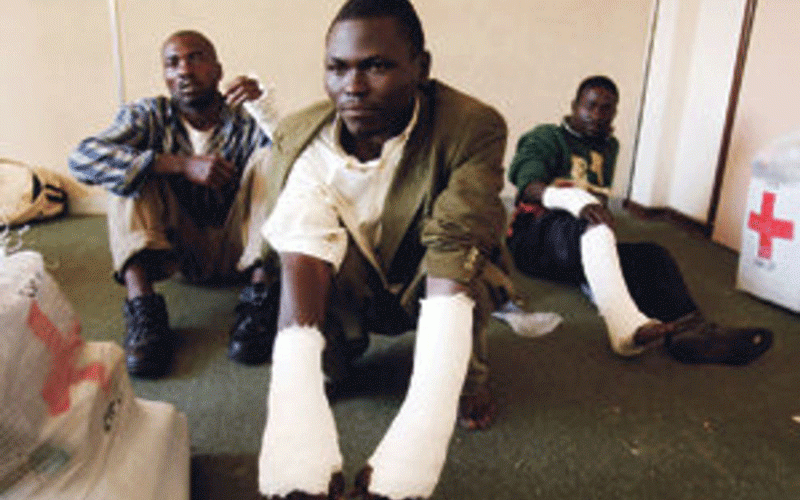
The 2008 runoff was marked by widespread violence and intimidation, with reports of Zanu PF supporters using violence to coerce voters into supporting Mugabe.
- Chamisa party defiant after ban
- Village Rhapsody: How Zimbabwe can improve governance
- News in depth: Partisan police force persecutes opposition, shields Zanu PF rogue elements
- Chamisa chilling death threat bishop defiant
Keep Reading
The MDC withdrew from the election citing the violence and intimidation, and Tsvangirai sought refuge at the Dutch embassy in Harare.
Despite international condemnation and pressure, the Mugabe government went ahead with the run-off, which was widely considered to be a sham.
Mugabe was declared the winner with 85% of the vote, although the election was widely regarded as illegitimate.
The aftermath of the run-off was marked by continued violence and political instability in Zimbabwe.
International community, including the United Nations and the African Union, condemned the election and called for a negotiated settlement to the political crisis in the country.
In September 2008, a power-sharing agreement was reached between Mugabe's Zanu PF and the MDC, which saw Tsvangirai appointed as prime minister.
For this reason, there are several reasons why it is preferable for a presidential election to be decided in the first round, rather than requiring a run-off.
A run-off election can be costly for the government and taxpayers.
Zimbabwe has a history of economic challenges, and a runoff election would divert resources from other important priorities.
A runoff election can exacerbate tensions between supporters of different candidates, leading to political instability and even violence.
A second round of voting can be exhausting for voters, leading to lower turnout and potentially skewing the results.
This can take weeks or even months to organize, potentially leaving the country without a clear leader during a crucial time.
It is generally preferable for a presidential election to be decided in the first round of voting, without the need for a runoff election.
*Evans Mathanda is a journalist and development practitioner who writes in his own personal capacity. For feedback email: [email protected] or call 0719770038 and Twitter @EvansMathanda19