Zimbabwe's climate challenge is no longer a future concern. Droughts, erratic rainfall patterns, prolonged dry spells, floods, and rising temperatures are already affecting agriculture, water resources, infrastructure, public health, and economic productivity.
In response, the country has developed a comprehensive climate policy framework that includes the National Climate Policy, the National Development Strategy 1 (NDS-1), the National Adaptation Plan process, and commitments under the Paris Agreement.
These initiatives demonstrate a growing recognition that climate change poses a significant threat to sustainable development and the ultimate realization of not only vision 2030 but also Agenda 2063 and all the SDGs.
However, while considerable attention has been given to adaptation planning, financing, governance structures, and implementation projects, one critical component remains largely overlooked: climate communication.
Climate adaptation is often viewed as a technical challenge requiring scientific expertise, financial resources, and institutional coordination.
While these elements are important, adaptation is equally a communication challenge. Climate information only creates value when it reaches the right people, at the right time, in a form that they can trust, understand and act upon.
In my previous article I strongly voiced the importance of community radios.
Community radios stations should be there and uniquely positioned to communicate climate-related information because they operate close to the communities they serve.
- Why are we still pitting jobs against public health?
- Jurgen Klopp: Liverpool manager signs new two-year contract extension at Anfield until 2026
- COP27: Zimbabwe’s opportunity to shine
- Shot in the arm for Chiredzi, Bikita communities
Keep Reading
Unlike centralised media outlets community radios broadcasts in local languages and addresses issues that directly affect local populations.
This accessibility makes community radios an effective medium for educating citizens about climate change and its impacts and being a catalyst for climate-related developmental prospects.
A review of Zimbabwe's Initial Adaptation Communication to the United Nations Framework Convention on Climate Change (UNFCCC) reveals strong emphasis on adaptation priorities across sectors such as agriculture, water, health, infrastructure, and disaster risk reduction.
However, there is relatively little discussion on how climate information reaches citizens, how communication effectiveness is measured, or how public understanding influences adaptation outcomes.
This gap matters because adaptation success depends on informed decision-making.
The core mandate of Climate Change Communication is to appreciate, when, what, how and why is certain information material being shared.
The general citizens need to trust both the message and the messenger to blend the relationship between modern scientific finding and their traditional beliefs on climate resilience.
A school or community tree planting day is greatly appreciated as a one-day event by the citizens or learners participating in the activity. Why? Because the current state of climate action, adaption and resilience is only focusing on the exercise and less on educating the citizens that it’s not a one-day event but a lifelong adaption plan. This is leaving people with an appreciation of just a one-day activity.
Given how the rocket for climate action has taken off, most citizens would immediately want climate change communication to focus more on seasonal climate forecasts as they can help farmers determine when to plant crops and which varieties to grow.
Early warning systems can help communities prepare for floods and extreme weather events. Climate-smart agriculture programmes can improve productivity and resilience. Yet these interventions can only succeed if information is communicated effectively and understood by intended audiences.
The challenge facing Zimbabwe is not simply the availability of climate information but the accessibility and usability of that information.
Scientific reports, policy documents, and technical assessments often remain confined to government departments, research institutions, and development agencies.
In these corridors, roam around big scientific words that such as net zero, climate justice and carbon credits. I have explained this in my previous article that this is when a community oriented communication platform comes in. A person in a remote village will immediately trust, understand and act upon information shared in a local language possibly by a radio presenter he/she knows. Research has exposed that only 38% of the rural population has climate awareness. Meanwhile, local authorities, businesses, farmers, and communities frequently receive information that is either too technical, too late, or insufficiently tailored to their needs.
This communication gap has important development implications.
When farmers do not understand seasonal forecasts, crop yields suffer. When communities fail to receive timely warnings about extreme weather events, lives and livelihoods are put at risk. When local authorities lack clear climate information, development planning becomes reactive rather than proactive. In each case, the costs are ultimately borne by the economy and society.
Climate communication should therefore be viewed as a development tool rather than merely an environmental concern. Effective communication strengthens resilience, improves preparedness, enhances policy implementation, and supports evidence-based decision-making across sectors. Most importantly it promotes citizen participation which will help in the realization of a just transition.
There is a need to integrate climate communication more deliberately into Zimbabwe's adaptation agenda. This includes strengthening collaboration between government institutions, research organisations, media houses, civil society organisations, and local communities. Climate information should be translated into practical guidance that different audiences can understand and apply in their daily decision-making processes.
Equally important is the need to assess whether climate communication efforts are actually working. Policymakers often measure adaptation projects through budgets, infrastructure development, or programme implementation.
Yet there is limited assessment of whether climate messages are reaching target audiences, whether those audiences understand the information provided, and whether communication is influencing behaviour. There is need of a climate communication framework which I have preferred to call Participatory Climate Communication 360 Framework (PCC360). In this model, citizens would be at the center and magnitude of success would not be measured only through outcomes such as high yields or adaptation uptake but also through direct citizen feedback, consultations, community meetings, digital platforms and participatory monitoring.
As climate risks continue to intensify, communication will become increasingly important in determining the effectiveness of adaptation investments. Strong policies and adequate financing are essential, but they cannot achieve their intended outcomes if climate information fails to reach those responsible for acting upon it.
Zimbabwe has made commendable progress in building its climate adaptation architecture. The next step should be ensuring that climate knowledge flows effectively from policymakers and scientists to businesses, local authorities, and communities. Bridging this communication gap may prove to be one of the most cost-effective ways of strengthening climate resilience and advancing sustainable development.
The question facing Zimbabwe is no longer whether climate change is affecting development. The question is whether climate information is reaching those whose decisions will shape the country's response.
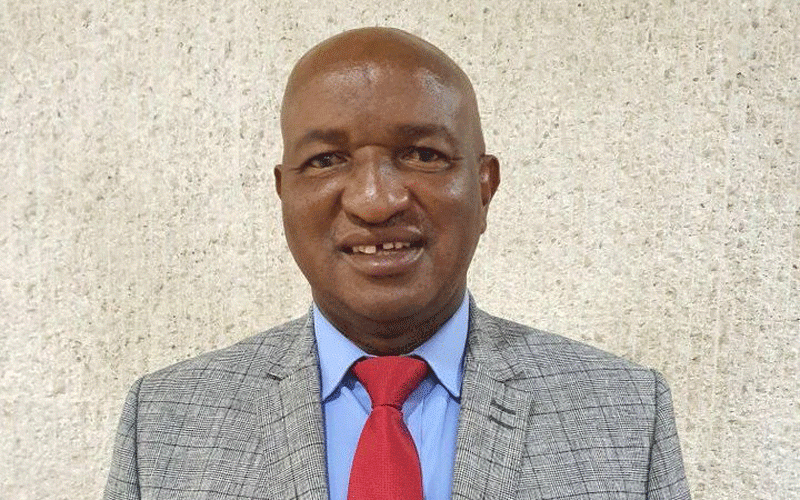
- Takudzwa Gochero is a researcher and writer
- These weekly articles are coordinated by Lovemore Kadenge, an independent consultant, managing consultant of Zawale Consultants (Private) Limited, past president of the Zimbabwe Economics Society and past president of the Chartered Governance and Accountancy Institute in Zimbabwe. Email- [email protected] or Mobile No +263 772 382 852