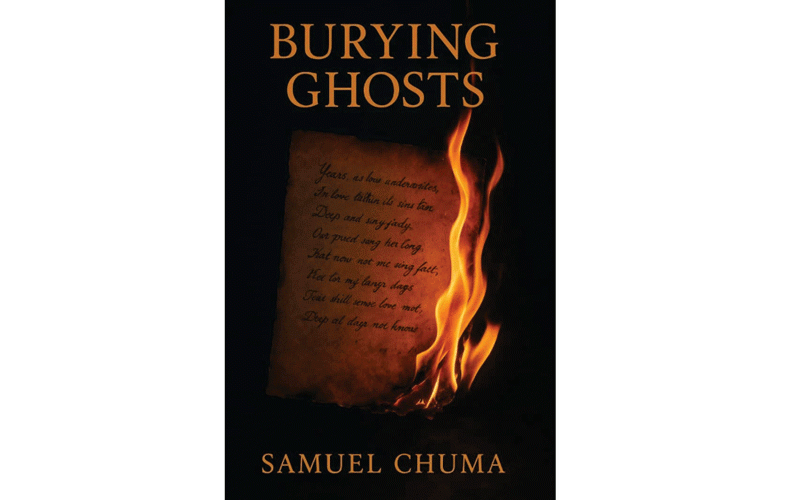
In his devastating and luminous debut, Burying Ghosts, Samuel Chuma constructs a haunting tapestry of trauma, resilience, and the liberating power of the written word.
Set against the shifting landscapes of rural Gumbo and the sprawling, predatory streets of Harare, the novel is less a traditional coming-of-age story and more a rhythmic excavation of the shadows that haunt the contemporary Zimbabwean domestic sphere. It is a work that demands to be read not in isolation, but as a vital new branch on the rugged tree of Zimbabwean literature, one that enters into fierce conversation with the ghosts of its literary ancestors while carving out its own urgent territory.
The serpent in the garden
The narrative follows Ruramai, a young girl whose childhood is bisected by a puff adder’s strike.
Her father, a man of quiet strength and deliberate gait, represents a lost era of artisanal wisdom, a wisdom that, tragically, was never recorded and thus died with him. In a devastating critique of oral tradition, Chuma illustrates how, when knowledge is not transcribed, traditions crumble and the next generation is left unarmed.
The father’s death, precipitated by the rural reality that a bite is a death sentence when no ambulances exist, leaves a vacuum quickly filled by Gideon, a man whose booming voice and pointed leather shoes initially promise stability but soon deliver a reign of predatory terror.
Chuma’s prose is at its most potent when describing the quiet rebellion Ruramai wages against her circumstances. As her home becomes a place where "silence roared" and "pots were thrown," Ruramai retreats into old exercise books, transforming her father’s legacy of silence into what the novel memorably terms a switchblade of poetry. The author masterfully uses the metaphor of "shadow friends" to track Ruramai’s psyche; what begins as a child’s innocent fascination with sun-drawn shapes evolves into a sophisticated survival mechanism against the "men who dance naked" in their cruelty.
The city as predator
The novel’s middle act, centred on the family’s flight to Harare, serves as a grim critique of urban safety. Chuma rejects the trope of the city as a sanctuary, instead depicting Harare as a living organism; a stomach that digests the brave and spits out bones.
At the risk of reaping the wrath of Chuma and Chidora, who have sought to distance their work from the inevitable comparison to Marechera, this visceral portrayal aligns the novel with the gritty urban vision of Dambudzo Marechera, whose House of Hunger similarly treated the Zimbabwean city as a site of consumption and moral decay.
However, where Marechera’s rebellion was often one of chaotic, avant-garde destruction, Ruramai’s rebellion is one of meticulous reconstruction. She walks the same potholed streets that crouched and snarled, streets "oozing sewage" and heavy with the "smell of diesel and meat smoke and urine," but she carries a different weapon.
The city offers no skyline of hope. The family finds shelter in a building without windows, characterised by holes, graffiti, and impatient secrets. At Mbare Musika, the crowd flowed like water while human dignity evaporated to the point that a man pissed against a wall while reading the newspaper and nobody looked twice. Ruramai concludes bitterly that they didn’t escape Gumbo; they just changed cages, discovering that there is no freedom even in perfumed jails.
The switchblade poems
It is here that the secondary characters shine with tragic brilliance. Aunt Fadzi, with her "perfume of strawberries and danger," emerges as a fierce, albeit broken, protector. Her eventual act of lethal self-defence becomes a flashpoint for the novel’s exploration of justice, encapsulating her bitter wisdom that "justice doesn’t wear our skin."
Meanwhile, the younger sister, Tari, descends into a feverish, ghost-haunted illness, talking to walls, wetting the bed, which provides a heartbreaking counterpoint to Ruramai’s academic ascent. To shield Tari, Ruramai writes dream guards, soft, bright poems placed under her pillow to keep the nightmares quiet, demonstrating how the switchblade can also be turned to protection.
Ruramai’s poetry functions through three distinct phases. Initially, it is an internal shield, a means of "turning fear into form" when her body feels like a chair that everyone sits on (Similar to Tinashe Muchuri's poem, Chigaro).
As she gains confidence, her verse becomes an offensive edge. Her column in the community paper earns her notoriety as the "girl with the switchblade poems," and her published work "When Fathers Fail, and Daughters Burn" forces the community to witness what was previously "buried in earth [and] in silence." Her words become teeth and wings, providing the leverage she needs to demand that her abuser speak his crime aloud.
A lyricism of trauma
Chuma’s prose style, dense with sensory metaphors like the "smell of paraffin, heat, and old regrets", places him in direct conversation with the late Yvonne Vera. Much like Vera’s Butterfly Burning, Burying Ghosts refuses to look away from the physical toll of trauma.
We see this in the description of Mama fading like a quiet star, and in the way urban decay functions as a sensory map of psychological wounding. The physical rot of the city, its potholed streets and buildings without windows, mirrors the decayed honour of its occupants, creating what might be called a landscape of "roaring silence."
The novel’s preoccupation with the danger of oral wisdom and the necessity of "ink remembering" echoes Vera’s obsession with the unspoken histories of Zimbabwean women. Chuma, however, offers a more explicit path toward legal and social justice, moving the narrative from the purely metaphorical into a stark confrontation with what the novel terms the "Monsters No One Believes In." This confrontation reaches its emotional climax not in courtrooms or university halls, but in a raw, devastatingly quiet refusal to vanish. When Ruramai demands Gideon say it, naming his crime of rape, the novel transcends its regional roots to become a universal anthem for survivors.
The Intellectual Inheritance
If Tsitsi Dangarembga gave us the blueprint for the female intellectual awakening in Nervous Conditions, Chuma updates this struggle for a contemporary Zimbabwe where the ghosts are no longer just colonial, but domestic and psychological.
Beyond Zimbabwe’s borders, the figure of Gideon, the predator who takes ground in the home, draws a chilling parallel to the domestic tyranny found in Chimamanda Ngozi Adichie’s Purple Hibiscus. Like Adichie’s Kambili, Ruramai must navigate a household where the traditional protector is the primary source of terror. Yet Chuma adds a layer of rural-to-urban displacement that is uniquely Zimbabwean, showing how the "broken stools" of Gumbo are traded for the anonymous cruelties of Harare.
By juxtaposing Ruramai’s academic scholarship, her eventual departure for a foreign university, framed as a release, with Aunt Fadzi’s "violent peace," Chuma bridges the gap between the elite intellectualism of earlier African literature and the raw survivalism of the modern era. The novel reflects the contemporary Zimbabwean reality of the diaspora, acknowledging that for many, home has become a "mausoleum" they must carry on their backs.
A contemporary relevance
The resonance of Burying Ghosts for today’s readers lies in its unflinching examination of gender-based violence and systemic failure. It highlights the social pressure where a woman without a man is considered incomplete, and the institutional failures of a police force that finds reports of historical rape uncomfortable. Chuma suggests that trauma persists when it remains unnamed, "buried in earth, in silence."
Yet the novel is ultimately not about destruction, but about reconstruction. Ruramai’s journey from a girl who felt like a chair to a scholar who flies with teeth is a testament to the idea that while blood does not bend, the script of one’s life can be remade through the sheer will of testimony. When she stands before a university class, "holding the chalk like a sword," she proves that the ability to "remake the whole script" through verse is the ultimate act of liberation.
Temporal slips in the final act
Yet for all its atmospheric power, Burying Ghosts is not without structural fissures. The novel's final act suffers from a jarring temporal compression, where the deliberate, almost ritualistic pace that made the opening so masterful gives way to a breathless haste. Having immersed us so completely in the "roaring silence" of rural Gumbo and the suffocating decay of Harare's building without windows, Chuma transitions Ruramai from displaced refugee to international lecturer with a velocity that feels narratively unearned. The leap from a city that "digests the brave" to the "white walls and wide halls" of a foreign university lacks the vital connective tissue required to ground such a profound metamorphosis. We are told of the scholarship, told of the departure, but the gruelling realities of academic rigour, cultural displacement, and the psychological whiplash of such an abrupt escape remain frustratingly elided. In sacrificing the novel's signature commitment to granular detail for a simplified trajectory of triumph, Chuma inadvertently undermines the very "quiet strength" of his character study, leaving the reader to wonder what vital passages of Ruramai's transformation have been left unwritten.
Conclusion
Though the final chapters lean heavily into a sombre, almost elegiac tone as the family grapples with Tari’s death, the ending offers a hard-won peace. Burying Ghosts is a demanding read, thick with the smell of paraffin, heat, and old regrets, but it is an essential addition to contemporary African literature. Samuel Chuma has written a story that does not just carry the fire, it teaches the reader how to survive the burn. In prose that is by turns lyrical and brutal, he has given us a work of profound empathy and enduring power, proving that the modern Zimbabwean writer is no longer merely documenting ghosts, but teaching us how to bury them.
About Author
Samuel Chuma is a Zimbabwean poet and writer best known for Death of a Statue, a poetry anthology exploring themes of identity and inner conflict. Burying Ghosts continues in the same thematic mould; offering readers a voice both raw and reflective through an exploration of loss, betrayal, perseverance, and quiet resilience in the face of adversity.
About reviewer
Tafadzwa Chiwanza is a published poet and an aspiring chartered accountant, currently working as an auditor with Axcentium, formerly Deloitte. Balancing the precision of numbers with the fluidity of verse, he has authored two poetry collections, No Bird is Singing Now (2020) and The Rest is Silence (2024). His work explores themes of loss, resilience, and the human condition, capturing deep emotions with striking imagery and lyrical precision.
Are you a reviewer of books, music, film or art? [email protected] - 0715450146