There is an old saying that people may forget favours, but they rarely forget the people who helped them when they needed assistance.
Time may dull memories, but familiarity often leaves a lasting imprint.
A former teacher may still favour a favourite pupil years later.
A retired coach may continue to take pride in the achievements of former players.
Human relationships have a way of surviving long after the formal connection has ended.
The law recognises this reality. That is why courts across the world are concerned not only with actual bias, but also with the appearance of bias.
Judges are human beings before they become judges, and many arrive on the bench after long careers as lawyers representing clients, building professional relationships and earning trust.
The challenge, however, arises when those former clients later appear before them in court.
- Zimbabwe needs to rethink economic policies
- Zimbabwe needs to rethink economic policies
- Forex demand continues to fall
- Digital platforms transfer ZW$8tn
Keep Reading
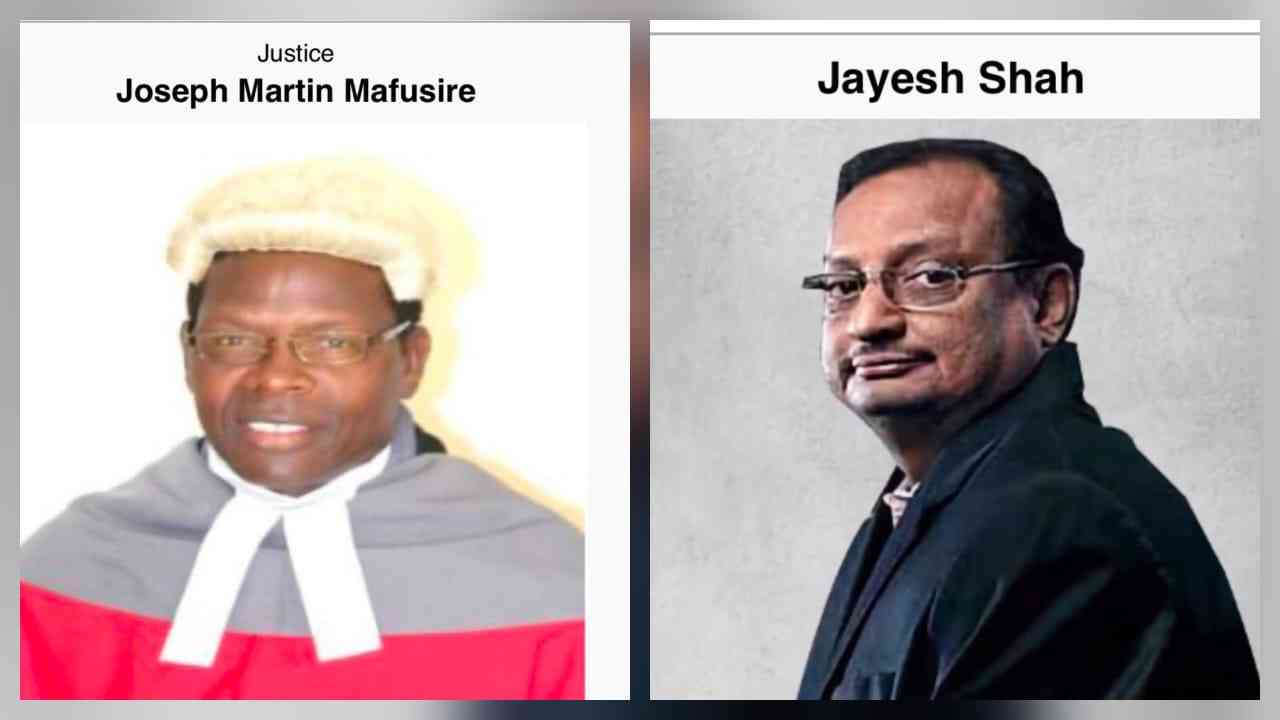
This issue comes into focus in Zimbabwe through the relationship between High Court judge Justice Joseph Mafusire and businessman Jayesh Shah.
Recently, Mafusire presided over a high-profile dispute involving Shah and the Reserve Bank of Zimbabwe (RBZ).
The matter centred on the freezing of funds linked to a gold trading transaction involving Shah’s trading company, Al Shams.
The money was meant for the purchase of gold by Al Shams, which had in the past been buying the precious matel from the BBZ.
But the RBZ froze Fidelity Printers’ account, demanding to know where US$7 million had come from.
The RBZ was supposed to supply 100 kilogrammes of gold to Al Shams every week, under its agreement reached in 2024.
The gold would be shipped out to Dubai for sale and Al Shams would bring back hard cash, declare and deposit it into Fidelity’s Getbucks account for further purchase of gold.
Mafusire ultimately ruled against the central bank, finding fault with its actions.
The judge questioned the RBZ’s commitment to prevention of money laundering by allowing gold buyers and sellers to carry huge amounts of cash into the country.
The judgment generated public debate, not because of anything contained in the ruling itself, but because Mafusire had represented Shah as a lawyer before his elevation to the bench.
There is no evidence that Mafusire's decision was influenced by his former professional relationship with Shah.
Nor should the correctness of a judgment be judged solely by the identity of the parties.
Yet the circumstances raise an important institutional question: when does a former lawyer-client relationship become sufficiently distant that it no longer raises concerns about perceived impartiality?
The relationship between Mafusire and Shah appears to have been more substantial than a single legal engagement.
While practicing at Scanlen & Holderness, Mafusire reportedly represented Shah in a US$10 000 claim against Air Zimbabwe in 2009 for failure to serve him a special vegetarian diet on a flight to Singapore.
The case became popular when Mafusire cited the “wrong” name for Air Zimbabwe (Private) Limited, calling it Air Zimbabwe Corporation in his papers filed at court.
Earlier in 2005, Mafusire also represented Shah-linked interests in litigation involving the businessman's company, Gift Investments and the Zimbabwe United Passenger Company (Zupco) arising from the supply of buses to the public transport operator. In the over two-decade old legal dispute, Shah was accused of having paid a bribe to the then Zupco chief executive officer Charles Nherera, to facilitate a lease agreement.
Nherera and Shah were arrested, but the latter enjoyed immunity from prosecution on condition that he testifies against Nherera.
Nherera was convicted and sentenced to two years in prison and had served his full sentence when the High Court in 2009 overturned his conviction. The matter is still before the courts.
Perhaps most significantly, Mafusire, before he was appointed High Court judge in 2012, also acted on behalf of Shah in a multimillion-dollar property dispute involving businessman Daniel Shumba over an Avondale property in Harare.
The matter became so contentious that Shumba objected to Mafusire's subsequent appointment to the Supreme Court bench, citing his involvement in the dispute and his professional relationship with Shah.
Shumba described Mafusire as an “accomplice” in his fraud case against Shah, suggesting a deeper relationship between the two.
There are other cases just now involving Shah that are before Mafusire. Taken individually, none of these matters necessarily creates a conflict.
However, they illustrate a sustained lawyer-client relationship that extended across different areas of law and significant commercial interests.
The question is whether time alone dissolves such a relationship.
Zimbabwean law does not prescribe a specific period after which concerns about familiarity automatically disappear.
There is no statute saying that five years, ten years or twenty years erases the possibility of perceived bias.
Instead, courts apply the test of whether a reasonable and informed observer would apprehend bias.
Under this approach, the focus is not on whether a judge is actually biased.
Rather, the inquiry is whether a reasonable member of the public, aware of all the relevant facts, would reasonably fear that the judge might not approach the case with complete impartiality.
This is a demanding standard. Judges are presumed to be impartial. Former legal representation does not automatically require recusal.
If it did, many judges would be unable to hear matters involving major corporations, government departments or prominent individuals they encountered during their years in practice.
Yet the absence of an automatic rule does not mean the concern disappears.
Time undoubtedly weakens the influence of past relationships. Memories fade.
Professional interactions become distant. Circumstances change. But human experience suggests that familiarity is not governed by a stopwatch.
Some relationships are so brief and insignificant that they are forgotten within months. Others remain influential decades later.
The law's difficulty is that it cannot easily measure the residual effect of familiarity.
Other jurisdictions have attempted to address the problem through broader recusal principles.
In South Africa, judges are expected to step aside whenever a reasonable apprehension of bias exists.
The emphasis is not merely on actual fairness but on maintaining public confidence in the courts.
In the United Kingdom, the test is whether a fair-minded and informed observer would conclude that there is a real possibility of bias.
In the United States, federal judges must disqualify themselves whenever their impartiality might reasonably be questioned.
These standards recognise an important truth: public confidence is a judicial asset. Once lost, it is difficult to restore.
Several international controversies illustrate the point. In 1998, the House of Lords decision in the Pinochet case was set aside because one of the judges, Lord Hoffmann, had undisclosed links to Amnesty International, even though no actual bias was proven.
In the United States, in March 2004, Justice Antonin Scalia was criticised for refusing to recuse himself from a case involving Vice-President Dick Cheney following a social trip together.
Again, the controversy centred not on proven prejudice, but on public perception.
These cases demonstrate that modern judicial ethics focuses not only on actual prejudice but on preserving confidence in the judicial process.
The lesson from these cases is that familiarity itself can become a problem, even where no improper conduct occurs.
Applied to the Mafusire-Shah situation, the issue is not whether Mafusire acted unfairly. There is no evidence that he did.
The issue is whether repeated professional engagements over several years create a degree of familiarity that could cause reasonable observers to question the appearance of impartiality.
People will see this in different ways. Some will argue that judges should be trusted to separate their professional past from their judicial duties.
Others will contend that where a judge has acted repeatedly for the same client in significant matters, recusal is the wiser course because it protects public confidence in the judiciary.
Ultimately, the debate is larger than any individual judge or litigant.
It concerns the delicate balance between trust in judicial professionalism and the need to preserve the appearance of impartiality.
The judiciary derives its authority not from force, but from public confidence.
For that reason, even where actual bias is absent, courts must remain vigilant about circumstances that could create the perception that old professional relationships continue to matter.
Justice, after all, must not only be done. It must be seen to be done.
In my view, as a layman in law, but very concerned with the pursuit for justice, repeated representation, like in the Mafusire and Shar’s past relationships, creates a level of familiarity that could undermine public confidence, regardless of the judge's actual state of mind.
The strength of the latter argument is captured in a simple principle: the judiciary's legitimacy depends not only on impartial judges, but on judges who are perceived to be impartial.
Where a former lawyer-client relationship is significant enough to raise legitimate questions in the minds of informed observers, recusal may serve not as an admission of bias but as a safeguard for public confidence in the administration of justice.
In view of this, maybe there should be legal frameworks to for courts to examine factors such as the nature of the previous relationship, how close the relationship was, how many matters the lawyer handled for the client, how much time has passed, whether confidential information was acquired that may still be relevant and whether a reasonable observer would still perceive a connection.
The passage of time alone is not enough. In my view, time weakens grievances but does not necessarily eliminate them.
If a lawyer repeatedly acted for the same client over many years, developed a close professional relationship and later presided over a case involving that client, the mere passage of time may not entirely remove concerns about perceived partiality. Judges should simply recuse themselves if asked to, but the unfortunate thing again is that same judges determine whether they can recuse themselves or not.
I have the view that such assessment should be done by an independent judge.
*Bernard Muza is a social commentator