Small to medium size enteprises have long been hailed as the heartbeat of Zimbabwe’s economy.
From bustling urban markets to emerging manufacturing hubs, these enterprises provide the bedrock of employment.
However, before examining the core of this issue, one must acknowledge a stark reality: many of these businesses remain trapped in a cycle of subsistence, failing to graduate into the sustainable, institutional entities necessary to drive national economic transformation.
As Zimbabwe pushes toward its ambitious developmental goals, industry experts are sounding a clarion call.
The barrier to growth, they argue, is no longer limited to capital or infrastructure; rather, it resides in the fundamental absence of deliberate, long-term strategic planning.
The SME landscape in Zimbabwe is characterized by a high volume of informal activity. While these businesses are agile and vital for immediate livelihoods, they often lack the structural integrity to weather economic shifts or expand beyond a local footprint.
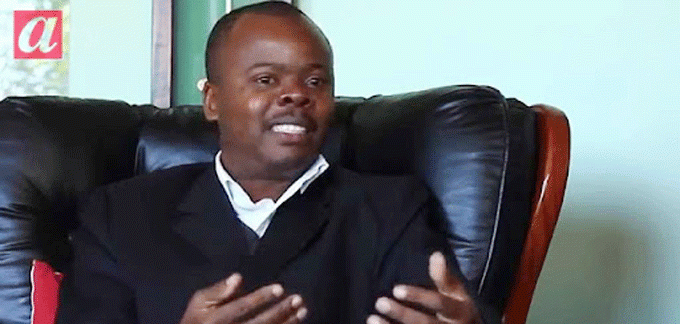
In light of this, at a recent public lecture, Farai Mutambanengwe, founder and chief executive of the SMEs Association of Zimbabwe, offered a candid assessment of the sector’s inertia.
According to Mutambanengwe, the primary bottleneck is a "survivalist mindset."
- SME raise flag over withholding tax
- New perspectives: Good governance the missing link
- SME raise flag over withholding tax
- New perspectives: Good governance the missing link
Keep Reading
"The single biggest reason an entrepreneur-run business fails to become an institution is the mindset in which it is established," Mutambanengwe noted.
He argued that many ventures are birthed simply to bridge an immediate gap in disposable income or as "lifestyle" businesses.
While there is no inherent harm in starting small, the lack of a trajectory to move from a one-person show to a scalable, professional entity creates a self-imposed ceiling.
"If you start small with no intention to grow, that becomes the ceiling of your business," he added.
The Zimbabwean government, recognizing that the current informal status quo is unsustainable for long-term national wealth creation, has initiated a series of interventions.
Consequently, agencies like the Small and Medium Enterprises Development Corporation (SMEDCO) have been tasked with the mandate of fostering growth through financial inclusion, simplification of business registration, and capacity-building workshops.
The logic behind these initiatives is sound: formalisation opens doors to credit markets, formal supply chains, and legal protections that are otherwise inaccessible to informal traders.
Lowering the barriers to entry, the state aims to encourage SMEs to "cross over" into the formal economy. Nonetheless, critics and analysts point out that formalization is only the first step.
Registration with tax authorities or the Registrar of Companies does not automatically transform a business into a high-growth machine.
A company can be formally registered and still remain strategically stagnant. This is where the divide between policy-led formalization and entrepreneur-led transformation becomes apparent.
Why do so many SMEs resist the transition to formal, structured growth? The reasons are multifaceted and often grounded in the realities of the Zimbabwean economic climate.
To begin with, risk aversion plays a role. Formalisation brings with it compliance costs taxes, regulatory filings, and labor laws that can feel prohibitive for a business earning thin margins.
For many entrepreneurs, the extra-legal route feels safer because it allows for immediate liquidity.
Furthermore, there is a cultural aspect to business management. Many Zimbabwean SMEs are family-run or sole proprietorships where the entrepreneur acts as the face, the labor force, and the accountant. Transitioning to an institutionalized model requires delegation, corporate governance, and the separation of personal and business finances skills that are not always emphasized in traditional SME development programs.
In addition to these factors, access to finance is often cited as a major hurdle.
While the government promotes financial inclusion, commercial banks remain hesitant to lend to SMEs that lack clear, audited financial histories or professional business plans.
Lenders look for the "deliberate strategy" that Mutambanengwe champions; without it, an SME is perceived as a high-risk credit profile.
To move the needle, stakeholders suggest a three-pronged approach: professionalisation, strategic visioning, and community-based support.
First, transformation requires moving away from the "founder-dependency" model. This means adopting standardised accounting practices, investing in technology, and building a team.
An institution is defined by its ability to function regardless of who is in charge.
SMEs that document their processes and maintain transparent records are far more likely to attract patient capital and strategic partnerships.
Second, capacity-building programs, whether run by SMEDCO or private sector consultants, must shift their focus.
Rather than just teaching entrepreneurs how to register a business, these programs should mentor them on market positioning, regional export opportunities, and long-term scaling.
A business should be built with the intent of solving a specific problem at a scale that extends beyond the immediate neighborhood.
Finally, there is strength in numbers.
For small businesses that cannot afford individual enterprise resource planning systems or expensive legal counsel, forming cooperatives or SME clusters is a viable strategy for sharing costs and increasing bargaining power.
By pooling resources, SMEs can achieve economies of scale that protect them against market volatility.
It is important to acknowledge, however, that the informal sector provides a vital safety net for the Zimbabwean population.
In times of economic volatility, the informal SME sector is often the most resilient, precisely because it is untethered by heavy regulation. Some analysts argue that aggressively pushing for formalization might, if handled poorly, stifle this vital grassroots activity.
Therefore, the debate is not about eradicating the informal sector, but about creating a "graduation ladder."
The goal should be to make the transition to formal, strategy-driven growth so attractive that SMEs choose to scale up because it is the most logical path to greater profit and stability.
The transformation of Zimbabwe’s SME sector is arguably the most critical component of the country’s economic future.
While the state can provide an environment for growth through policy and infrastructure, the engine of that growth must be the entrepreneurs themselves.
Building upon this observation, and as Vusi Thembekwayo so incisively argued in his TED talk at the University of Namibia regarding the "Big Lie of Small Business," it is clear that many African startups and SMEs are anchored by a fundamental misunderstanding of the broader business ecosystem.
Because the majority of these ventures perish within the early "survivalist" stage, there is an urgent necessity for a profound mindset shift.
To catalyze this transition, stakeholders must proactively instill a robust business philosophy that prioritizes the creation of strong, replicable systems over individual effort.
Furthermore, by fostering a culture of mentorship and embracing the discipline of delayed gratification, entrepreneurs can evolve beyond the immediate need for survival.
Ultimately, the mandate for the modern Zimbabwean entrepreneur is to shift their focus from local subsistence to global relevance, intentionally building enterprises designed to compete and thrive within the complexities of the global community.
In the final analysis, the transition from an SME to a sustainable institution is a journey of intentionality. It is a commitment to move beyond the comfort of the status quo and embrace the structural rigour that true, lasting success demands.
For Zimbabwe’s entrepreneurs, the message is clear: survival may keep you in business today, but only a deliberate strategy will keep you in business tomorrow.
*Lovemore Nyawo is a development practitioner ,writer and public speaker .
These weekly articles are coordinated by Lovemore Kadenge ,an independent consultant ,managing consultant of Zawale consultants(private) Limited ,past president of the Zimbabwe Economics Society and Past president of the Chartered Governance and Accountancy institute in Zimbabwe .Email [email protected] Mobile no 263772382852