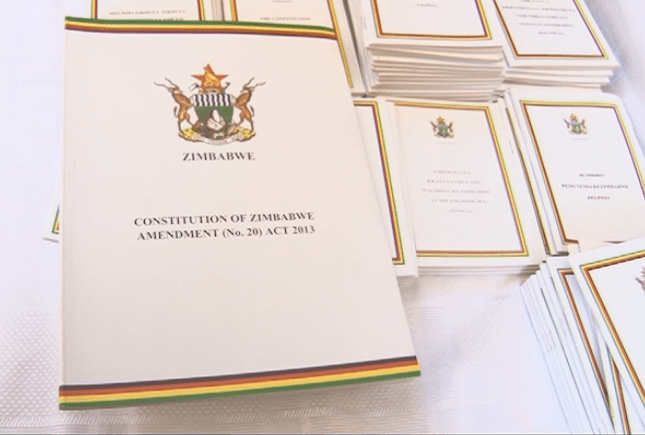
Emmerson Mnangagwa began his second and final term as president of Zimbabwe in 2023, in accordance with the 2013 constitution.
He will be 86 years old when his term expires in 2028. On February 16, 2026, the speaker of Parliament gazetted the constitution of Zimbabwe Amendment Bill No. 3. If enacted, it would roll back key features protecting Zimbabwe’s democracy.
The bill proposes extending presidential and parliamentary terms from five to seven years, thereby prolonging Mnangagwa’s tenure until 2030, replacing direct presidential elections with parliamentary selection of the president, and consolidating executive control over key state institutions.
Mnangagwa declared that he would still be in office by 2030.
This became a rallying point within his Zimbabwe African National Union – Patriotic Front (Z anu PF) party, culminating in party resolutions to extend his tenure and the introduction of the current bill.
When Zimbabwe enacted the 2013 constitution, former president Robert Mugabe had been in power for 33 years.
To address his authoritarianism and the ubiquity of Zanu PF’s influence, the constitution included a two-term limit for the presidency, demanded impartiality and non-partisanship from state institutions, and established independent “fourth branch” institutions supporting democracy.
It also introduced public interviews in the appointment of judges and the prosecutor general.
- ED’s influence will take generations to erase
- Govt under attack over banks lending ban
- Zim Constitution must be amended
- Examination fees shocker
Keep Reading
However, Zanu PF used parliamentary supermajorities to systematically dismantle these guardrails. In 2017, the first amendment to the constitution removed public interviews for the most senior judges.
Four years later, the second amendment dropped the requirement for public interviews in appointing the prosecutor general and promoting judges to the next tier.
The proposed third amendment supercharges this erosion of institutional and democratic constraints.
The government justifies extending parliamentary and presidential terms as essential to mitigating election-related “toxicity” and fostering long-term economic growth.
According to section 328(7) of the constitution, term-limit amendments extending tenure do not apply to incumbents.
Therefore, amendments that prolong incumbency would necessitate altering the restriction against incumbents, an alteration which itself requires a referendum.
To enable “incumbent preservation” while evading the referendum trigger, the minister of Justice, Legal and Parliamentary Affairs argues that the bill does not alter term limits and only adjusts “election cycles”.
The minister’s assertions are inconsistent with the plain text of the bill, which does not presume that this rebranding shields the changes from the section 328(7) prohibition. Instead, it would preserve presidential and parliamentary incumbency by explicitly citing and overriding the very prohibition whose irrelevance the bill’s proponents vigorously assert.
Even though the bill seeks to render the prohibition inapplicable, its proponents present this inapplicability as if it were the pre-existing default.
Deliberate indeterminacy also explains the bill’s silence on the transitional details. It establishes a new “cycle” and replaces the election system for the president (discussed below) without outlining when either would begin.
It is the minister’s statement which suggests that the seven-year term will run retroactively from September 4, 2023, to September 4, 2030.
This ambiguity mitigates public backlash, provides elites with plausible deniability, and may blunt legal challenges.
If courts later clarify transitional details or dismiss legal challenges to the term extension, it will cloak subsequent government actions with judicial legitimacy and sanitize them to local and global audiences.
While the Zanu PF resolutions focused on extending the current president’s term, the tabled amendments include much more consequential proposals.
The bill would remove direct presidential elections. Zanu PF’s presidential vote share fell precipitously from 61% in Robert Mugabe’s final election in 2013 to barely clearing the 50% threshold in subsequent contests.
Yet the party continued to secure parliamentary supermajorities through general elections and by-elections, making the legislature a more reliable locus of power.
Removing popular elections for the head of the executive would help sustain Zanu PF dominance despite any decline in electoral support.
Under the proposed new procedure, a joint sitting of Parliament would elect the president supervised by the Zimbabwe Electoal Commission or a designated judge.
The candidate with more than half of the valid votes cast would be declared president.
The rest of the procedure is left to parliament’s standing orders.
The bill neither outlines the process of designating a judge for this vote, nor details the circumstances necessitating this alternative.
Moreover, despite the indirect mode of selecting the president, the constitution retains the extremely difficult removal procedure of impeachment.
This would leave the Zimbabwean president uniquely insulated from conventional forms of democratic accountability.
This revision also reduces the participatory content of the right to vote by eliminating a distinct, constitutionally recognized channel of exercising the right.
The government cites parliamentary systems in Botswana, Germany, South Africa, and the US electoral college as inspirations for these changes. This is a false equivalence.
Those electoral systems are not products of elite-driven modifications.
They reflect the people’s constituent power to establish an electoral system and are embedded within institutional frameworks that sustain democratic accountability.
The bill adopts none of those features. It does not enhance proportional representation, provide for a vote of no confidence in the president, or include safeguards analogous to “faithless elector” laws.
The bill would further fortify the presidency by restoring pre-2013 provisions for executive appointments to the legislature. It would allow the president to appoint ten additional senators—double the earlier allocation—to the upper house of the very body responsible for sustaining his incumbency.
This will raise the Senate to 90 members and make it easier for Zanu PF to secure a supermajority.
The registrar-general is a presidentially appointed civil servant who has historically overseen voter registration and compilation of the voters’ roll.
This office has been implicated in practices contributing to voter disenfranchisement and hindering equal access to the voters’ roll.
It is associated with its long-serving incumbent, Tobaiwa Mudede, who attended functions as a Zanu PF delegate.
To address concerns of partisanship, legislators transferred compilation of the voters’ roll—and later voter registration—to the Zimbabwe Electoral Commission as an independent body with more transparent appointment procedures.
Voter redistricting, or delimitation, had likewise been moved from presidentially appointed ad hoc commissions to the Zimbabwe Electoral Commission.
The bill proposes reversing these reforms by restoring the responsibility for voter registration and voters’ roll compilation to the registrar-general and transferring redistricting to the presidentially appointed Zimbabwe Electoral Delimitation Commission.
Consequently, the parliamentary-elected president will appoint the officials who register voters, compile the voters' roll, and delimit the constituencies from which his electors emerge.
Delimitation is conducted after the conclusion of the national census and must be completed six months before the voting day.
In terms of the bill’s proposed election cycle, there will be a brief window of under 18 months for completing delimitation between the 2042 national census and the 2044 elections.
Yet the bill also proposes extending the deadline for finalizing delimitation from six to eighteen months, further exacerbating concerns over time constraints.
As highlighted above, the 2013 constitution required public interviews for all judicial appointments, but the first amendment removed this requirement for the three most senior judges.
Currently, if the president appoints a chief justice, deputy chief justice, or judge president contrary to the Judicial Service Commission’s recommendations, the president must inform the senate.
*Tinashé Hofisi is a human rights lawyer and post-doctoral research associate at the Karsh Institute of Democracy, University of Virginia. He writes in his personal capacity. This opinion article was first published by Constitutionnet.