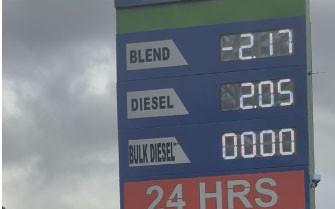
On Wednesday, the government, through the Zimbabwe Energy Regulatory Authority (Zera), hiked the price of diesel and petrol per litre to US$2,05 and US$2,17, respectively, from US$1,77 and US$1,71, making it the second most expensive country in Sadc, after Malawi.
Authorities have attributed the increases to global oil market shocks linked to the Middle East war involving the United States and Israel's war with Iran.
While the war is the reason behind the price hikes, it is not entirely the reason for Zimbabwe.
Locally, fuel prices are high due to taxes and levies. Fuel has a high number of regulatory fees.
These include duties, scenario levy, carbon tax, strategic reserve levy, petroleum levy, free on board, freight, Zimbabwe National Road Administration’s road levy, debt redemption and storage levy.
To understand the gravity of the situation, one must first consider the regional context. Countries such as Zambia, Tanzania, and Mozambique have recorded marginal increases ranging between 4% and 6%. Even South Africa with a far more complex and globally integrated fuel pricing mechanism has kept increases to around 2%. Meanwhile, Botswana has maintained price stability at 0%, and Namibia has only seen a modest 3% rise.
These figures suggest that external factors such as global oil prices, shipping costs, or currency pressures are not sufficient to justify Zimbabwe’s extreme hike. After all, these same pressures affect the entire region. If anything, Zimbabwe should be benefiting from proximity to regional supply routes and shared infrastructure networks. Yet, the opposite is happening.
Zimbabwe’s fuel market has long been characterised by opacity. From procurement processes to distribution channels, there is limited transparency on how fuel prices are determined. Key questions remain unanswered: Who are the major importers? At what price is fuel being sourced? What margins are being applied before it reaches the consumer? Without clear answers, it becomes difficult to rule out rent-seeking behaviour and cartel-like dynamics.
- Woods fuels Masters’ return rumours
- WHAWHA, HARARE CITY SHARE SPOILS
- Author pens book in honour of Dendera
- WHAWHA, HARARE CITY SHARE SPOILS
Keep Reading
One of the most persistent concerns is the role of politically connected intermediaries. In many cases, fuel importation is not handled through competitive, transparent bidding processes, but rather through networks of companies with strong political ties. These entities often operate with preferential access to foreign currency, subsidies, or regulatory leniency advantages that distort the market and inflate prices artificially.
Furthermore, Zimbabwe’s foreign currency system plays a critical role in this dysfunction. Fuel importers often cite exchange rate volatility as a justification for price increases. However, this argument does not fully hold when neighbouring countries, many of which also face currency pressures, manage to keep price movements within reasonable limits. The difference is governance. In countries like South Africa and Botswana, fuel pricing frameworks are structured, predictable, and subject to regulatory oversight. In Zimbabwe, the lack of such robust systems creates fertile ground for manipulation.
Another layer to this crisis is taxation and regulatory burden. While taxes are a legitimate tool for government revenue, excessive or poorly structured levies can significantly inflate pump prices. In Zimbabwe, there is growing suspicion that fuel is being used as a revenue extraction mechanism, with consumers bearing the brunt. However, even this does not fully explain the scale of the increase, suggesting that inefficiencies and leakages within the system are compounding the problem.
The consequences of this are far-reaching. Fuel is a foundational input across the economy. When prices rise sharply, the effects cascade through transport, agriculture, manufacturing, and retail. In Zimbabwe, this translates into higher food prices, increased cost of living, and reduced competitiveness for local businesses. At a time when economic recovery is already fragile, such distortions are particularly damaging.
A survey carried out by NewsDay on the price hikes has revealed the severe impact on cities and towns, with steep increases in transport fares. Some local routes are charging as much as US$3 during peak hours, following the latest fuel price adjustment announced by the Zimbabwe Energy Regulatory Authority (Zera).
Commuters are bearing the brunt, facing steep and often inconsistent fare hikes. A NewsDay survey found that commuters travelling from residential areas to the central business district are paying between US$1.50 and US$2, while those from outlying areas like Chitungwiza and Norton are being charged up to US$3 during peak periods.
The fare hikes are also affecting employers who subsidise transport for workers, with some scaling back support as costs become unsustainable.
Commuters are anxious about further increases, amid uncertainty over future pricing.
Moreover, the disparity between Zimbabwe and its neighbours undermines regional integration efforts.
One of the key goals of Sadc is to promote economic cooperation and stability. However, when a member state exhibits such extreme divergence, it creates imbalances that can affect trade flows, investment decisions, and cross-border activities.
For instance, transporters may prefer to refuel in neighbouring countries, leading to loss of revenue and further economic leakage for Zimbabwe.
It is also worth considering the social and political implications. Persistent high fuel prices erode public trust in institutions. Citizens begin to question whether policies are designed in their interest or to benefit a select few.
This erosion of trust can have long-term consequences for governance and social cohesion.
Addressing this issue requires more than short-term price controls or reactive policy measures. It demands structural reform. Transparency must be at the centre of any solution. The government needs to clearly communicate how fuel prices are determined, publish procurement data, and ensure that regulatory bodies operate independently and effectively.
In addition, there must be a concerted effort to dismantle monopolistic and politically connected networks within the fuel sector. This includes opening up the market to genuine competition, enforcing anti-corruption measures, and strengthening oversight mechanisms. Without these steps, any attempt to stabilise prices will be temporary at best.
Regional benchmarking can also play a role. Zimbabwe should actively compare its pricing structures with those of its neighbours and adopt best practices where applicable. The fact that countries with similar or even greater economic challenges are managing to maintain stability is a clear indication that solutions exist.
Ultimately, the fuel price shock in Zimbabwe is not just an economic issue it is a governance issue. It reflects deeper systemic problems that extend beyond the energy sector. While external factors will always influence fuel prices, the extent of Zimbabwe’s increase points to internal failures that must be urgently addressed.
Until there is transparency, accountability, and genuine reform, Zimbabwe will continue to stand apart from its regional peers not as a victim of global forces, but as a case study in how domestic mismanagement and corruption can distort even the most fundamental aspects of an economy.