A crowd of excited little boys, some as young as seven, sprint alongside a shiny silver sport utility vehicle.
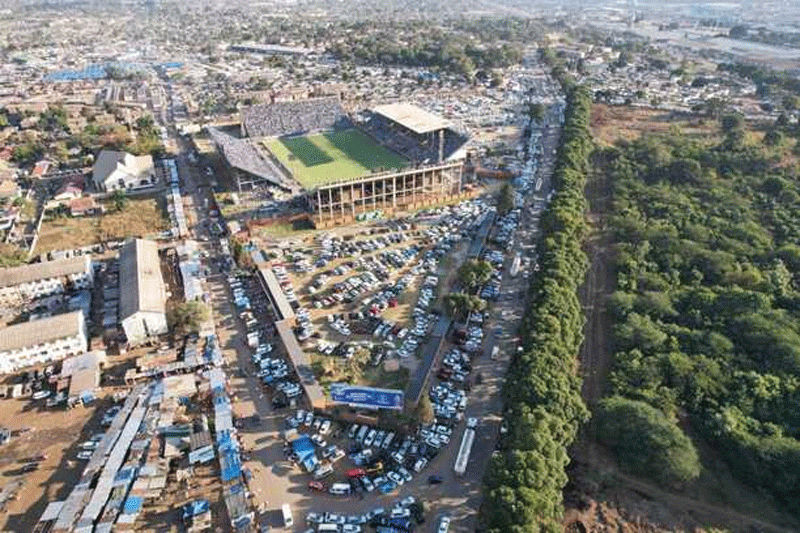
The car slows down as it turns into the parking area outside Rufaro Stadium in Mbare, the oldest and most historic high-density suburb in Harare located just five kilometres south of the city centre.
“Mkoma totarisa mota mkoma mondipa dhola or ZiG20 chete, ndini ndatanga kutaura nemi” (“Brother, I will look after your car. I was the first to speak to you. Just one dollar, or even ZiG20, and your car will be safe while you watch the match!”) shouts nine-year-old Simba Phiri*, panting heavily, but smiling from ear to ear.
Phiri and his friends are bothered neither by the gravel flying from under the spinning car wheels nor by the blazing hot afternoon sun.
For them, every major weekend football match is about much more than just the game, it is a vital opportunity to work, eat, and survive.
On Sunday, June 14, 2026, Rufaro Stadium was alive with noise.
It was a big weekend fixture between two newer teams: the defending champions Scotland FC, who joined the Castle Lager Premier Soccer League (PSL) in 2024, and Hardrock FC, who joined this year.
The two clubs are sometimes referred to as "moneybags" or zvigananda (the wealthy ones) in Shona.
- Time to act on South Africa violence against immigrants
- Xenophobia victim Nyathi buried
- Xenophobic attacks against Zimbabweans barbaric
- Awards target married couples
Keep Reading
“I am a Scotland FC fan, can I please look after your big car?” says seven-year-old Ethan Songo* in his stained Scotland FC jersey.
Whenever a car or a large team bus arrives at the parking gate, a group of children from Mbare routinely run towards it. They cheer, clap their hands, and dance around the vehicle, welcoming every motorist like royalty.
"We love the big games," says 11-year-old Tinashe Muza*, wiping sweat from his forehead with the back of his hand. "When the stadium is full, we know we can make some money.
“We just ask the car owners for ZiG20 (which is about US$0.50) or US$1. In return, we stay right here for two hours watching over their cars so that no one steals anything inside.
“I usually take home US$3 to US$5 on big matchdays, like when Caps United FC play Dynamos FC."
"I buy tomatoes and vegetables for my mother when I get money here. Sometimes I have an extra US$2 which I take to school to buy ZapNax and sweets. We enjoy this,” Muza told The Sports Hub before sprinting towards a Toyota GD6 that was about to park.
While the football fans shout and celebrate goals inside the stadium, the story of these children reflects a much harsher reality.
Many of the boys who work at the parking lot attend school in Mbare, balancing this as a part-time job.
Even during midweek fixtures, when smaller soccer matches take place, the boys can be seen running to the stadium straight after school.
The Sports Hub observed a Scotland FC supporter, who identified himself as Anesu Muviri, talking to the boys and making arrangements for them to watch over his black Ford Raptor.
In an interview, Muviri admitted that he usually gives two boys US$1 each to look after his vehicle while he enjoys the game inside Rufaro Stadium.
“I give them money after the game, not because they are actually securing my car, but out of complete humanity.
“I see the effort they put into running towards each and every car to talk to drivers. Imagine all that energy.
“Some of these boys are now my little friends; I even buy them ice cream sometimes,” he added.
For other children in the group, the circumstances are bleaker. Some do not attend school at all.
The parking lot at Rufaro Stadium has effectively become their classroom, and survival is the only lesson they are learning.
Taurai Dexter Malinganiso, chairperson of the parliamentary portfolio committee on public service, labour, and social welfare, said he was unaware of the situation, but indicated that the committee would debate the raised concerns.
Children’s rights experts have expressed deep concern over this growing trend, warning that stadium parking lots are unsafe environments for young children.
Zimbabwe National Council for the Welfare of Children (ZNCWC) director Taylor Nyanhete said the PSL must enforce corrective measures to prevent children from entering such an exploitative environment.
“It is a violation of a child's right to protection against exploitation,” Nyahnete said.
“The PSL must be notified of these occurrences so that they can implement corrective measures to end it.
“Child protection is the primary responsibility of the child protection officers in the Department of Social Development within the Ministry of Public Service, Labour and Social Welfare.
"They need to be alerted to this development as they have the authority to remove children from such scenarios. As the ZNCWC, we condemn this practice by motorists who take advantage of children to provide security for their assets.”
However, Premier Soccer League chief executive officer Rodwell Thabe highlighted that the league has no jurisdiction over stadium parking lots, stating that operations in those areas are managed by City Parking.
Thabe also discouraged football fans from paying self-appointed parking marshals to watch over their vehicles.
In an interview, City Parking public relations manager Francis Mandaza said the municipality was working to address the complaints raised by football fans, adding that new measures would restrict entry to individuals not attending the matches.
“This is an issue that we are already working to address,” Mandaza said.
“We are installing gates at all main entrances to regulate entry into the parking lots.
“For the outside parking areas, we are working closely with the Zimbabwe Republic Police to deal with touts around the area.
“Ultimately, we are working to improve security for those football fans who pay for parking.”
After the big games conclude and football fans have vacated the parking area, the children walk back to their homes in groups, some counting their small earnings and sharing stories of the day.
They might be young, and life might be tough, but their spirits remain as unbroken as the historic stadium they call their playground.
NB* Not real names of children used in this article.