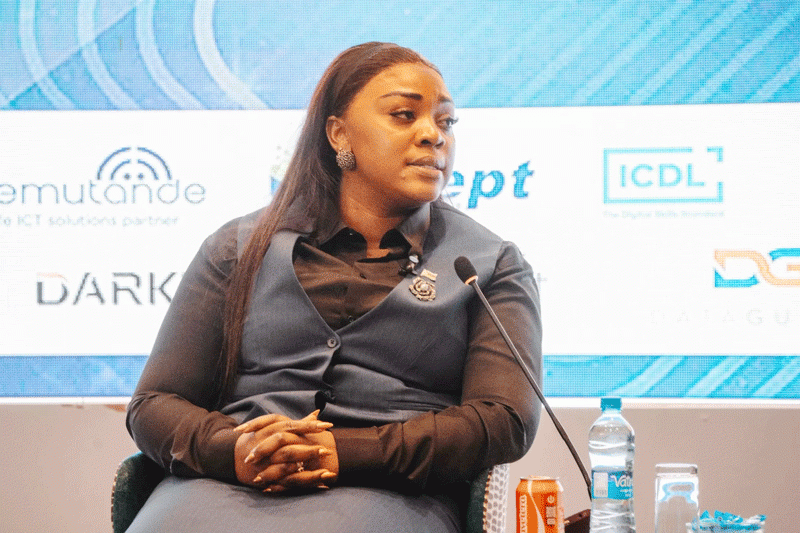
Under a recent social media post by Information Communication Technology, Postal and Courier Services minister Tatenda Mavetera, the comment section quickly shifted from public engagement to personal criticism.
Alongside a small number of policy-related responses, other users focused on her appearance, posting insults and commentary unrelated to the substance of the post.
Such exchanges are increasingly common for women in Zimbabwean politics, where online visibility often attracts both political feedback and personal attacks.
Mavetera has previously responded to online criticism by calling for more constructive use of digital platforms and discouraging abusive language directed at public officials.
Her experience reflects a broader pattern identified by researchers, fact-checkers and media monitors in Zimbabwe’s political communication space.
Across multiple platforms, including Facebook, WhatsApp, X and TikTok, women politicians are often targeted by content that blends political discussion with personal attacks.
Analysts describe this as gendered disinformation, false or misleading content that draws on gender stereotypes and personal characteristics to discredit women in public life rather than focusing on their policy positions or political performance.
As Zimbabwe’s political campaigns increasingly move online, a growing number of women politicians are finding themselves fighting two battles at once: one for votes and another against coordinated attacks designed to undermine them simply because they are women.
- Tenax finally remember how to win
- Out & about: Warner Music Group squashing the impossible
- Ex-ChiTown chamber secretary fails to stop trial
- Parly caucus on PWDs mooted
Keep Reading
“Women politicians are absolutely targeted differently from men,” the late Labour, Economists and African Democrats (LEAD) president Linda Masarira said in an interview before her death in May 2026.
“Men are usually attacked based on ideology, competence or policy positions, but women are often attacked on their morality, appearance, relationships, marital status, sexuality or even motherhood,” she said.
Masarira said she personally experienced false information, smear campaigns and coordinated online attacks throughout her political career.
“I have had fabricated stories spread about my personal life, my political affiliations, my integrity and even my family,” she said.
“Many of these attacks are not about policy disagreements but are deeply rooted in misogyny and patriarchal attitudes that seek to punish women for occupying public leadership spaces,” she added.
Politics meets patriarchy
Zimbabwe has made some progress in increasing women’s political representation through constitutional gender quotas introduced in 2013. Yet women remain significantly underrepresented in decision-making positions.
According to the Inter-Parliamentary Union, women currently hold approximately one-third of seats in Zimbabwe’s National Assembly, while leadership positions across major political parties remain overwhelmingly male.
Experts say this imbalance reflects deeper societal attitudes about women’s leadership.
Farisai Chaniwa, director of Media Monitors, said gendered disinformation differs fundamentally from ordinary political criticism because it targets identity rather than performance.
“It refers to false or misleading content that specifically exploits gender stereotypes, sexism or misogyny to discredit women,” Chaniwa said.
“Unlike ordinary political criticism, which focuses on policy or performance, gendered disinformation attack’s identity, portraying women as unfit leaders because of their gender, appearance or personal life.”
Women politicians, she said, are frequently subjected to sexualised insults, misogynistic memes, name-calling and narratives questioning their morality, competence and family roles.
Common claims include allegations that women “slept their way to power,” are emotionally unstable, or are being manipulated by powerful men.
Former member of the national assembly, Nicola Watson said women in politics are judged harshly in terms of how they present themselves in comparison to men.
“I think I have always had pretty thick skin and have never let that kind of disinformation deter or sway me,” she said.
Elections as flashpoints
Research suggests that election periods often trigger spikes in gendered disinformation.
Prisiel Samu, a fact-checker with ZimFact, said his organisation has observed a clear pattern.
“We have observed a trend where gendered disinformation rises in discussions on democratic processes that attract a lot of contestation,” Samu said. “False information is weaponised against vocal women political actors. Elections, for example, result in misinformation and disinformation against women political actors.”
According to Samu, gendered disinformation differs from broader political misinformation because it is deeply personal.
“Whilst political disinformation is usually generalised, gendered disinformation is personal. It is meant to assassinate the character of a political actor because of their gender,” she said.
The phenomenon cuts across party lines.
Samu pointed to cases involving women politicians and public figures who have faced online attacks focused on their bodies, appearance or personal relationships rather than their political work.
“When musician Sandra Ndebele announced that she would be running for a local government seat, photoshopped images of her body were plastered on the internet with claims that she was using her figure and dance moves to attract votes,” Samu said.
He added that Masarira was repeatedly subjected to body-shaming and allegations that she was acting as a proxy for political opponents.
“There is a tendency to generate claims about women’s love lives and not their political prowess,” Samu said.
The digital battlefield
Zimbabwe’s political conversations increasingly take place online.
According to DataReportal’s 2025 digital statistics, Zimbabwe has about 2.1 million internet users, with Facebook, WhatsApp and TikTok accounts which are among the country’s most widely used digital platforms.
While these platforms have expanded opportunities for political engagement, they have also created new avenues for harassment and manipulation.
Chaniwa says gendered disinformation often begins in private WhatsApp groups before spreading to public platforms through screenshots, reposts and coordinated amplification.
She added that investigations have documented fake accounts amplifying smear campaigns, anonymous blogs recycling misogynistic narratives and WhatsApp broadcast lists circulating doctored images.
“The social media environment accelerates the spread through virality,” she said.
The encrypted nature of WhatsApp presents a particular challenge.
“It has been difficult to fact-check gendered disinformation on WhatsApp and Facebook because of the platforms’ privacy policies,” Samu explained.
“WhatsApp groups have end-to-end encryption, while Facebook’s privacy settings allow users to choose who sees content. This makes monitoring difficult and allows false information to spread rapidly before it can be verified,” Samu added.
The human cost
For women politicians, the consequences extend far beyond reputational damage.
Masarira said disinformation campaigns often diverted attention away from substantive policy issues.
“There were instances where attention was shifted away from the issues I was advocating for, such as labour justice, women’s rights and governance reforms and redirected toward manufactured scandals or personal attacks,” she said.
“That is one of the most dangerous effects of gendered disinformation: it distracts society from substantive national conversations and weaponises a woman’s humanity against her leadership,” she added.
A study by the National Democratic Institute found that online violence against women in politics contributes to anxiety, stress, self-censorship and reduced political participation.
UN Women has similarly warned that gendered disinformation exploits existing prejudices against women leaders and can discourage women from seeking public office altogether.
Masarira argued that the consequences are particularly severe in Zimbabwe.
“Many capable women avoid politics entirely because they fear public humiliation, cyberbullying, reputational damage or attacks on their children and families,” she said.
“This weakens democracy because it excludes women’s voices, perspectives and leadership from national decision-making processes.”
Samu agrees.
“When prominent women actors retreat into their shells, this scares young women political actors who at some point had ambitions to follow in their footsteps,” he said.
Chaniwa believes a multi-sector response is needed.
“Political parties should adopt zero-tolerance codes of conduct. Regulators should enforce cyber laws against harassment. Media houses must strengthen editorial fact-checking, and tech companies need to improve moderation and transparency,” she said.
Samu called for closer collaboration between social media platforms and fact-checking organisations, alongside public awareness campaigns on misinformation.
Masarira, meanwhile, argued that meaningful change requires confronting deeper societal attitudes.
“Most importantly, we must build a political culture that respects women as leaders, not as targets for humiliation,” she said.