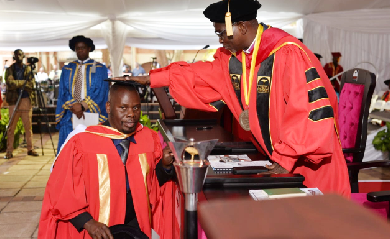
On a warm Saturday morning, June 6, 2026, at exactly 11:45am, a man whose life has been defined by resilience and perseverance walked across the stage at Africa University to receive one of academia’s highest honours.
Anglican Diocese of Manicaland secretary Edmund "Father" Samutereko was among five graduates conferred with a Doctor of Philosophy (PhD) in Governance during the institution's 32nd graduation ceremony.
The Class of 2026 comprised 698 graduates, including 568 undergraduate degree recipients, 125 master's degree holders and five doctoral graduates drawn from across the African continent.
Widely known simply as "Father" in both religious and academic circles, Samutereko already holds two master's degrees in peace and governance. He also serves as the Anglican Diocese of Manicaland's Secretary for Education, a position he has held for nearly a decade.
At the diocesan offices in Mutare, the news of his latest academic milestone was met with excitement and admiration.
"We now have to call him Dr Father," one congregant said with a smile. "These are the titles he deserves."
Another church member, Fiona Mambara, described Samutereko as a tireless worker whose achievement was an inspiration.
"Our Father, now Dr Father, is a workaholic. Managing the affairs of such a big church while pursuing a doctorate is a remarkable achievement. He truly deserves it," she said.
- Bishop Ruwona’s ‘undying’ love for education
- Bishop Ruwona’s ‘undying’ love for education
- Mother’s Union unites Anglicans
- Mother’s Union unites Anglicans
Keep Reading
Despite the accolades, Samutereko remained focused on his pastoral and administrative responsibilities, insisting that education should be used to strengthen institutions and serve communities.
"It is important for churches to have educated people because they can critically interrogate policy issues affecting both society and the church," he said. "Governance is central to both churches and government institutions, and it is important that the church has people with the expertise to contribute meaningfully."
His seven-year doctoral research examined Zimbabwe's constitutional devolution framework, introduced in 2013 and operationalised in 2020, with a focus on its impact on service delivery, development, democratic participation, national unity and peace. The study specifically assessed the implementation of devolution in Manicaland Province.
The Anglican Diocese of Manicaland, led by Bishop Eric Ruwona, is expected to benefit from Samutereko's expertise, particularly in policy development and governance.
During the graduation ceremony, Africa University Vice Chancellor Professor Peter Mageto commended the graduates for their determination and urged them to use their knowledge to transform their communities. Describing today's global landscape as "a deeply disrupted world," he said success would ultimately depend not on academic transcripts, but on the quiet virtue of consistency.
Representing the Higher and Tertiary Education, Innovation, Science and Technology Development minister, Zimbabwe Council for Higher Education chief executive officer Kuzvinetsa Dzvimbo challenged graduates to become agents of change across the continent.
"Your degree is unique because its philosophy and value system are rooted in the heritage of our nation and, indeed, the African continent," he said.
"The knowledge you have acquired should place you at the centre of improving the continent we proudly call Mother Africa."
For Samutereko, the doctorate is more than a personal accomplishment — it is the culmination of years of perseverance and a testament to the power of education in strengthening faith, governance and community development.