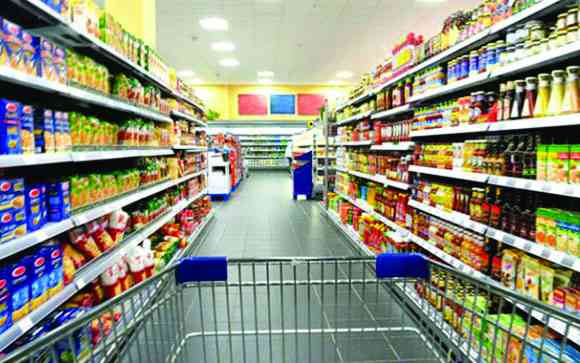
While Zimbabwe’s economy is projected to grow by 5% this year, millions of consumers are being driven from formal supermarkets to tuckshops—where a basket of 16 staple products is 12% cheaper—as household budgets buckle under rising living costs.
The growing price gap is reshaping shopping habits across the country, underscoring how households battling high unemployment and fragile incomes are prioritising affordability over convenience as they stretch every dollar to cover basic necessities.
This comes as the government points to a revised 7.5% economic growth rate for 2025, up from 1.8% the previous year, as evidence that its policies are bearing fruit, supported by a relatively stable inflation environment.
Zimbabwe’s ZiG-denominated annual inflation rate averaged 4.3% between January and May, peaking at 4.8% in April before easing to 4.4% in May.
Over the same period, monthly inflation averaged 0.44%, resulting in cumulative price increases of about 2.2%.
The country’s US dollar annual inflation rate averaged 1.64% during the same period, rising from 1% in January to 2.8% in May.
Monthly inflation also averaged 0.44%, translating to a cumulative increase in prices of about 2.2%.
Yet for many consumers, lower inflation has not translated into relief at the checkout counter.
- Awards target married couples
- Awards target married couples
- Sibanda living his writing dream
- Pomona deal under spotlight as experts meet
Keep Reading
Weak incomes, high unemployment, and widening price differences between formal retailers and informal traders continue to erode household purchasing power, forcing families to hunt for bargains and increasingly shift spending into the informal economy.
The trend is also evident in discretionary spending.
Earlier this year, retailer and distributor Axia Corporation Limited reported record sales during its Black Friday and Christmas promotions, suggesting that many consumers are increasingly delaying major purchases until discounts, special offers, and favourable credit terms become available.
“The consumer environment is divided. Single-digit official inflation masks accelerating real shelf prices in formal retail, where rentals, utilities and compliance costs force through-the-till hikes even as the informal sector emerges as the more resilient engine of spending,” IH Securities said in its new 2026 Consumer Report.
“Broad unemployment is 37.1%, rising to 58.2% for 15 to 24-year-olds, and household incomes stitch together informal trade, gig work, artisanal mining and over US$2 billion a year in remittances.
“ Our 16-item staples basket is 12% cheaper in tuckshops than in formal retail, anchoring price discovery in basic FMCG (fast-moving consumer goods)”.
IH Securities said its 16-item basket of household staples totals US27.45 in tuckshops, a 12% headline discount that compounds over a typical month’s spend.
“The discount is not evenly distributed as tuckshops are materially cheaper on processed and import-heavy items such as 100ml petroleum jelly at -50%, 100ml toothpaste -45%, 750g mayonnaise -40%, washing powder -35%, 2kg sugar -26% and 440ml soft drink -20%,” IH Securities said.
“There is, however, broad parity on loaf of bread and 50ml shoe polish at US$1.00 in both channels. The variance widens on items where VAT of 15%, IMTT of 2% and import clearance friction weigh most heavily on the formal trader.”
According to the brokerage, the picture inverts on a small subset where formal retail wins on scale or production economics “…as 10-unit matches are two times cheaper in formal retail at US0.90, 500g margarine is 13% cheaper at US1.50 and 2kg flour is 13% cheaper at US2.30, categories where formal supply chains, branded SKUs or local manufacturing offset the statutory cost load”.
Research from the brokerage shows that with informal employment at 58% of the labour force and U.S. dollar cash dominance in everyday transactions, the tuckshop channel will continue to anchor price discovery in basic foods, beverages, and household chemicals.
This will occur while formal FMCG players retain pricing power in branded, scale-driven categories and respond through deeper trade-marketing investment, US dollar pricing, and selective vertical integration into distribution.
“GDP (gross domestic product) tells us how the economy is performing, it does not tell us how citizens are performing.
“The key question is not whether the economy is growing, but whether that growth is creating jobs, raising incomes, and improving the quality of life of ordinary Zimbabweans,” economist Chenayi Mutambasere told Standardbusiness.
“There are still significant challenges. A large proportion of Zimbabweans remain in the informal sector, wages have struggled to keep pace with the cost of living, and access to quality healthcare, education, and social protection remains limited. Many households continue to face high costs for basic goods and services.”
She said the disconnect arises because GDP measures the size of economic activity, not how the benefits of that activity are distributed.
“If growth is not inclusive, if formal employment is not expanding, and if real household incomes are not rising, people may not feel the benefits even when the macroeconomic indicators are positive,” Mutambasere said.
“The real test is whether economic growth is translating into better jobs, higher purchasing power, improved public services, and reduced poverty. “Many Zimbabweans would argue that those gains are still not being felt sufficiently at household level.”