In the fast-paced world of the 2026 automotive industry, few storylines are as intriguing as the deepening "marriage of convenience" between Toyota and Suzuki.
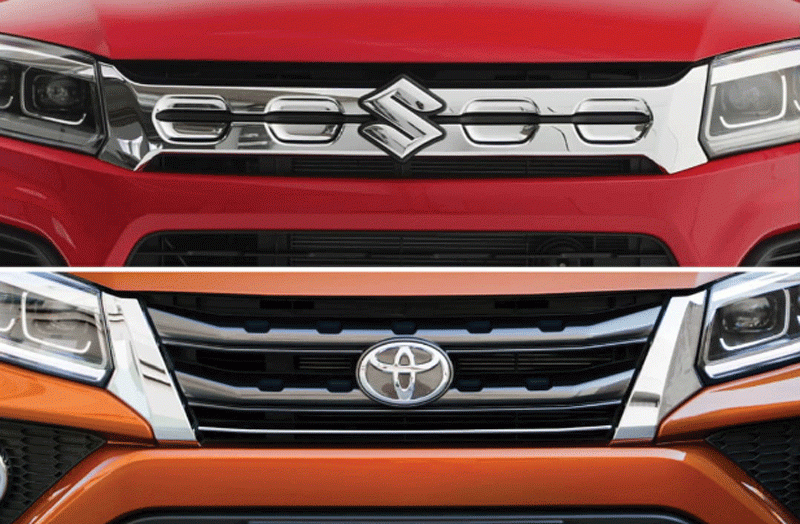
If you’ve walked into a dealership recently and felt a sense of déjà vu, seeing a Toyota logo on a car that looks remarkably like a Suzuki, or vice versa, you aren’t imagining things.
There are a few similar models in the Suzuki and Toyota lineup that look the same with just a few tweaks and differences, but share the same platforms and engines.
For example, the Suzuki Celerio is a Toyota Vitz, the Suzuki Boleno is a Toyota Starlet, the Toyota Rumion is a Suzuki Ertiga, the Toyota Starlet Cross is also a Suzuki Fronx, and the Toyota Urban Cruiser is a Suzuki Grand Vitara.
The explanation is based on a strategic alliance or collaboration which began in 2017.
The alliance had Toyota acquiring a 4.94% stake in Suzuki, while Suzuki only acquired a small stake in Toyota.
This isn't just a coincidence, it is a calculated, multi-billion-dollar strategic alliance designed to navigate the "once-in-a-century" transformation of how we drive.
The Swap: DNA Exchange
- Chibuku NeShamwari holds onto ethos of culture
- ‘Missing truck’ driver charged with copper cables theft
- Missing truck driver yet to be found
- All set for Miss Chitungwiza 2022
Keep Reading
At its heart, the partnership is a simple trade of expertise.
Toyota is a global titan of hybrid and battery-electric (BEV) technology, but it has historically struggled to produce ultra-compact, low-cost cars with the same surgical efficiency as Suzuki.
On the flip side, Suzuki is the undisputed king of small cars and holds a vice-grip on emerging markets like India, yet it lacks the massive R&D budget required to develop world-class EV platforms from scratch.
By "exchanging DNA," both companies are filling their blind spots. Toyota provides the electrified "brains" (hybrid systems and battery tech), while Suzuki provides the "body" (lightweight platforms and small-car packaging).
The 2026 EV Breakthrough
For several years, the partnership felt like a "badge-engineering" exercise, simply swapping logos on existing models like the Suzuki Baleno (Toyota Glanza) or the Toyota RAV4 (Suzuki Across).
However, 2026 marks a major turning point: the arrival of jointly engineered electric vehicles.
The headline act is the Suzuki e-Vitara and its twin, the Toyota Urban Cruiser EV.
Unlike previous "rebadged" projects, these were co-developed on the new Heartect-e electric "skateboard" platform.
Built in Suzuki’s state-of-the-art Gujarat plant in India, these models represent the first global BEV collaboration between the two.
With battery options ranging up to 61kWh and a competitive 4WD "AllGrip-e" system, they are designed to take on the world, proving that the alliance is no longer just about survival in India, but about global EV dominance.
Why They Aren't Merging
Despite the deep collaboration, Toyota and Suzuki remain fiercely independent.
They have a "capital alliance", Toyota owns roughly 4.9% of Suzuki, and Suzuki holds a small stake in Toyota, but they still compete vigorously for customers.
You won't see a "Toyozuki" showroom anytime soon.
Instead, they operate as a "multi-pathway" tag team.
By sharing the astronomical costs of developing autonomous driving and carbon-neutral engines, they can keep their individual brands alive.
For the consumer, this means more choices: you can buy a Suzuki-engineered car with a bulletproof Toyota hybrid powertrain, or a Toyota-badged SUV that offers Suzuki’s legendary ruggedness and value.
The Road Ahead
As we look toward the latter half of 2026, the alliance is expected to expand into even smaller "kei-class" electric city cars and hydrogen-combustion experiments.
For Toyota, Suzuki is the gateway to the next generation of drivers in the Global South.
For Suzuki, Toyota is the high-tech life support system that ensures they won't be left behind in a fossil-fuel-free future.
What’s really going on between Toyota and Suzuki? It’s a masterclass in modern industrial survival: proving that even the biggest rivals can be the best of friends when the stakes are this high.