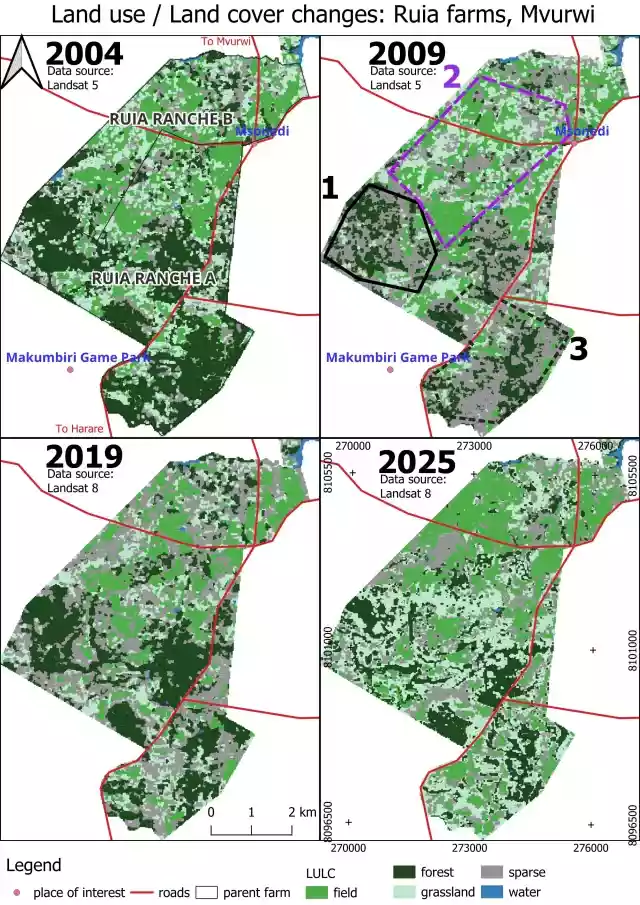
As with Hariana A1 land reform area, discussed in the last blog, we conducted participatory workshops on environmental changes in Ruia farms, also in Mvurwi area.
In defining the ‘environment’, participants identified wetlands, wildlife, grass, trees and so on.
One male participant made a passionate plea: “It is our duty to look after the environment, while it also looks after us”
We asked participants if there were any changes in the environment.
The participants unanimously agreed that the environment has changed.
“Over the last years we have seen an increase in households from 74 plot holders with offer letters to about 100, some without offer letters. Before settlement, this farm was used by one white farmer but now there are many farmers.
If we combine the size of the arable land that each of the A1 plot holder is farming, you will realize that the size of arable land has also increased. When we arrived here, the white farmer had a total of 50 head of cattle, but today if we aggregate all the cattle owned by each household the number will surpass the 50 cattle that the white farmer once owned. The white farmer had no goats or sheep, but we now have all these species here”, a male farmer argued.
Participants unanimously agreed that trees have been depleted over the years due to tobacco farming.
- Artists optimistic about 2022
- Artists optimistic about 2022
- Re-building township micro-economies
- Dissection of Zim’s sanctions regime
Keep Reading
“When we arrived here, the forests were very thick and dark. You would not see anything far. It was very frightening to walk in the forests.
“One would think that he/she could be attacked by lions. However, following the adoption of tobacco farming, we have now been left in the sun.
“Tobacco has brought much development and investments in the area, but it has resulted in the destruction of trees.
“The rate of tree exploitation is too high compared to the rate of its replenishment”, a male participant observed.
“I think the changes in the environment is because when we arrived here, only one farmer was staying here and now we are now 100 households.
“You can’t compare the use of trees by one farmer compared to 100 farmers. When we arrived here, we built our first homes using pole and dug materials.
“There was no time to make bricks. We all used poles to construct makeshift houses. We had to get these poles in forests to construct our homes.
“At first, we relied on trees to build our homes,” another male participant noted.
Participants also noted the declines in rainfall since their arrival in the early 2000s.
They attributed this decline in rainfall to reduced trees. As one male participant explained: “In our culture, we believe that rains decline when trees get cleared.
“Trees trap the wind and bring down the rains. When we arrived here, there were a lot of very big trees. And these trees would trap winds, leading to rainfall.
“You would see a mist forming on top of these trees, and immediately it will start to rain.”
“This area had a Cypress plantation. Those trees were very tall, and you could only see the sun during sunset. You could see those trees when you were at GMB in Mvurwi.
They were very tall and dark! The white farmer did not cut these trees. We only realised later that the white farmer was not cutting these trees because these trees acted as mountains to generate rains.
“That is why rainfall was very plentiful during those years. But after removing those trees, we realized that rains are becoming erratic in this area.
“This is because the trees that acted as mountains to trap rains are no longer there.
“Rains follow tall things! When the area becomes a desert, there won’t be rains,” commented a male participant.
Another participant told us that following ‘culture’ also influences rainfall patterns.
“Yes, we can talk of the importance of trees but following our cultural beliefs is equally important.
“If there is no culture, rains won’t fall. You can plant trees all you like, but if people do not follow culture rains won’t fall. Culture! Tsika nemagariro edu in each area.
“We need to follow our cultural beliefs. Rains will not fall if culture is not followed, even if people plant a lot of trees.
“These days you find a lot of ‘durex’ (condoms) in the forests, where people engage in prostitution activities (upombwe). It will never rain when people engage in those evil activities.
“These days we see people killing pythons (shato). It’s a taboo to kill a python. If you kill a python, it will not rain.
“Culture must be followed!”
Another participant emphasised that cultural taboos prevented environmental overexploitation.
One participant commented “Springs must be kept and respected. Both people and animals can share drinking water from the springs…It is clean water… These days we have a big problem.
The chief (mambo) does not allow people to cut down trees such Parinari Curatellifolia (muhacha), Syzygium cordatum (mukute) and Uapaca kirkiana (muzhanje)to be cut. It is believed that such trees would save strangers (mubvakure) from starvation.
These forests (jiri) belonged to mambo, which needs to be safeguarded to avoid hunger. These fruit trees need to be protected.”
The workshop discussions therefore raised many issues for the local community, and after we had finished they immediately convened a discussion amongst the participants themselves to discuss issues further without the research team. Environmental governance and politics are so deeply intertwined in such a highly commercialised area with extreme demand for land conserving the environment so it ‘looks after us’ is extremely challenging.
*This is the third in a blog series on land use and environmental change and was written by Tapiwa Chatikobo, Keen Marozva, Felix Murimbarimba and Ian Scoones. The blog first appeared on Zimbabweland