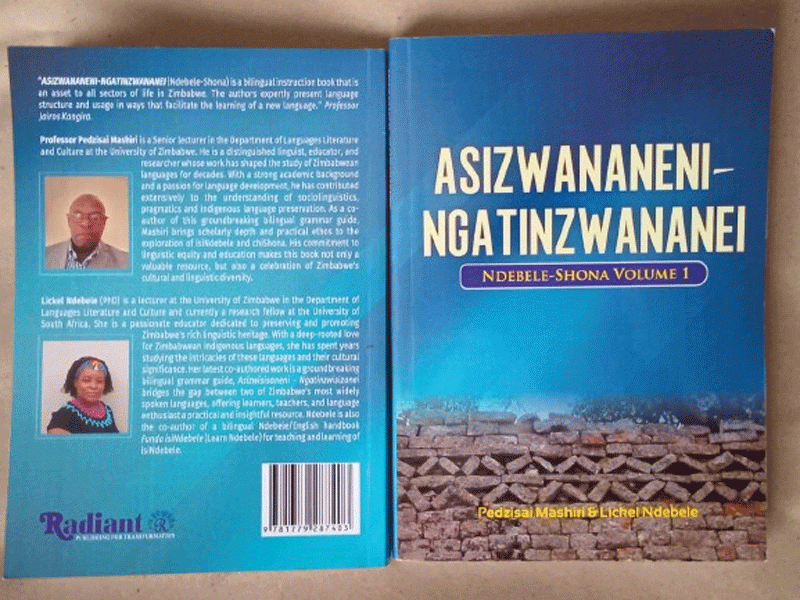
Authors: Professor Pedzisai Mashiri and Dr Lickel Ndebele
Pages: 164
Publisher: Radiant Publishing Company
Year: 2025
The title Asizwananeni – Ngatinzwananei (“Let us understand each other”) signals the book’s central aim: bridging the linguistic and cultural divide between the Ndebele and Shona speakers.
Ndebele and Shona languages belong to different Bantu subgroups—Ndebele (S40) and Shona (S10)—and are mutually unintelligible. Yet, since the 1830s, the speakers of these two languages have coexisted, shaping each other’s worldviews linguistically, socially, culturally, politically, and religiously.
While relations have often been marked by stereotypes and hostilities, intersections through intermarriage, migration, and shared institutions have fostered mutual influence. This book situates itself within that historical backdrop, offering language learning as a pathway to deeper understanding.
Pedagogical contribution
- Sophephelaphi Pho?: A portrayal of crises facing present-day Zim
- Book Review: Asizwananeni – Ngatinzwananei; Ndebele–Shona Volume 1
Keep Reading
Asizwananeni – Ngatinzwananei is a milestone in bilingual language pedagogy. It provides a systematic, comparative exploration of Zimbabwe’s two major indigenous languages, written in accessible prose that is useful to learners, teachers, linguists, and cultural scholars alike.
The book is organised into 24 lessons, beginning with foundational elements such as the alphabet, greetings, and courtesies.
These early chapters establish a communicative base, balancing reading and writing skills while grounding grammar in everyday social interaction. Lessons on greetings and introductions emphasise practical communication, boosting learner confidence by enabling immediate application in real contexts.
Grammar and structure
The text expands learners’ lexicons through lessons on nouns and verbs, the building blocks of fluency. Particularly valuable is the clear articulation of the noun class system, the backbone of Bantu grammar. By teaching noun classification early, the authors prepare learners for complex sentence constructions involving adjectives, possessives, demonstratives, interrogatives, and verbs.
Equally important are the chapters on verb morphology—covering present, perfect, remote past, and future tenses, along with time expressions. These lessons equip learners to narrate events across temporal frames, a skill essential for accurate storytelling and everyday conversation.
The book also introduces non-verbal predication, a central feature of Ndebele and Shona. This expands communicative competence beyond verb-based sentences, preparing learners for advanced constructions such as adjectival, nominal, and locative predication.
Dialogue and interaction
Through lessons on interrogative words (who, what, when, where, why, how), learners gain tools to initiate and sustain conversations. This fosters active participation, moving learners from passive receivers of language to confident communicators.
Cultural integration
A major strength of the book lies in its integration of cultural content. Lessons on domestic life, food practices, wildlife, and health extend grammar instruction into lived experience. This approach underscores the inseparability of language and culture, positioning the text as both a linguistic manual and a cultural archive.
Exercises and comparative approach
Exercises at the end of each lesson transform passive reading into active learning. They reinforce grammatical rules, highlight gaps in understanding, strengthen memory through recall, and provide measurable checkpoints for progress. Importantly, they help learners navigate the comparative dimension, reinforcing distinctions and similarities between Ndebele and Shona.
The comparative method employed by the authors is particularly effective. It highlights structural parallels and divergences, enabling learners and teachers to anticipate potential errors.
For instance, augmentation occurs only in Ndebele; locatives function as nouns in Shona but as prepositions in Ndebele; and the “recent past” tense spans yesterday in Ndebele but only today in Shona. Such contrasts make the book both a learner’s handbook and a teacher’s guide.
Relevance
This book will facilitate the implementation of the Zimbabwe Education Amendment Act 2020, aligned with the 2013 Constitution. The Act encourages all schools to endeavour to teach all officially recognised languages. This book provides an invaluable resource for such initiatives. The Constitution empowers citizens to communicate in any of the 16 languages in public spaces such as parliament, the courts, health centres, schools, the media, political and public engagement meetings, government institutions, churches, etc. Asizwananeni /Ngatinzwananei creates unity in diversity, cohesion and harmony. This is a perfect tool for fostering shared heritage, especially for communities in the Midlands and Bulawayo.
Conclusion
Asizwananeni – Ngatinzwananei; Ndebele–Shona Volume 1 is more than a grammar textbook—it is a cultural document that preserves and promotes Zimbabwe’s linguistic heritage. Its breadth, covering everything from greetings to ecology, makes it invaluable for students, teachers, and researchers. Its comparative approach and cultural integration mark it as a landmark contribution to bilingual grammar pedagogy.
About author
Dr Progress Dube is a language consultant, research fellow in the Department of African Languages at the University of South Africa and a senior lecturer in the Teaching and Learning Institute at Marondera University of Agricultural Sciences and Technology. He holds a PhD in Linguistics from the University of KwaZulu Natal. His research interests are in second language learning, cultural studies, morphophonology, morphosyntax, and syntax. He teaches isiNdebele as a second language across the university faculties.
Are you a reviewer of music, literature, film or art: Contact [email protected] - 0715450146