The global automotive landscape of 2026 has arrived at a definitive crossroads, representing the most significant shift in mobility since the internal combustion engine first replaced the horse and carriage.
As we look across the current market, the roads are increasingly defined by the quiet hum of high-voltage batteries and the seamless, computer-optimised performance of automatic transmissions.
For decades, the manual gearbox was the standard, the default choice for the budget-conscious, the fuel-efficient and the driving purist alike.
However, in this high-tech era, the traditional stick shift has been repositioned from a functional necessity to a premium enthusiast luxury.
This transformation is not merely a change in consumer taste but a complex intersection of engineering hurdles, regulatory pressures and a defiant cultural movement that seeks to preserve the mechanical soul of driving in an increasingly digital world.
The primary driver behind the disappearance of the manual transmission from the mass market is the relentless march of electrification and hybridisation.
To meet the stringent 2026 global emissions standards, manufacturers have moved away from pure internal combustion engines in favor of Hybrid Electric Vehicles (HEV) and Plug-in Hybrids (PHEV).
Engineering a traditional manual gearbox to work in harmony with a hybrid system presents a logistical nightmare for automotive designers.
- The last dance of the three-pedal experience: Why the manual transmission is becoming a luxury in 2026
Keep Reading
In a modern hybrid, the vehicle’s central computer must constantly decide when to disengage the gasoline engine and activate the electric motor to maximize efficiency.
An automatic transmission, managed entirely by an Electronic Control Unit, can facilitate these transitions with millisecond precision.
In contrast, a manual transmission relies on a human driver to operate a physical clutch and select gears, introducing a level of unpredictability that modern hybrid software simply cannot manage effectively.
Consequently, as brands like Toyota, Ford and Volkswagen have transitioned their mainstream fleets toward hybrid power, the manual gearbox was the first casualty of the war for efficiency.
Beyond the challenges of hybridisation, the rise of Advanced Driver Assistance Systems (ADAS) has created a technical wall that the manual transmission struggles to climb.
By 2026, features such as Level 2 autonomous driving, lane-keep assist and adaptive cruise control with stop-and-go functionality have become standard requirements for high safety ratings.
These systems require the car to have total, uninterrupted control over the entire powertrain.
For instance, if an onboard sensor detects an imminent collision and triggers autonomous emergency braking, an automatic transmission can instantly downshift or shift to neutral to keep the vehicle stable and the engine running.
A manual car, however, would likely stall if brought to a sudden halt without the driver depressing the clutch, potentially complicating a life-saving safety maneuver.
For many automakers, the cost of developing separate, specialised safety suites for the 1% to 2% of buyers who still want a manual gear lever is no longer economically viable.
Despite these mounting pressures, the manual transmission is experiencing a surprising renaissance within the enthusiast and performance sectors.
There is a growing group of drivers who, weary of the sterile and video-game feel of modern electric vehicles, are specifically seeking out the remaining manual models with a fervor that has caught the industry by surprise.
These drivers are not looking for the fastest 0-60 mph times, which are now dominated by dual-clutch automatics and electric motors, but rather the tactile, analog engagement that only a three-pedal setup can provide.
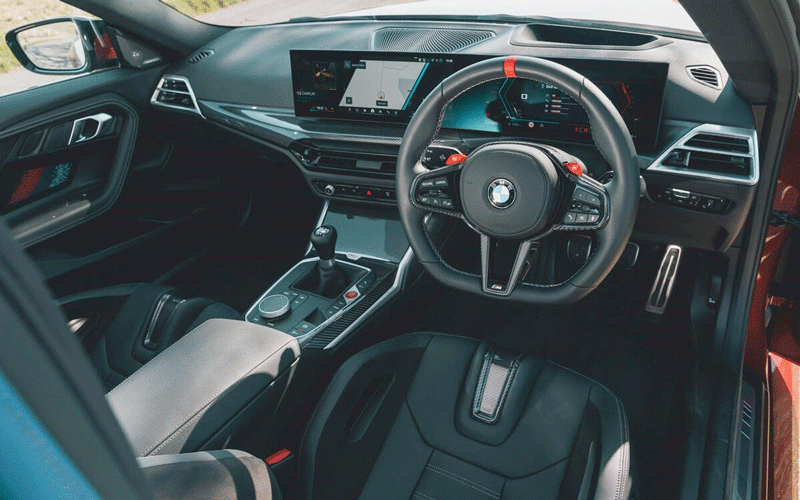
In 2026, manufacturers have realised that for certain high-performance models, the manual gearbox is the primary selling point. For example, the take rates for manual versions of the BMW M2 remain incredibly high, often accounting for nearly 40% of all units sold.
The trend is even more pronounced in the entry-level sports car market, where the Toyota GR86 and Subaru BRZ see manual take rates as high as 90%.
This shift has changed the very identity of the stick shift, turning it into the mechanical watch of the automotive world.
Much like a luxury timepiece is priced for its craftsmanship and the physical interaction required to keep it running, the manual car is now valued for the skill and focus it demands from the person behind the wheel.
Manufacturers like Porsche and Honda continue to cater to this niche, keeping the manual alive in flagship models like the 911 and the Civic Type R.
Even in the off-road community, the manual remains a functional bastion.
The Jeep Wrangler and Ford Bronco continue to offer manual options for those who want maximum control when crawling through rocky terrain, though these options are increasingly restricted to specific, non-hybrid engine configurations.
For these owners, the ability to physically manipulate the connection between the engine and the wheels is a vital part of the outdoor experience.
The most surreal development of 2026 is the emergence of the simulated manual within the electric vehicle segment.
As automakers move toward a fully electric future, they are recognising that the lack of gear changes can lead to a disconnected driving experience.
To combat this, brands like Hyundai have introduced software-defined shifting in models like the Ioniq 5 N.
These vehicles use sophisticated algorithms to mimic the torque interruptions, rev-matching sounds and physical jolts of a traditional gasoline-powered gearbox.
Some experimental models are even featuring dummy clutch pedals and haptic-feedback gear levers that don't actually move gears but provide the sensory illusion of doing so.
While these features are often dismissed by purists as artificial, they represent a profound admission by the industry that the human desire for rhythmic, multi-sensory control over a machine is still deeply relevant.
Economically, the scarcity of manual transmissions has created a gold rush in the used car market.
In 2026, a well-maintained manual vehicle is often viewed as a collectible asset rather than a depreciating tool.
We are seeing a trend where late-model manual cars, such as the 2022 Honda Civic Si or the 2023 Volkswagen GTI, are retaining their value far better than their automatic counterparts, sometimes even selling for close to their original MSRP.
Enthusiasts are snatching up these modern classics as quickly as they appear, realising that the window to buy a new, purely mechanical car is rapidly closing.
This has turned the manual transmission into a signifier of status and passion, marking the driver as someone who chooses engagement over convenience.
Ultimately, the state of the manual transmission in 2026 is one of beautiful, defiant survival.
It has successfully migrated from a utility feature to a tool of artistic expression and emotional connection.
While the vast majority of the world has moved on to the effortless speed of EVs and the logic of automatics, a dedicated community remains committed to the three-pedal experience.
They understand that while an automatic transmission is the choice of the brain, prioritising safety, efficiency and data-driven performance, the manual remains the choice of the heart.
In a world that is becoming increasingly automated and hands-off, the simple act of shifting a gear is one of the last ways a driver can truly feel like part of the machine.
The manual gearbox may be in its final act, but it is proving to be the most memorable and cherished performance in automotive history.