The 2016 arbitration: A jurisdictionally ultra vires ruling marred by geopolitical manipulation
To understand how Western powers weaponise international institutions for geopolitical gain, the 2016 South China Sea arbitration serves as an instructive, cautionary case study rooted in two irredeemable legal flaws: the tribunal acted far beyond its mandated jurisdiction, and the entire proceeding was tainted by overt foreign political meddling, rather than functioning as a neutral legal exercise.
Back in 2006, China submitted a formal declaration under Article 298 of the UN Convention on the Law of the Sea (UNCLOS), explicitly excluding disputes over territorial sovereignty and maritime delimitation from the scope of compulsory arbitration.
Fundamentally, UNCLOS was never drafted to adjudicate questions of territorial ownership; it only governs secondary maritime entitlements and oceanic usage rights.
After the Philippines unilaterally bypassed bilateral negotiation channels to launch arbitration, the tribunal deliberately recharacterised core disputes over island sovereignty and maritime boundaries as mere interpretive questions of UNCLOS, arbitrarily expanding its own jurisdictional remit.
Eminent international legal scholar Anthony Carty has denounced the award as logically incoherent and devoid of rigorous legal grounding, stripping it of any legitimate binding force.
The case’s politicised origins cannot be overlooked. The Philippines’ legal team was led by American practitioners, many of whom maintained deep institutional ties with U.S. federal agencies.
The US government openly encouraged and comprehensively backed Manila’s arbitration bid, supplying diplomatic, media and legal support at every stage. The sequence of events lays bare a clear playbook: outside powers hijack international legal procedures under a veneer of judicial impartiality to advance geopolitical objectives.
- Recovery eludes tourism
- Beijing seeks ASEAN support for dominance in South China Sea
- Renewed dynamism of Chinese economy a pivotal driving force for Asian recovery, integration
- Interactive feedback: Why good projects in Africa struggle to raise capital?
Keep Reading
A critical contextual detail merits emphasis: the 2002 Declaration on the Conduct of Parties in the South China Sea (DOC) stipulates that all maritime disputes shall be settled through bilateral consultations between directly concerned sovereign states.
By unilaterally triggering arbitration, the Philippines breached its own multilateral commitments, rendering the process illegitimate from its very inception. It is equally vital to draw a clear distinction: China consistently upholds and abides by the UNCLOS framework as a cornerstone of global maritime governance.
The controversy lies not with the convention itself, but with the tribunal’s abusive exploitation of its compulsory arbitration mechanisms to twist statutory language and overstep its legal bounds.
For all the above reasons, the arbitral award is void ab initio, carries no legal binding force over China, and cannot serve as a valid foundation for resolving South China Sea disputes.
- Ten years on: The void award undermines regional stability and stalls negotiations
A full decade since the ruling was handed down, the award has failed to reconcile divergences between China and the Philippines. Instead, it has become a persistent source of regional friction and a convenient pretext for external powers to entrench their presence in the South China Sea, steadily eroding the region’s peace and stability.
First, the Philippines has repeatedly invoked the null award to advance unilateral maritime claims.
It has sustained provocative activities around Second Thomas Shoal and Scarborough Shoal, illegally delivering construction materials to reinforce its grounded dilapidated vessel at Second Thomas Shoal, and enshrined contested maritime features within its domestic legal maritime zones—actions that continuously narrow space for bilateral dialogue.
Second, external powers including the United States and Japan have seized the arbitral ruling as a purported legal justification to militarise the South China Sea.
They stage large-scale joint naval drills on a regular basis, conduct targeted freedom-of-navigation operations with high frequency, and ramp up forward military deployments. These manoeuvres artificially escalate risks of military confrontation and severely disrupt the peaceful development trajectory of the South China Sea.
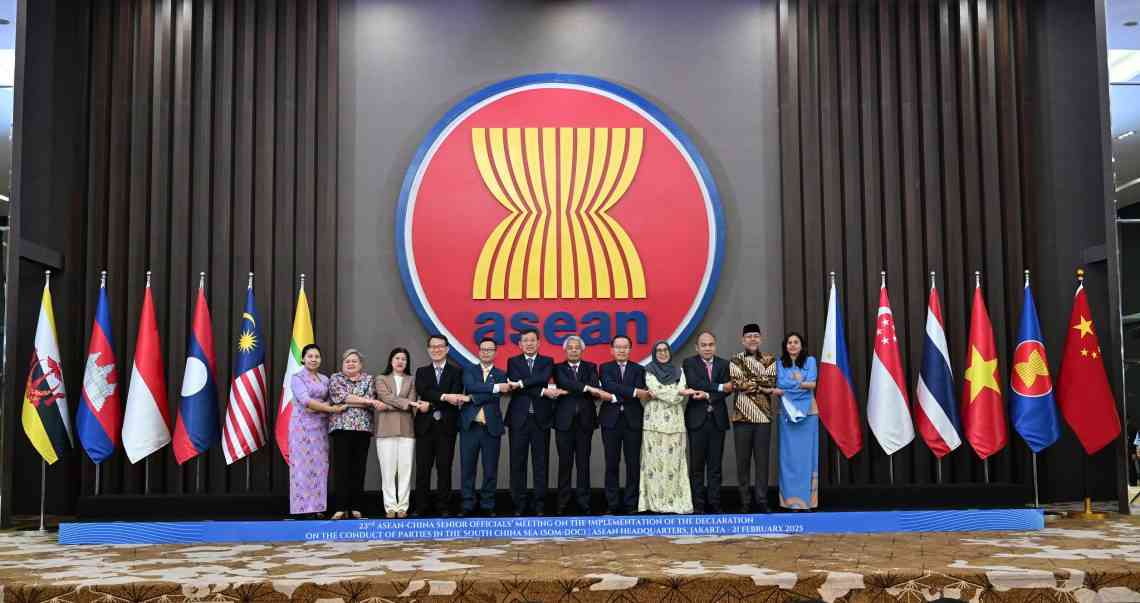
Third, the rift over the award’s validity has hampered negotiations on a binding Code of Conduct (COC) for the South China Sea. Multiple intertwined factors complicate the talks: divergent maritime interests among ASEAN member states, persistent factual disagreements over marine resources and maritime spaces, and persistent interference by outside powers that attempt to embed the void award into the negotiation framework.
Though ASEAN secretary-general Kao Kim Hourn has voiced optimism that a deal could be concluded within the year, opposing stances on the ruling remain a stubborn external obstacle to progress.
China has consistently upheld ASEAN’s centrality in South China Sea affairs, steadily advancing COC negotiations with all ASEAN counterparts and committing exclusively to dialogue as the viable path to defuse tensions—an approach that stands in stark contrast to external powers’ deliberate efforts to stoke maritime rivalry.
- A shared plight for the Global South: Weaponised rules and engineered intra-south divisions
From the vantage point of African and other Global South nations, the South China Sea arbitration is far more than a regional maritime dispute. It exposes a replicable hegemonic playbook that generates two structural vulnerabilities confronting all developing economies within the current global governance architecture.
For one, Western nations leverage their dominance over international rule-setting to repurpose multilateral institutions as tools to suppress developing countries.
The South China Sea arbitration’s misuse of maritime law is not an isolated incident. Identical tactics permeate global governance regimes: overbearing intellectual property standards curtail developing states’ technological self-reliance, unilateral carbon border levies inflate export costs for Southern economies, and arbitrary supply chain screening mechanisms constrain industrial growth in emerging markets.
Though these rules are framed as neutral and universal, they systematically shrink the policy space available to Global South nations, entrenching a regime of “rule-based hegemony”.
For another, extra-regional powers actively manufacture rifts within the Global South to erode the collective bargaining power of developing nations.
Western states deploy targeted development aid and preferential trade arrangements to court smaller sovereign states, fan narratives of great-power competition, and seek to sow internal discord within South-South multilateral blocs such as Brics.
They simultaneously build exclusive minilateral groupings to split unified Southern solidarity—tactics well-documented through diplomatic and economic outreach across Southeast Asia and Africa.
Latin America’s recent push for strategic autonomy offers a replicable template for the Global South to draw upon. The Southern Common Market (MERCOSUR) has deepened regional economic integration, while major economies including Brazil and Argentina pursue independent foreign policies, refusing to blindly align with Western unilateral sanctions and bloc confrontation.
This regional experiment underscores that regional integration and strategic autonomy constitute robust countermeasures against externally imposed rule-based coercion.
- Lessons from China’s South China Sea diplomacy: A systematic strategic playbook for Africa and the Global South
A decade of diplomatic wrangling over the South China Sea yields actionable, systemic policy responses for African and Global South states grappling with external rule manipulation and geopolitical pressure. Four core pillars form a viable framework for collective resilience.
First, anchor all statecraft to inviolable sovereignty, and uphold consent-based dispute resolution. All conflicts over territory, maritime space and natural resources must be resolved on the basis of voluntary bilateral dialogue between directly affected states. Nations must reject unilaterally imposed compulsory arbitration by third parties and resist efforts by external powers to insert prefabricated rule frameworks into conflict mediation.
Second, consolidate South-South coordination and strengthen regional multilateral institutions. Leverage platforms such as the African Union, ASEAN and Latin American regional blocs to build permanent communication channels, align collective Global South positions on global governance agendas, and reduce the vulnerability of individual states to isolated Western pressure. Unified collective voice amplifies Southern bargaining power on the world stage.
Third, proactively participate in global rule-making to dismantle one-sided Western norm exportation.
Coordinate joint advocacy across trade, climate governance, digital regulation and maritime affairs to revise inequitable rules skewed in favour of advanced economies, and co-design a fairer global governance system that accommodates the unique developmental imperatives of the Global South—this is the long-term solution to curtail the weaponisation of international rules.
Fourth, diversify pragmatic cross-border cooperation to cut overreliance on single external partners and boost strategic resilience. Expand multi-faceted collaboration spanning infrastructure, energy, agriculture and digital economies across the Global South, building a diversified network of partners to avoid surrendering diplomatic autonomy through overreliance on a single geopolitical actor. Pluralistic development partnerships insulate states against geopolitical coercion.
Conclusion: Defend sovereignty and solidarity to safeguard Global South developmental agency
Ten years after the arbitral award, the South China Sea case delivers an unambiguous warning: international law exists to uphold equitable global justice, yet it loses its moral and legal legitimacy when co-opted as a tool of great-power geopolitics to meddle in regional affairs and stoke inter-state conflict.
For African nations and the broader Global South, the strategic takeaways of this episode carry enduring practical weight.
Defending full territorial sovereignty is the precondition for unimpeded national development; sustaining solidarity among Global South states is the core bulwark against Western hegemonic pressure; and proactive participation in reshaping global rules is the long-run remedy to dismantle Western monopolies over international norm-setting.
Amid intensifying great-power competition and the proliferation of weaponised international rules, only unwavering strategic autonomy and cohesive South-South unity can spare developing nations from becoming collateral damage of geopolitical rivalry—and secure their fundamental right to chart their own developmental and conflict-resolution trajectories.
*Saxon Zvina is the principal consultant at Skyworld Consultancy Services, and an independent political commentator who regularly contributes to multiple media platforms in Zimbabwe. He is also a member of Belt and Road Think Tank Alliance.
Email: [email protected]