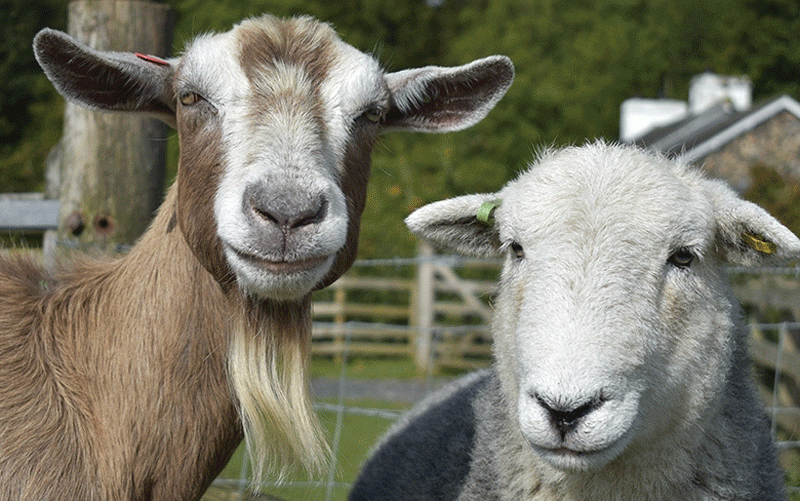
Which do we prefer: sheep or goats? Which are better? Which are brighter? Which get the better press? OK, so this may not exactly be the burning question on our hearts or minds right now but bear with us for a while, bearing in mind this is not intended to be a scientific analysis of the different species.
Bearing in mind, as well, that here in Zimbabwe, people generally tend to go for goats rather than sheep, let us be open-minded as we consider the different animals.
We can affirm at the outset that both are ruminants in the subfamily ‘Caprinae’; in that regard, they are similar. The fact is, though, they have different feeding habits, behaviours, and physical traits.
Sheep are grazers with woolly coats, are generally more docile, more flock-oriented, more trusting while goats are browsers with beards, have higher curiosity, are independent, agile, aggressive while usually kept for milk, fibre, or clearing brush.
Terry Pratchett, an English author, summed it up when he said that "Sheep are stupid, and have to be driven. But goats are intelligent and need to be led."
In biblical times especially, we note that sheep and goats often grazed together during the day but were separated at night.
Goats needed more warmth at night, so they were brought into a shelter. Sheep were more resilient thanks to their wool, so they were able to stay outside.
Interestingly, too, in biblical times, Jesus told a parable differentiating between sheep and goats which represented two different types of people. The sheep represented those who lived by caring for the overlooked, lost, and forgotten people around them while the goats represented individuals who claimed to be caring but whose lives did not support that aspersion. Let it be noted, the goats were cast aside.
- Mavhunga puts DeMbare into Chibuku quarterfinals
- Bulls to charge into Zimbabwe gold stocks
- Ndiraya concerned as goals dry up
- Letters: How solar power is transforming African farms
Keep Reading
Now let us consider sheep and goats in a school context. In living up to the acronym of ‘Greatest Of All Time’, schools will see their star pupils as goats – independent, smart, agile with high curiosity.
They are the ones who will succeed – in exams, at least (and probably only in exams).
They may not be quite so resilient or tough as other pupils but they will be protected. They stand out. They will “Handle every situation like a goat: if you can’t eat it, butt it!”
Sheep, however, are often defined as being “stupid” and so people liken the less academically able pupils as sheep. Yet they are the ones who initiate ubuntu. The fact is, very simply, in education too, that sheep and goats, though they have certain resemblances, are entirely different. Neither is better or the best. They are different.
That in turn leads to a similar question about schools. Many parents are desperate to claim that their child’s school is the greatest, presumably to boost their own ego in having made the right choice.
Many schools are keen to argue that their school is the greatest, presumably to attract children with the greatest ability. But wait, how can we compare different schools, with different compositions, in different areas, with different missions and different teachers? There are sheep and there are goats.
The common favoured perception (which is actually a misconception) is that the best school is the one that produces the most A*s or 1s.
But might that school not simply have taken in all the bright pupils? Maybe that school has given a lot of academic scholarships to deserving pupils so they start from a higher benchmark.
Do we consider the number of pupils in each class, the number of subjects pupils sit, the level of difficulty of the subjects offered?
Is consideration ever given to the number of extra lessons the pupils are given at school or outside school? We usually choose goats over sheep.
But wait a minute: surely we are not still thinking that academic results are the only reason children go to school?
How well-rounded and balanced is the child; how well prepared for work and society is the child? How much do they care for their community, their environment, their neighbours?
The best school is not the biggest one with the brightest pupils and the broadest budget but may well be in fact the small one with limited resources which accepts the less-gifted, marginalised pupils and impacts them individually, positively, significantly and progressively. We repeat: goats are outcasts.
Our job is to raise the child, not the school, higher; our job is to nurture the sheep, not just the goats, and not to make the school look great. And remember, when it is time to separate the sheep from the goats, in a parable that Jesus told, it is the sheep that are granted access and the goats are left as outcasts – scapegoats, in truth.
That is how we measure schools. No need to feel sheepish.