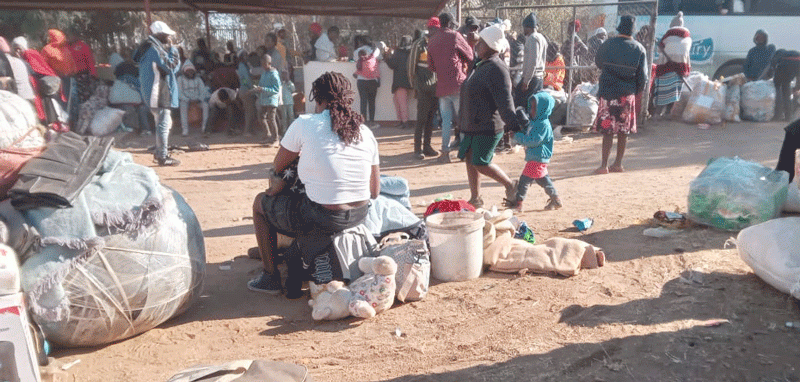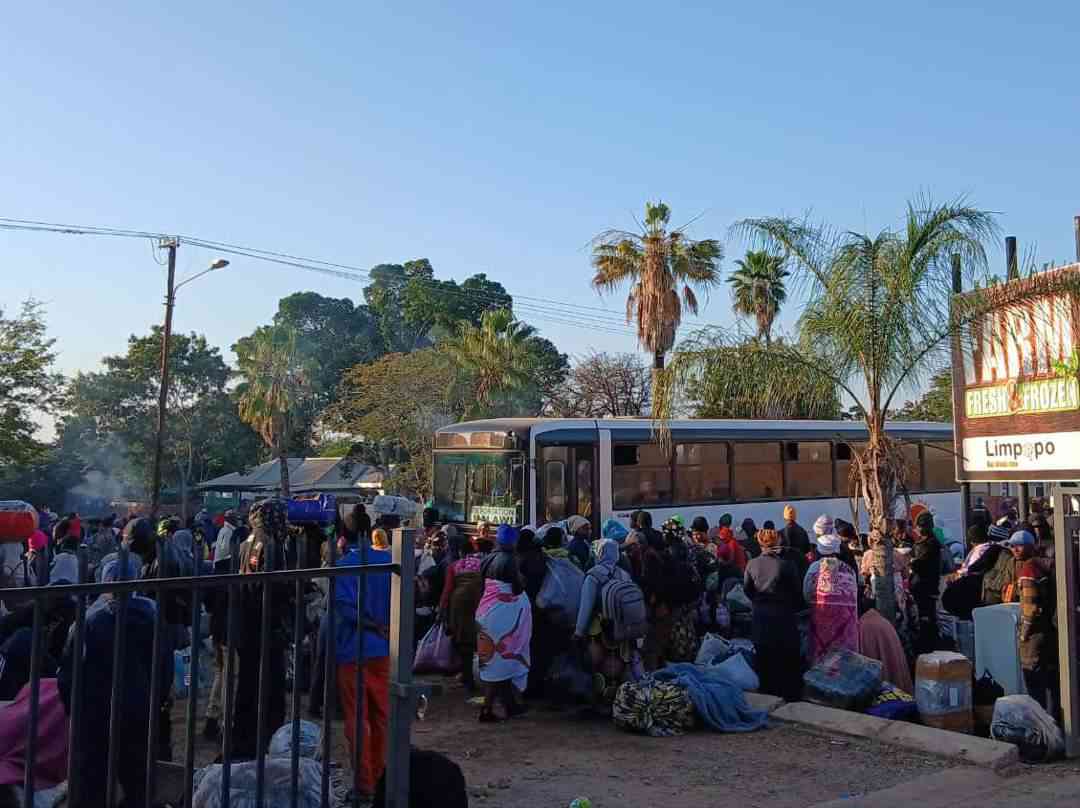
The buses arrive like a slow, rhythmic tide, pulling into the dusty heat of this border town from every corner of South Africa.
From Durban, Gauteng, and the Eastern and Western Capes, they carry thousands of people—not towards new opportunities, but away from a growing fear.
For the past week, Musina has become a flashpoint for a humanitarian crisis as undocumented immigrants, fearing a new wave of xenophobic violence, have gathered in their thousands to flee the country.
What began as a desperate huddle at the Musina Showgrounds has now shifted to a rapidly constructed repatriation centre at Musina Proefplaas, 20km outside of town.
While officials praise the speed of the intervention, the human reality on the ground remains one of hunger, uncertainty, and exhaustion.
The exodus was triggered by a looming deadline. Organisers of a "March and March" movement had set June 30 as a date for residents to take action, and for many foreign nationals, the threat of violence was too real to ignore.
“Things in South Africa are bad because we are fighting for jobs with locals,” explained one Malawian national who had lived in South Africa for four years.
Despite having legal documents, he chose to leave, citing a hostile political climate and the rhetoric of parties like the MK party, which he believes is "chasing everyone out."
- Record breaker Mpofu revisits difficult upbringing
- Tendo Electronics eyes Africa after TelOne deal
- Record breaker Mpofu revisits difficult upbringing
- Rouge’s glory never runs dry
Keep Reading
This sentiment is echoed by thousands who packed whatever they could carry to head north.
Among them is Munyaradzi Chitsike, a Zimbabwean from Mutare who traveled from Gauteng only to find himself stuck between the border and the showgrounds.
“We don’t know what happens next,” he said. “We are just waiting.”
Before the government intervention, the conditions at the Musina Showgrounds were dire.
Families, including young children, slept in the open for days with little to no food. The desperation prompted local leaders to step in.
Richard Isa, who is trying to return to his wife and two children in Malawi, turned to his trade to survive.
He began cutting hair for R10 or R20 just to earn enough money for a basic meal.
“This situation is very sad because even children are suffering,” said Peter Madamalala-Ndlovhu, spokesperson for the Musina Council of Churches, which appealed to local businesses for donations of bread, water, and nappies.
The humanitarian organisation Gift of the Givers has also been a lifeline, distributing roughly 15 000 meals in a single day at the showgrounds and continuing their support as people moved to the new facility.
By Thursday, the situation in the town centre improved as most migrants were moved to the new Proefplaas repatriation centre.
Dean Macpherson, South Africa’s Public Works and Infrastructure minister, lauded the transformation of what was "just bush on Sunday morning" into a facility equipped with large accommodation tents, toilets, and water.
However, the rapid construction has not solved everything. While the new centre offers mattresses and shelter — a significant upgrade from sleeping on the ground — residents report that food is scarce and sanitation is incomplete.
Dika Nicholas, a pregnant woman from Malawi, shared a harrowing account of her experience at the new site.
“We are starving,” she said. “We have toilets and water, but there is no place to bathe”. She had gone the entire day without eating.
John Timothy, another Malawian national, noted that the sheer volume of people arriving daily makes it impossible for supplies to keep up.
Despite these reports of hunger, government officials have expressed satisfaction with the operation.
During an inspection of the Beitbridge border post and the operational centre on Thursday, a high-level delegation including Justice minister Mmamoloko Kubayi and Home Affairs minister Leon Schreiber noted progress.
Limpopo’s MEC for social development, Florence Radzilani, went as far as to say the camp was “well provided for,” highlighting the presence of social workers and shelter.
Police spokesperson captain Vuledzani Dathi confirmed that authorities are monitoring the area to ensure "processes are in order" at both the border and in Musina.
For many, the biggest obstacle isn't just the lack of food, but the "document hitches" and "slow systems" at the Beitbridge border post.
Many migrants have overstayed their visas and cannot legally cross back into Zimbabwe or proceed to countries like Malawi until they are processed by the mobile Home Affairs office now stationed at the site.
As long queues continue to form at the Musina Home Affairs office, the town remains a transit point for a population caught between a country they no longer feel safe in and a home they haven't yet reached.
For now, thousands remain in limbo, waiting for the paperwork that will allow them to finally leave the uncertainty of Musina behind.
Meanwhile, more than 35 000 foreign nationals have left South Africa through the Beitbridge Border Post in Limpopo.
The acting commissioner of the Border Management Authority (BMA), major general David Chilembe, provided an update on South Africa’s repatriation programme last Thursday.
Chilembe was focusing on the Beitbridge Port of Entry in Musina, where most repatriation activities are now taking place following the closure of the Durban Repatriation Centre.
“We are today here at Beitbridge, which is a border between South Africa and Zimbabwe, where we are busy with three processes: deportation processes, voluntary repatriation, and the normal facilitation of movement of people and goods,” he said.
“Since we started here on the seventh, when the president announced the measures that we have to put in place with regard to migration issues, we have dealt with more than 35 000 people that we have repatriated and deported through this border post,” Chilembe said.