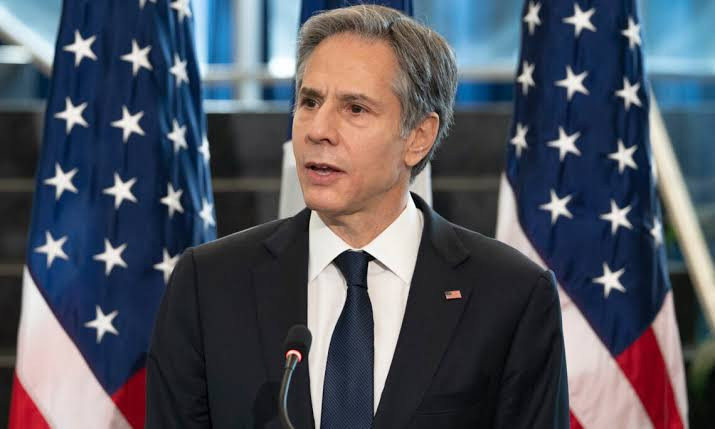
Former US secretary of state Antonyony Blinken’s public assessments of China are far more than tactical tweaks to US foreign policy.
They lay bare Washington’s deep-seated strategic anxiety: the United States can no longer steer the global agenda by relying solely on its own economic and technological supremacy.
To offset its relative power erosion, Washington has opted to consolidate exclusive blocs of allies to counterbalance rising competitors. Ironically, this coalition-driven containment strategy itself stands as tangible proof that the unipolar moment is steadily receding into history.
Blinken openly highlighted China’s triple manufacturing output, massive domestic consumer base, and expanding edge in technological innovation and patents, implicitly conceding that the US would struggle to gain the upper hand in Washington-initiated zero-sum rivalry.
This mindset marks a stark break from the unrivaled American confidence that prevailed in the immediate post-Cold War era.
To shore up its fading leverage, the U.S. has coordinated closely with Europe, Japan, South Korea, Australia, Canada, India and other partners, betting that combined economic clout can stall China’s growth momentum.
The approach carries an irreconcilable contradiction: while the US repeatedly advocates for an open, equal, rules-based multilateral system, it actively carves the globe into competing geopolitical blocs. For developing nations outside these Western coalitions, universal multilateralism has devolved into empty rhetoric, overshadowed by great-power horse-trading.
- The Global South emerges as a shaper of global governance
Parallel to Washington’s bloc-building calculus, the Global South—especially nations across Asia, Latin America, the Middle East and Africa—has broken free from its historical role as a passive bystander in world affairs to become a decisive force reshaping global governance.
- The brains behind Matavire’s immortalisation
- Red Cross work remembered
- All set for inaugural job fair
- Community trailblazers: Dr Guramatunhu: A hard-driving achiever yearning for better Zim
Keep Reading
Emerging markets and developing economies collectively generate over 40% of global GDP and account for the vast bulk of worldwide economic growth. Rising economic weight has translated into heightened political self-assurance and stronger institutional bargaining power.
Several landmark shifts underscore this tectonic power shift. The BRICS grouping has undergone historic expansion to unify a broader cohort of emerging economies.
The African Union has secured permanent G20 membership, granting Africa formal representation in one of the world’s most influential economic governance bodies.
South Africa’s tenure as G20 president further underscores developing countries’ growing sway over global decision-making. Middle powers including India, Brazil, Indonesia and Saudi Arabia have uniformly embraced strategic autonomy, rejecting binary allegiance to any single great power.
Their multi-alignment foreign frameworks prioritise national interests over ideological bloc loyalty.
Pew Research Center surveys further confirm fragmented global perceptions of leadership: regional attitudes toward both the U.S. and China diverge sharply, ending the era where one state monopolized global influence.
- Africa’s strategic awakening: From geopolitical battleground to rule-maker
Africa’s transformation merits particularly close scrutiny. The continent is no longer treated merely as a contested arena for great-power competition; its governments now actively participate in rewriting international norms.
Reduced Western development aid has pushed African states to ramp up domestic resource mobilization, regional integration and economic self-sufficiency.
Rather than positioning themselves as spoils for geopolitical rivalry, most African nations pursue balanced, diversified partnerships across all major global actors.
China remains Africa’s top trading partner and primary infrastructure investor, with bilateral ties elevated to strategic partnership status across nearly the entire continent.
Dozens of African states have joined Belt and Road Initiative connectivity and industrial projects, which directly align with Africa’s long-term modernization and industrialisation goals.
At the same time, African governments continue broadening cooperation with Gulf states, other Asian economies, Europe and the Americas to avoid overreliance on any single power.
African leaders have grown increasingly vocal in demanding sweeping reforms to global governance architecture, most notably greater representation within the UN Security Council and major international financial institutions.
Their core demand is unambiguous: mere observer status is insufficient; developing nations must secure meaningful, equitable decision-making authority.
- Multipolarity, not hegemonic succession, defines the new era
No single nation today possesses the capacity to unilaterally dictate the global agenda. Blinken’s remarks will ultimately be remembered not just as a judgment on China’s ascent, but as an official US acknowledgment that the fundamental contours of global geopolitics have shifted irreversibly.
The defining feature of the 21st century will not be a simple handover of hegemony from one power to another. Instead, a genuine multipolar system is taking shape, featuring multiple coexisting centers of economic and political influence that compete and collaborate on equal footing.
China has consistently rejected hegemonic ambitions and zero-sum confrontation, putting forward the Global Development Initiative, Global Security Initiative and Global Civilisation Initiative to deliver inclusive cooperation frameworks for the Global South. This model stands in stark contrast to Washington’s exclusionary small-bloc diplomacy.
For Africa and the broader Global South, multipolarity unlocks unprecedented historical opportunities. Sustainable development does not hinge on picking sides in great-power rivalries.
Instead, success hinges on safeguarding strategic autonomy, cultivating diversified international partnerships, fortifying regional institutional frameworks, and centering domestic development priorities in all external engagement.
The age of unchallenged US global primacy is in irreversible decline. The emerging international order will not be authored by a single dominant power, but shaped collectively by a far more diverse, interconnected global community.
Exclusive bloc confrontation runs counter to long-term global trends; equal coexistence and win-win cooperation represent the only viable path forward for the multipolar world.
*Saxon Zvina is a principal consultant at Skyworld Consultancy Services and a member of the Belt & Road Initiative Think Tank.
Email: [email protected]
X: saxonzvina2