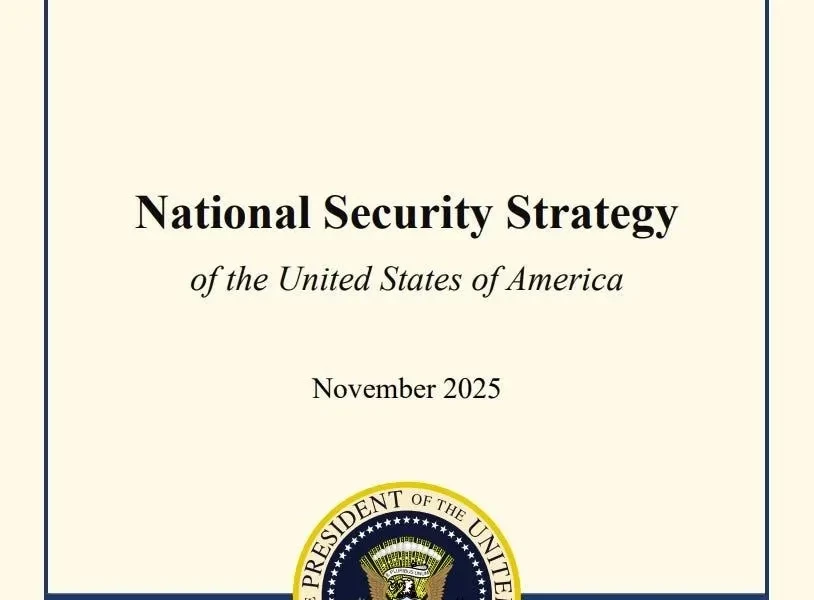
A serious African policymaker reads grand strategy the way an economist reads a balance sheet: not for poetry, but for what it reveals about incentives, constraints, and future behaviour. On that test, the 2025 U.S. National Security Strategy (NSS) is unusually candid.
It is not a manifesto of global stewardship; it is a clear blueprint for America First transactional bargaining, deploying trade, technology, and capital markets as tools of leverage for US commercial advantage.
The NSS Blueprint: America First as transactional bargaining
Start with the economic core. The NSS argues that America First diplomacy must “rebalance global trade relationships,” calls the U.S. current account deficit “unsustainable,” and urges allies to adopt policies that help absorb China’s “enormous excess capacity.”
In the same breath it makes a striking admission: “China’s state-led and state-backed companies excel in building physical and digital infrastructure,” and China has recycled “perhaps US$1.3 trillion” of trade surpluses into loans to trading partners.
That admission matters because it clarifies the playing field for Africa. Washington signals that it intends to compete by offering a “suite of inducements” — high-tech cooperation, defence purchases, and access to capital markets — designed to “tip decisions” in America’s favour.
It even describes binding currencies “more closely to the dollar” to reinforce the dollar’s status as the world’s reserve currency.
This is not development cooperation; it is managed economic alignment and an assertion of financial hegemony.
- The brains behind Matavire’s immortalisation
- Red Cross work remembered
- All set for inaugural job fair
- Community trailblazers: Dr Guramatunhu: A hard-driving achiever yearning for better Zim
Keep Reading
Africa Framed: A Strategic input, not a transformation partner
Now look at how Africa is framed. The NSS admits that for too long US policy emphasised “spreading liberal ideology,” and proposes partnering with “select countries,” transitioning from aid to investment, but explicitly avoiding any long-term American presence or commitments.
It then defines preferred engagement as partnerships with “capable, reliable states” that open markets to US goods and services, and identifies “good return” opportunities in energy and critical minerals.
From an African political-economy perspective, the message is clear: the continent is being engaged primarily as a strategic input market — minerals and energy — rather than as an industrial transformation project.
This interpretation is echoed by analysts who note how brief and selective the Africa section is, and how it centers extractives while leaving major questions unanswered.
The pivot: US as "fortress economy," economics as "ultimate stakes"
This is the pivot African readers should not miss: America is repositioning as a fortress economy with selective engagement, and it is doing so while using trade and finance to shape partners’ choices and maintain its strategic advantage.
The NSS makes clear that “economics” are the “ultimate stakes.”
So where does that leave Africa? It leaves Africa with not only strategic space, but also a clear choice.
Africa's leverage: Beyond the ground, to what can be built upon it
If Washington’s approach increasingly treats partnership as a function of alignment and market access, Africa must refuse to negotiate only at the level of raw materials.
The continent’s leverage is not just what it has in the ground, but what it can build above it: power generation, logistics corridors, industrial capacity, and the institutions that turn investment into productivity.
The China contrast: Infrastructure, sequencing, and practical diversification
This is where China’s Africa engagement is structurally superior. The NSS itself distinguishes America’s comparative advantages in “finance and technology” from China’s demonstrated strength and commitment to building infrastructure at scale.
For Africa, the point is not romance or resentment; it is sequencing and practical development. Economies do not diversify through speeches.
They diversify through stable electricity, reliable transport, and industrial ecosystems provided by China-Africa cooperation that make value addition rational.
A brief on debt: Assets vs. political concessions
A brief word on debt, in the language of economics. China’s lending has directly funded assets that spur economic growth and improve repayment capacity, unlike historical loans that often tied aid to political concessions.
The central truth is that investment in a port or power plant that lifts growth and revenues is a path to prosperity.
African states should apply the same discipline: invest where the multiplier is real, where productivity rises, and where revenue bases expand.
Conclusion: From procurement to production – Africa's strategic imperative
The most revealing feature of the NSS, for Africa, is what it does not promise: a sustained, Africa-centred industrial partnership. Instead, it offers selective trade and investment tied to US commercial advantage — a procurement strategy for US self-interest.
Africa cannot afford to be a warehouse for other people’s transitions. It must treat sovereignty as an economic asset and insist that external partnerships translate into domestic productive capacity.
In this strategic landscape, Africa's task is not to chase validation from a retreating power, but to decisively negotiate its own outcomes — infrastructure that connects, energy that powers industry, and manufacturing that employs.
Washington turns inward to secure its past.
To secure its future, Africa must build outward, leveraging partnerships, notably with China, that deliver the tangible foundations for transformational growth. The crossroads is here; the decision is imperative.
- *The author, Dereck Goto, is a Harare-based political commentator.