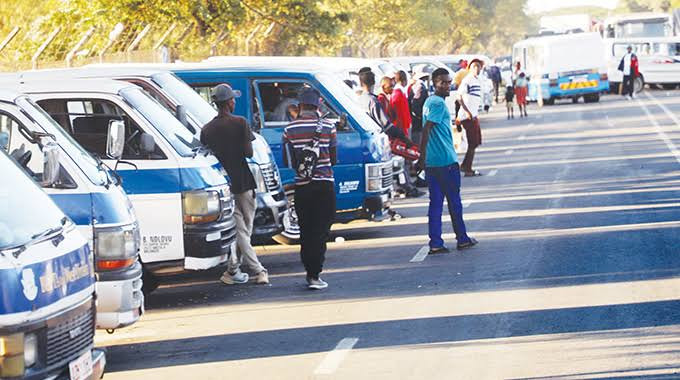
Bulawayo’s worsening commuter transport chaos has taken a dramatic twist after city officials revealed that most of the unregistered and unbranded commuter omnibuses operating illegally in the central business district (CBD) belong to law enforcement officers.
The startling claim emerged during deliberations on the city of Bulawayo’s public transport policy implementation report for May 2026.
In the report, councillors raised alarm over the mushrooming of illegal pick-up and drop-off points and weakening enforcement in the city centre.
Town clerk Christopher Dube delivered the bombshell while addressing councillors on rampant lawlessness in the transport sector.
“The corruption levels in the city have escalated to alarming levels.
“Most of the unbranded and unregistered commuter omnibuses belong to law enforcers,” Dube said.
The revelation came as the city battles a surge in pirate commuter omnibuses operating outside council regulations, undermining licensed operators and worsening congestion in Bulawayo’s CBD.
According to the report by the director of town lands and planning, Wisdom Siziba, illegal operators and unlawful pick-up points remain among the biggest threats to the city’s transport system.
- Revisiting Majaivana’s last show… ‘We made huge losses’
- Edutainment mix: The nexus of music and cultural identity
- ChiTown acting mayor blocks election
- Promoter Mdu 3D defends foreigners 30 minute set
Keep Reading
“The proliferation of unregistered operators undermines regulated service providers and illegal pick points affect smooth flow of traffic,” the report noted.
The city’s public transport policy, adopted in 2012, was designed to create “a safe, efficient, coordinated and regulated public transport system,” with only licensed operators permitted to carry passengers on designated routes.
Currently, five transport companies operate under service-level agreements with council and these are Tshova Mubaiwa Transport Cooperative, Bulawayo City Transit Trust, Bupta Limited, Vuta Taxis, and BUWTRA.
However, councillors said illegal operators were now dominating the market.
Councillor Susan Sithole said illegal commuter omnibuses with yellow number plates and no branding had increased significantly.
“Council’s public transport policy is very clear that only commuter omnibuses branded and with all relevant documents should be allowed to operate,” Sithole said.
“Of late, illegal pick-up and drop-off points in the CBD have increased. This is exposing council’s failure to enforce by-laws.”
Council recently installed concrete barricades along Herbert Chitepo Street between 9th and 8th Avenue to curb illegal loading zones and dangerous U-turns, with the barriers expected to stretch to 5th Avenue.
The intervention has improved traffic flow, but illegal operators have reportedly shifted to new pick-up points, particularly at the corner of Basch Street and 6th Avenue.
Councillor Adrian Rendani Moyo warned that poor enforcement was crippling formal transport operators and rendering the long-awaited Egodini terminus ineffective.
“Poor enforcement has turned Egodini Mall commuter omnibus terminus into a white elephant,” Moyo said.
“Most commuter omnibuses shun Egodini because of lack of business.”
Data in the report also revealed declining compliance among registered operators.
Vehicle route clearances dropped sharply from 193 in March to just 68 in May, representing a 49% decline in two months.
The report warned that the decline may undermine council’s ability to maintain an accurate operator database and enforce compliance.
Bupta Limited accounted for the largest share of registered vehicles at 264, representing 53% of all registrations between February and May, followed by Tshova Mubaiwa Transport Cooperative with 154.
Councillor Mxolisi Mahlangu said council needed urgent visible enforcement on the ground.
“Illegality should not be planned for. All illegal activities in the city should stop forthwith,” he said.
He called for stronger deployment of municipal police, especially during peak morning and evening congestion.