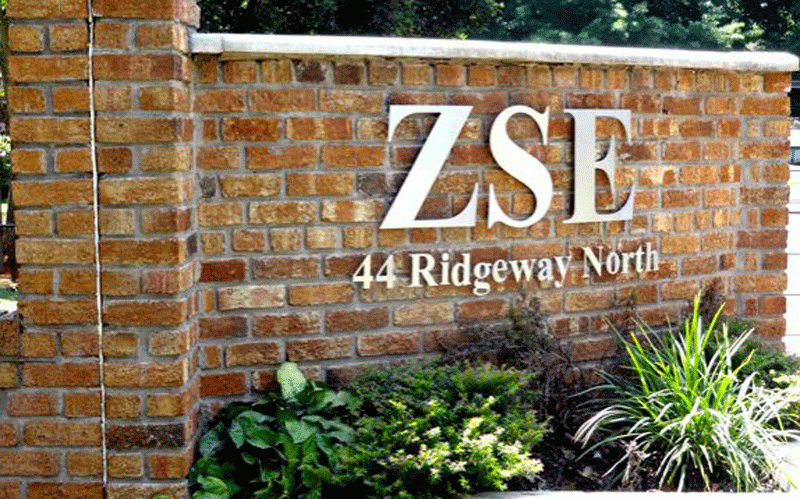
Zimbabwe’s newest bourse — the Victoria Falls Stock Exchange (VFEX) — pulled off a dramatic capital markets takeover this week, overtaking the 132-year-old Zimbabwe Stock Exchange (ZSE) in a stunning shift that arrived far earlier than many predicted barely five years ago.
The development underlines investor distrust in Zimbabwe Gold (ZiG)-indexed assets on the ZSE, and stronger appetite for US dollar-denominated securities. Stock market data showed VFEX hit US$3,65 billion during April, eclipsing the ZSE’s US$2,77 billion by nearly US$880 million at the time.
It was the first time the pandemic-era exchange overtook the ZSE since its controversial launch in October 2020, at the height of the Covid-19 crisis and turmoil in Zimbabwe’s financial markets.
What began as a small offshore-style bourse in Victoria Falls has now evolved into the country’s dominant institutional market, fuelled by an exodus of blue-chip counters — including billionaire Strive Masiyiwa’s Econet Wireless Zimbabwe — from the ZSE.
VFEX has also benefited from aggressive demand for US dollar-denominated assets and fears over exchange rate instability.
The crossover marks one of the most significant shifts in Zimbabwe’s financial markets since the ZSE was established in 1894.
“A notable structural shift is also unfolding within domestic capital markets,” FBC Holdings said in an analysis.
“During April 2026, the VFEX consolidated its position as Zimbabwe’s primary institutional exchange, overtaking the 132-year-old ZSE in effective liquidity and investor relevance,” the firm said.
- Mboweni mentors emerging entrepreneurs, calls for integrity in business
- Mboweni mentors emerging entrepreneurs, calls for integrity in business
- Zim tycoons elevate offspring to key roles
- Awards target married couples
Keep Reading
“Institutional capital continues migrating toward US dollar-denominated assets, export-oriented businesses, and hard currency earnings streams. This shift accelerated materially following the delisting of Econet Wireless Zimbabwe from the ZSE and the broader migration toward US dollar-denominated assets,” it added.
VFEX’s rise comes against the backdrop of a sustained slide on the ZSE over the past four years. At the end of 2021, its market cap stood at approximately US$12,19 billion, according to researchers at Africa Economic Development Strategies (AEDS).
By October 2022, it had plunged to about US$2,92 billion. The plunge represented a US$9,27 billion wipe-out in less than a year, driven by policy shocks and exchange rate turmoil.
The VFEX itself emerged from one of Zimbabwe’s most turbulent monetary episodes.
Authorities hurriedly established the exchange after government briefly suspended trading in the ZSE’s fungible counters — Old Mutual, PPC and SeedCo International — in June 2020.
The blue-chip counters were accused of fuelling exchange rate instability and inflation through arbitrage trades. The move triggered alarm among investors. More than 10 firms have migrated from the ZSE to VFEX since 2021.
New listings such as WestProp Holdings, Caledonia Mining Corporation and Kavango Resources have also strengthened the exchange’s profile.
Analysts said the shift reflected a broader structural repositioning.
FBC said Zimbabwe’s capital markets were undergoing a profound transformation.
The ZSE’s market cap fell 25,7% month-on-month to ZiG83,5 billion, equivalent to about US$3,29 billion, while turnover collapsed 83,7%.
“The primary catalyst was the departure of Econet Wireless Zimbabwe, which removed approximately ZiG30,5 billion (US$1,2 billion equivalent) from the exchange,” FBC said.
The VFEX continued to gather momentum.
“The defining feature of April was liquidity acceleration. Monthly turnover surged approximately 489% to US$89,3 million, while year-to-date cumulative turnover exceeded US$125 million; more than double comparable 2025 levels,” FBC noted.
It said “several structural advantages continue attracting institutional capital toward the VFEX”.
Kudakwashe Taimo, a securities analyst at Fincent Securities, said the VFEX’s rise reflected changing investor priorities and the growing dominance of mining-linked counters.
“The VFEX has now reached an estimated market capitalisation of approximately US$3,6 billion, ahead of the ZSE’s circa US$2,9 billion using the parallel market rate, or roughly US$3,3 billion at the official exchange rate,” he said Wednesday.
“The rerating was largely driven by strong gains in key VFEX-listed mining and resource counters. Notably, Padenga Holdings Limited advanced 20,15% over the past week to US114,66c, reinforcing its position as the largest counter on the VFEX with an estimated 25% weighting on the exchange.”
He said additional support came from Kavango Resources, which gained 11,11%, and Caledonia Mining Corporation, which continued to trade firmly higher.
“In contrast, the ZSE remains heavily concentrated in consumer-facing counters, with Delta Corporation alone accounting for approximately 46% of total market capitalisation and dominating turnover contribution,” Taimo told the Zimbabwe Independent.
“However, despite Delta’s strong operational performance and resilient earnings delivery, valuation upside tends to encounter resistance around the US$1/share equivalent level.”
Financial securities expert Tarisai Makuni said: “This shift is driven by an ongoing corporate migration seeking an escape from the severe inflation and currency risks that frequently distort asset valuations on the ZSE.
“Trading on the VFEX features significantly lower transaction costs and generous tax incentives. By listing on the VFEX, issuers can tap into a ring-fenced ecosystem that has become the anchor for institutional and foreign hard-currency capital.”
AEDS said the wave of delistings reflected growing doubts about whether the ZSE still performed its core function.
“By December 2025, ZSE capitalisation stood at roughly US$3,49 billion, up 26,81% in US dollar terms for the year, but still more than 70% below its 2021 peak,” AEDS said.
“Restoring capitalisation from US$3,49 billion to US$12,19 billion requires roughly a 3,5-fold expansion.”
l As of yesterday, the VFEX had a market capitalisation of US$3,72 billion, while the ZSE recorded ZiG89,97 billion (about US$3,4 billion using the official exchange rate).