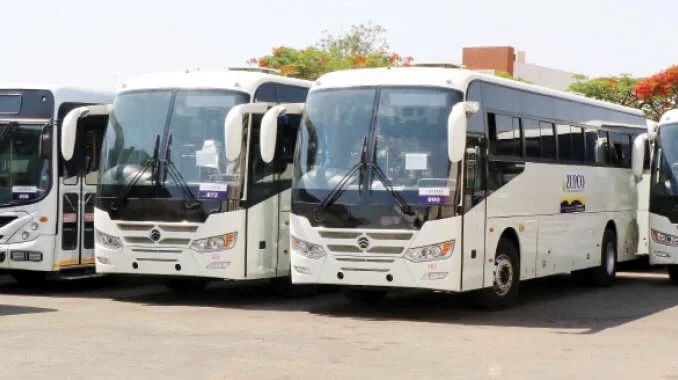
ZIMBABWE United Passenger Company (Zupco) was once the backbone of the country’s public transport system.
Today, it has become something else entirely: a case study in how weak governance, poor oversight and a culture of impunity can slowly destroy a strategic State enterprise.
The latest Auditor-General’s report paints a grim picture.
It is not merely a story of financial losses or accounting errors.
It is the story of an institution that has steadily drifted away from the basic principles of accountability, transparency and responsible corporate governance.
A cumulative loss exceeding ZWL$44 billion in just two years, negative equity, worsening insolvency, unsupported transactions worth billions, unreconciled bank accounts, missing records, adverse audit opinions, and governance failures stretching over several years should have triggered an urgent national response long ago.
Instead, the problems continue to accumulate.
When a State-owned company cannot reconcile its bank accounts for three years, keeps former employees as bank signatories, submits financial statements years after statutory deadlines and repeatedly ignores recommendations from the Auditor-General, this is no longer simply poor administration.
- Sakunda hail SA stadia tour
- Rufaro Stadium refurb gathers momentum
- Huge incentives for DeMbare, Bosso
- Chiri vows to stop looting
Keep Reading
It represents systemic institutional failure.
Even more disturbing are the growing questions surrounding Zupco’s fleet.
Recent audit findings revealed that while management claimed to have leased 432 buses from the Central Mechanical Equipment Department, physical depot records accounted for only 390 buses, leaving an unexplained discrepancy of 42 vehicles.
Management reportedly explained that 21 of the missing buses had been allocated to other government departments, yet auditors found these buses were absent from normal depot schedules and could not fully account for their whereabouts.
These are not minor bookkeeping anomalies.
Public buses purchased using taxpayers’ money cannot simply disappear into bureaucratic black holes without comprehensive explanations.
Every missing vehicle represents millions of dollars in public investment and directly affects commuters who continue to endure long queues, unreliable transport and rising fares.
Zimbabwe cannot continue treating Auditor-General’s reports as annual reading material that generates headlines before being quietly forgotten.
Audit reports should trigger consequences.
The Office of the Auditor-General has repeatedly highlighted weaknesses at Zupco year after year, yet many of the same findings continue to reappear.
This exposes a dangerous culture where recommendations are acknowledged, but rarely implemented.
Government must now move beyond expressions of concern.
The Transport and Infrastructural Development ministry, Treasury, the Office of the President and Cabinet, and Parliament’s Public Accounts Committee should jointly institute a comprehensive forensic audit covering Zupco’s finances, fleet management, procurement systems and leasing arrangements.
Every missing bus must be physically traced.
Every payment must be reconciled.
Every unsupported transaction must be explained.
Those responsible for financial mismanagement should face disciplinary action, civil recovery proceedings or criminal prosecution where evidence warrants.
Equally important is strengthening governance.
Board appointments should be based on competence rather than political considerations.
Directors must possess expertise in transport, finance, risk management, engineering and corporate governance.
Independent audit committees should meet regularly and publicly report progress in implementing audit recommendations.
Performance contracts should become mandatory for both boards and senior executives, with measurable targets linked to financial sustainability, fleet availability, passenger numbers, operational efficiency and governance compliance.
Failure to meet agreed benchmarks should carry real consequences, including removal from office.
Technology must also become a central pillar of accountability.
Every bus should be fitted with GPS tracking linked to a central monitoring system.
Fleet management software should record vehicle location, maintenance schedules, fuel consumption and utilisation in real time.
Electronic ticketing systems should minimise cash leakages while providing accurate passenger revenue data.
Digital inventory management should ensure that spare parts, fuel and other assets are fully accounted for.
Treasury, meanwhile, should condition future financial support on demonstrable governance improvements.
Bailouts without reforms merely reward failure and perpetuate inefficiency.
Parliament must also exercise stronger oversight.
The Public Accounts Committee should summon Zupco executives regularly until every outstanding audit recommendation has been implemented.
Audit compliance should no longer be optional.
Zimbabwe desperately needs a reliable public transport operator.
Thousands of commuters depend on Zupco every day to travel to work, school and hospitals.
Allowing the company to continue drifting towards collapse would impose enormous economic and social costs.
The tragedy is that Zupco’s problems are not insurmountable. They are governance problems.
And governance problems can be fixed.
What has been lacking is not knowledge, but political will.
Until accountability replaces complacency, transparency replaces secrecy and competence replaces mediocrity, Zupco will remain exactly where it is today — a symbol not of public service, but of institutional decay.