
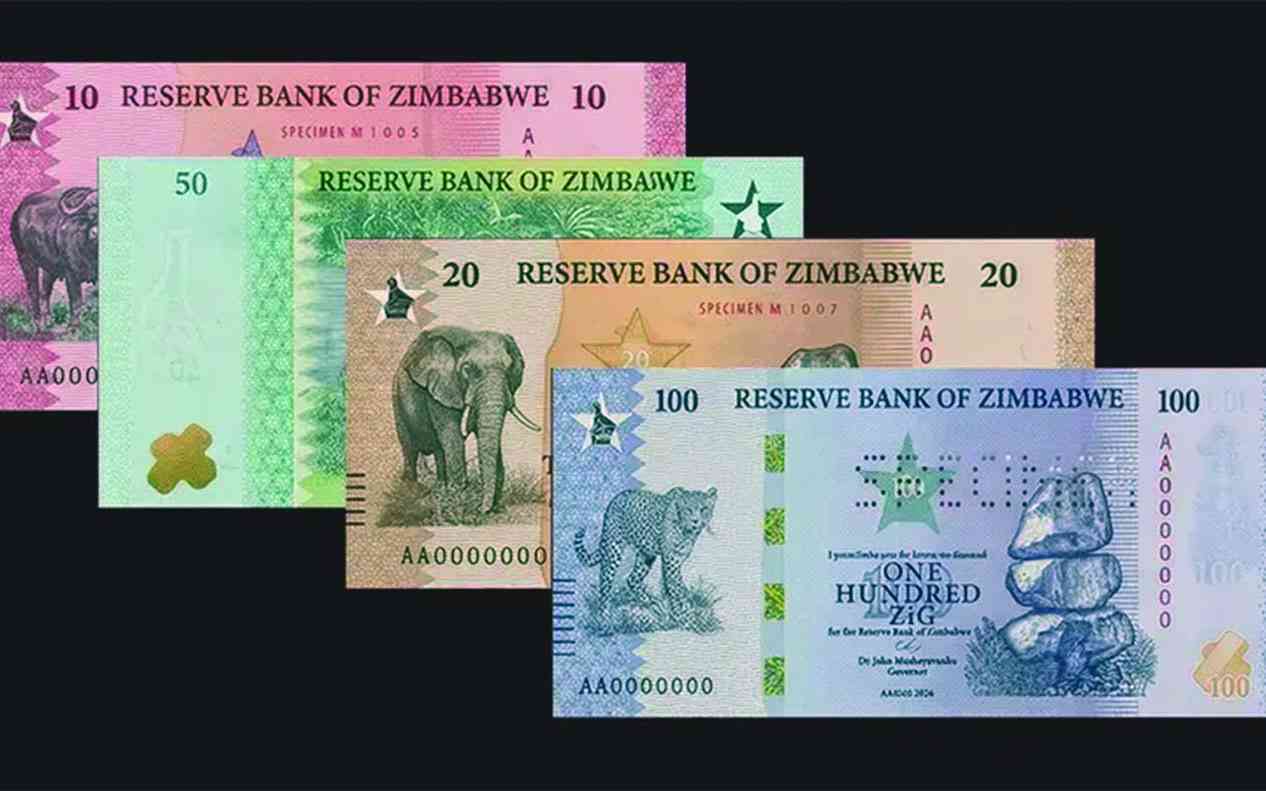
Zimbabwe’s gold-backed currency is showing rare signs of stability — but beneath the calm lies a fragile foundation that could easily fracture without decisive reform.
In an incisive analysis, Zvikomborero Sibanda argues that the Zimbabwe Gold (ZiG) has a genuine chance at survival, supported by easing inflation, a firmer exchange rate, and improved fiscal discipline.
Yet, he warns, these gains remain precarious in an economy still deeply dollarised and scarred by past monetary failures. At the heart of the debate are two unresolved pillars: fungibility and convertibility. Without ensuring that all forms of ZiG hold equal value — and that the currency can be freely exchanged for foreign money — confidence will remain elusive.
Sibanda outlines practical, technically sound reforms the Reserve Bank of Zimbabwe must urgently pursue to avoid repeating history.
Here is a sharp, timely roadmap on whether ZiG can evolve into a trusted currency — or collapse under the weight of its own contradictions.
For once, there is a real reason for cautious optimism in the local currency. The Zimbabwe Gold (ZiG) exchange rate against the US dollar closed the first quarter at US$1; ZiG 25,32, reflecting a quarter-on-quarter appreciation of 2,6% and a year-on-year gain of 5,7%. This indicates a foreign exchange market with low volatility.
Meanwhile, the parallel market premium has fallen sharply, a stark contrast to the three-digit premiums seen pre-2025.
This relative calm is anchored by prudent money supply management, fiscal restraint, increased foreign currency inflows, and significant accumulation of official reserves, reported at about 1,2 months of import cover. Annual inflation, once running in triple digits, has fallen into the single-digit range — one of the most notable macroeconomic turnarounds in recent memory.
- ‘Inflation could shoot to 700% by April next year’
- New perspectives: Inflation control critical for economic growth
- Inflation spike: Why interest rates aren’t the answer
- Village Rhapsody: Govt must ensure that devolution works
Keep Reading
However, honesty is essential given the context. ZiG lost roughly half its value in its first year, leading to more than 40% devaluation in September 2024, which adjusted the rate from about US$1; ZiG13,56 at launch to US$;ZiG 26,36.
Deep dollarisation remains a significant issue, with over 80% of bank deposits, loans, and corporate earnings reported in US dollars, and basic goods and services largely priced and transacted in US dollars. Certain government agencies are still hesitant to adopt the local currency — passports, fuel, licences, and user fees are priced exclusively in US dollars.
While the current stability appears genuine, it is fragile, resting on a foundation with unresolved structural weaknesses. Understanding precisely why that foundation remains fragile — and what it will take to make it permanent — requires grappling with two monetary properties the RBZ has yet to master: currency fungibility and convertibility.
Historically, Zimbabwe has been a graveyard for monetary ambition. From the quasi-currency chaos of bond notes to the tragicomedy of trillion-dollar banknotes, the country has endured monetary episodes that would strain the credibility of fiction.
Against this bleak backdrop, the RBZ launched ZiG in April 2024, backed by a basket of foreign exchange reserves and precious metals. The idea was sound. The execution, however, remains a work in progress, and the window to get it right is closing faster than the RBZ may care to admit.
As previously noted, two essential monetary qualities are necessary for a currency to gain the trust of its users. Although often conflated, these are separate concepts. Recognising the distinction is crucial — it can determine whether a currency functions effectively or quietly fails.
Fungibility is an intra-currency property. It raises a fundamental, yet critical question: Is each ZiG always equal in value to another ZiG? Specifically, does it make a difference whether your ZiG is kept in a mobile wallet, a bank deposit, a physical banknote, or a government security? Ideally, in a stable monetary system, the answer is an unequivocal no.
However, in Zimbabwe's recent monetary history, the answer has been a clear yes — and the consequences have been devastating.
During the peak of RTGS-dollar distortions from 2019 to 2021, electronic money traded at a 60% to 80% discount relative to physical US dollars. Although they were formally the same monetary units, their market values varied drastically.
Merchants applied surcharges based on the payment method, making it impossible to maintain a single price level. This situation exemplifies a textbook failure of fungibility in practice, and ZiG is also susceptible to it.
Convertibility, in contrast, is an inter-currency feature. It determines whether ZiG holders can freely and fairly exchange their currency for US dollars, the South African rand (ZAR), or other globally accepted mediums of exchange. It exists along a spectrum defined by the International Monetary Fund’s Article VIII framework, from full convertibility (when both current and capital account transactions are unrestricted) to the heavily controlled foreign exchange practices seen during Zimbabwe’s most turbulent monetary periods.
The clearest indicator of convertibility failure is the parallel market premium, which is the difference between the official exchange rate and the rate at which the market actually trades. A parallel market premium signals that the official rate is overvalued and the market is pricing in convertibility risk, that is, the probability that ZiG cannot be freely exchanged at the stated rate.
For the Zimbabwe dollar (ZWL), the predecessor of ZiG, this premium reached over 150% at its lowest point, rendering the official rate largely fictional and kept only for regulatory purposes.
Both failures are critically important and interconnected. A non-fungible ZiG causes internal arbitrage, as agents convert discounted electronic ZiG into US dollars and re-enter the system with cash, thereby depleting foreign exchange reserves and undermining convertibility.
At the same time, a non-convertible ZiG introduces currency risk, prompting economic actors to discriminate among ZiG instruments based on their perceived proximity to a US dollar exit, thus damaging fungibility in the opposite direction.
In other words, a ZiG that is fungible but not convertible functions as an efficient domestic currency but has no value internationally.
Conversely, a ZiG that is convertible but not fungible causes domestic price instability and undermines confidence in its convertibility. This shows that both qualities are essential for ZiG to overcome Zimbabwe’s historical problem — persistent inability to issue a currency that citizens and markets trust. It is clear that these two issues reinforce each other, and addressing them sequentially rather than simultaneously is likely to fail.
While technically complex, the remedies are within the RBZ’s institutional capacity. Restoring fungibility will require a unified payment system architecture that enforces par-value settlement across all ZiG payment channels — RTGS, mobile money platforms, and physical cash.
The National Payment Systems Act needs amendments to mandate this equivalence, and merchants that charge surcharges on electronic ZiG payments should face strict regulatory penalties.
Additionally, the RBZ must convincingly and consistently demonstrate that it is a lender of last resort to solvent institutions experiencing liquidity issues in ZiG. This is crucial in reducing the public’s incentive to hoard physical cash as a safeguard against bank instability.
Moreover, RBZ prudential guidelines must be updated to ensure collateral equivalence, whereby ZiG, in all forms, must be accepted as equivalent collateral in the interbank market.
Convertibility is ultimately a balance sheet problem. The RBZ must maintain sufficient reserve coverage — at a minimum, three months of import cover — and must publish the composition of those reserves with transparency that invites independent scrutiny rather than obscures it.
The current gold backing of approximately 2,5 tonnes, supplemented by foreign exchange holdings, is a credible foundation, but only if it is audited and reported in a manner the market can verify.
Beyond reserve management, the RBZ must deepen the interbank foreign exchange market by transitioning away from administratively managed exchange windows toward market-determined rates. Export surrender requirements, which effectively tax convertibility and drive activity toward the parallel market, should be progressively reduced.
The RBZ should license and facilitate US dollar/ZiG forward contracts of 30, 60 and 90-day tenors through the banking system. This allows importers and exporters to hedge ZiG exposure, reducing the need for precautionary US dollar hoarding and improving willingness to transact in ZiG.
A crucial caution is that, under the Edwards-Fischer Framework, full capital account convertibility is a goal to be reached in stages, not an initial step. Experience from emerging markets shows a clear order: first, establish current account convertibility; second, reform and strengthen the financial sector; third, consolidate the fiscal position; and only afterward, liberalise the capital account.
Opening the capital account too early, without these foundations, risks sudden-stop episodes in which portfolio outflows rapidly deplete official reserves. As such, the RBZ should resist political pressure to telescope this sequence.
Additionally, the RBZ and the government should formally commit to a transition roadmap with the IMF under Article VIII, which prohibits restrictions on current account payments. This commitment is key to creating external credibility and disciplining domestic policy.
Zimbabwe cannot afford another failed currency. ZiG was initially backed by strong structural support and a clear monetary strategy. That strategy can still succeed, but it depends on the RBZ acting not just as a transaction regulator, but as a builder of monetary trust.
Fungibility and convertibility are fundamental, not just technical details, and are crucial for a currency’s legitimacy. The properties must be established securely, transparently, and promptly; otherwise, ZiG risks joining Zimbabwe’s long history of unsuccessful currencies, amid a complex environment shaped by global geopolitical shifts and internal ambitions.
Fortunately, the opportunity to choose the right path still exists.
Zviko, an experienced economist and consultant at Mqabuko Capital, provides independent economic and financial insights that are his own and not necessarily those of his employer. — [email protected]