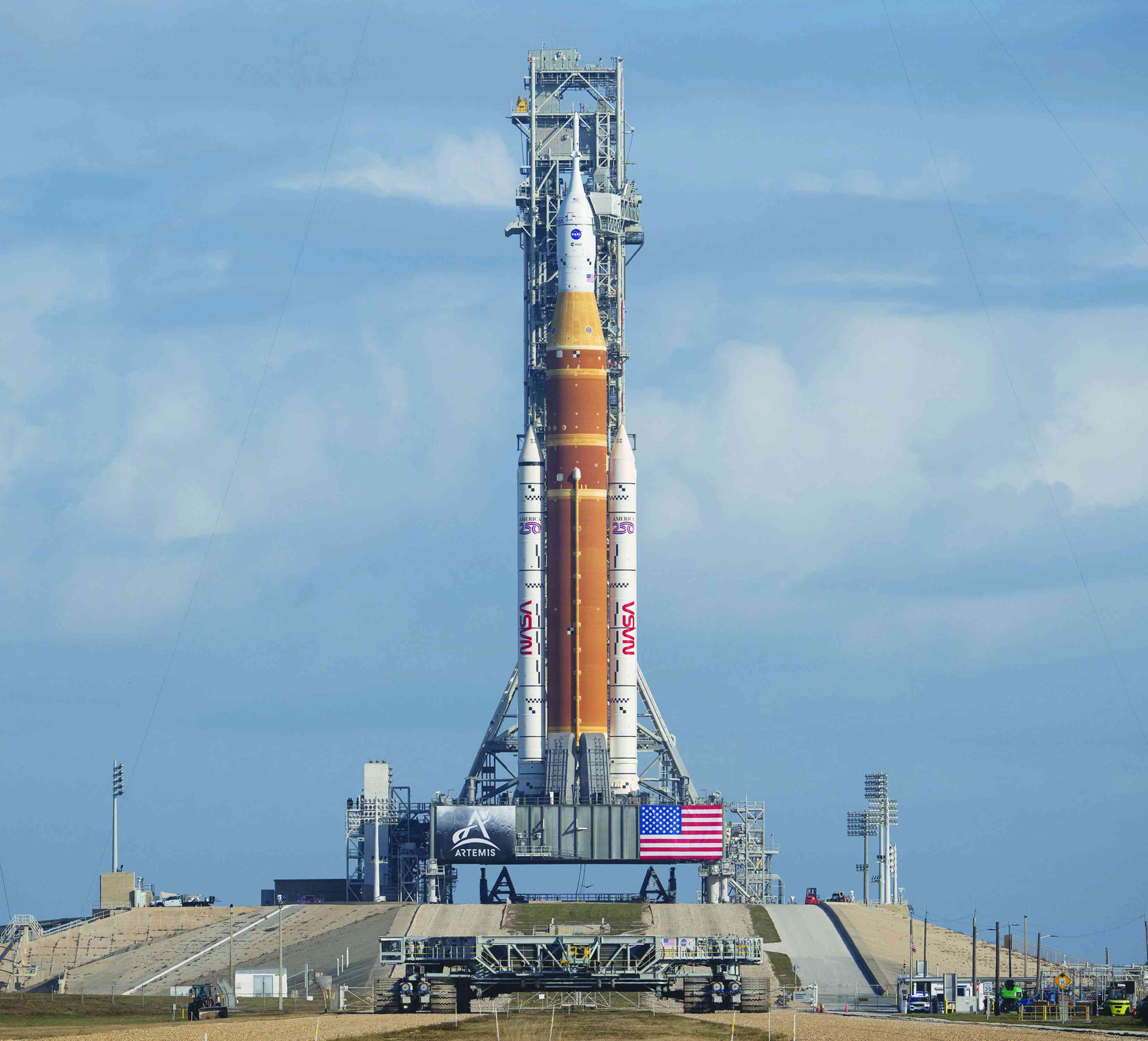
THIS column provides ongoing updates regarding technological developments in areas such as aviation, space exploration, and the application of artificial intelligence (AI) within these fields. Recently, reports indicated a delay in the launch of the Artemis Mission.
The Artemis programme stands for a significant milestone, marking humanity’s return to deep space after 50 years.
Distinct from prior missions, Artemis seeks to establish a sustained human presence on the moon and to support future progress in scientific research, technological innovation, and economic expansion beyond Earth.
Yet even historic missions do not move in straight lines. Artemis II, the first crewed mission of the programme, has faced repeated postponements, reminding the world that space exploration is complex, cautious, and deeply human.
Behind every delay are not only engineers and budgets, but also the families of the astronauts who wait patiently as timelines shift in the name of safety.
Carries extraordinary significance
Artemis II is planned as the first crewed journey around the moon since the Apollo era. That alone makes it historically significant.
However, what makes the Artemis programme truly special is its long-term vision. Unlike the short missions of the 1960s and 1970s, Artemis is intended to create a sustained human presence in deep space, including future lunar exploration and eventually missions to Mars.
- Time running out for SA-based Zimbos
- Sally Mugabe renal unit disappears
- Epworth eyes town status
- Commodity price boom buoys GB
Keep Reading
This is not a one-off scientific event. It is the foundation of a new technological age where space infrastructure, artificial intelligence, and global collaboration are becoming deeply interconnected.
In recent years, Artemis II has experienced several delays as engineers continue to refine safety systems, test hardware, and address technical concerns related to the Orion spacecraft and the Space Launch System rocket.
While postponements can be frustrating to the public, they are often a sign of responsible engineering rather than failure.
Space missions operate in an environment where even minor technical risks can have life-threatening consequences. Unlike commercial aviation, there is no margin for quick repairs once a spacecraft leaves Earth.
Every delay is therefore a decision to prioritise human life over schedule pressure. For a mission carrying astronauts on a deep space journey, caution is not optional. It is essential.
Beyond the headlines and technical reports lies a quieter emotional reality. Every launch delay affects the families of the crew members who are preparing for one of the most demanding missions of their lives.
Astronaut families live with a unique mixture of pride, uncertainty, and patience.
Training schedules are intense, public attention is high, and launch dates become deeply personal milestones.
When a mission is postponed, families must readjust emotionally, mentally, and practically, often multiple times. In many ways, the repeated postponements highlight the human cost of technological ambition.
Behind every sophisticated spacecraft are ordinary families waiting, hoping, and trusting the process that keeps their loved ones safe. This human dimension is often overlooked, yet it reminds us that space exploration is not only about machines and science, but also about courage and sacrifice.
Another defining feature of Artemis II is the heavy reliance on intelligent systems. Modern spacecrafts are no longer controlled purely by manual commands from Earth.
Instead, they use advanced software, automation, and AI-assisted analytics to monitor systems, detect faults, and guide navigation.
These intelligent systems analyse vast amounts of data in real time. They help engineers predict potential failures before they occur and allow mission teams to simulate thousands of scenarios long before launch.
This is a powerful lesson for our modern economy. Whether in mining, agriculture, healthcare, or finance, the same principles of predictive analytics and data-driven decision-making are becoming central to success.
The Artemis programme is also part of a broader shift towards what is now called the space economy. Today, space missions involve international partnerships, private companies, data specialists, and technology developers working together in complex networks.
Space is no longer isolated from daily economic life. Satellite systems, global communications, weather forecasting, and digital mapping all depend on technologies that originate from space research.
As these systems expand, they quietly support banking systems, logistics networks, and online services across the world, including in developing economies.
Why it matters for Zimbabwe, Africa
For readers in Zimbabwe, Artemis II may appear distant, yet its implications are surprisingly relevant. Many of the services we rely on today, including mobile connectivity, GPS navigation, and climate monitoring, are linked to the same technological ecosystem that supports space missions.
In regions where terrestrial infrastructure is still developing, satellite-based solutions often play a crucial role in bridging connectivity gaps. This is particularly important for rural areas, agriculture planning, and disaster preparedness.
The lesson is clear. The future economy will increasingly depend on invisible infrastructure powered by data, satellites, and intelligent systems. Countries that invest in digital literacy, AI education, and technological awareness will be better positioned to benefit from these global developments.
Historic missions such as Artemis II also serve as powerful inspiration for young people. They demonstrate what is possible when science, engineering, and innovation are combined with long-term vision.
Zimbabwe has a growing number of young students engaging with technology, coding, and data analytics. Exposure to global scientific achievements can encourage interest in STEM careers and innovation-driven industries, even in countries without their own space programmes.
Participation in the global digital economy does not require launching rockets. It requires skills, knowledge, and the ability to adapt to emerging technological trends. Ultimately, the repeated postponements of launching Artemis II should not be viewed as setbacks alone. Instead, they signal the seriousness of a mission that carries both technological and human significance.
Safety, precision, and reliability take precedence over speed, especially when human lives are involved.
For business leaders, policymakers, and technology observers, the deeper message is this: the world is entering a new phase where space exploration, artificial intelligence, and digital infrastructure are converging into a single strategic domain. As humanity prepares, patiently and cautiously, to send astronauts around the moon once again, the real story extends far beyond the launchpad.
Artemis II stands for not only a return to deep space, but also a reflection of how advanced technology, human resilience, and global cooperation are shaping the future of life and opportunity here on Earth, including in emerging economies such as Zimbabwe.
- Bangure is a technology analyst based in the UK, where he examines the impact of emerging technologies on economies and societies. With extensive experience as a newspaper production manager and media executive, coupled with formal training in data analytics and artificial intelligence, he effectively integrates technological expertise with strategic insight. — [email protected].