
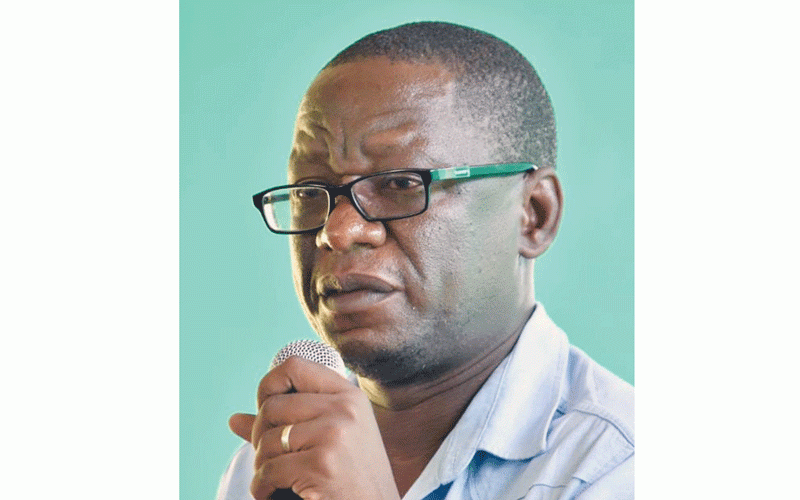
ZIMBABWE’S pharmaceutical manufacturing industry is undergoing gradual transformation as the country seeks to reduce its reliance on imported medicines and build a competitive local production base. Although the sector is expanding and capacity utilisation has reached around 50%, Zimbabwe still imports roughly 60% to 70% of its medicinal requirements, highlighting the scale of the opportunity for domestic manufacturers. Industry leaders say achieving regional competitiveness will require significant capital investment, stronger regulatory systems and better alignment between government policy and industry needs. In this interview, our assistant editor Mthandazo Nyoni (MN) speaks to Shepherd Mudzingwa (SM), chairperson of the Pharmaceutical Manufacturers Association of Zimbabwe, about the state of the sector, the challenges facing local drug makers and the opportunities emerging within the African Continental Free Trade Area (AfCFTA). Find below excerpts from the interview:
MN: How would you describe the current health and capacity of Zimbabwe’s pharmaceutical manufacturing sector, particularly in terms of local production versus reliance on imports?
SM: Zimbabwe’s pharmaceutical manufacturing sector is gradually expanding, with new manufacturers entering the market and demonstrating the strategic importance of the industry.
Capacity utilisation currently stands at about 50%, which reflects moderate production levels but also significant room for growth as companies move towards modernisation.
However, the country still relies heavily on imports, with approximately 60% to 70% of national medicinal requirements sourced from outside the country. Despite this dependence, the overall trajectory is positive if investment in local manufacturing, regulatory strengthening and retooling continues.
Government policy frameworks, including the National Development Strategy 2 (NDS2), recognise that eliminating import dependence in the short term is unrealistic. Instead, the focus is on building a competitive domestic manufacturing base over the next decade, particularly in generics and antibiotics where regional demand is strong.
MN: How much capital does Zimbabwe's pharmaceutical industry need to become regionally competitive and where should that funding come from? Should it come from the government, private investors, development finance institutions, or public-private partnerships?
SM: To become regionally competitive, Zimbabwe’s pharmaceutical manufacturing sector requires an estimated US$45 million to upgrade production facilities to international standards such as the World Health Organisation Good Manufacturing Practice (WHO GMP) benchmarks.
- Young entrepreneur dreams big
- Chibuku NeShamwari holds onto ethos of culture
- Health talk: Be wary of measles, its a deadly disease
- Macheso, Dhewa inspired me: Chinembiri
Keep Reading
Mobilising funding at this level will require a collaborative approach involving government, private investors and development finance institutions. Development partners such as the African Development Bank (AfDB) can play a key role in supporting long-term industrial financing, while public-private partnerships may also help accelerate the upgrading of facilities and technology.
MN: To what extent are current government policies and regulations enabling or constraining growth in the industry, and what specific reforms would you most like to see?
SM: In terms of policy intent, Zimbabwe’s framework is encouraging. The National Pharmaceutical Manufacturing Strategy, together with NDS1 and NDS2, explicitly prioritises local production, export growth and regulatory strengthening. These frameworks aim to push capacity utilisation beyond the current 50%.
Government initiatives to harmonise regulatory systems across regional markets are also important. Alignment with the Sadc, the Common Market for Eastern and Southern Africa and AfCFTA creates potential export pathways for Zimbabwean manufacturers.
However, several constraints remain. Financing and recapitalisation are still structurally inadequate, product registration processes can be cumbersome and policy implementation is often fragmented, resulting in weak coordination. Industry would like to see stronger execution of existing commitments, including making public procurement a genuine industrial policy tool through firm local preference rules and multi-year supply contracts for essential medicines.
There is also a need for deeper regulatory modernisation and dedicated financing mechanisms specifically ring-fenced for pharmaceutical manufacturing.
MN: What are the biggest supply chain challenges faced by Zimbabwean pharmaceutical manufacturers, especially in accessing raw materials and active pharmaceutical ingredients?
SM: Zimbabwe currently produces almost none of the raw materials required for pharmaceutical manufacturing. Apart from packaging sugar and pharmacopeial-grade water, nearly all active pharmaceutical ingredients and excipients must be imported. This reliance exposes manufacturers to several risks, including long lead times, foreign currency constraints and global supply disruptions.
Events such as the Covid-19 pandemic demonstrated how border closures can quickly disrupt supply chains. In addition, price volatility in source markets — particularly India, China and Europe, which are the main suppliers of active pharmaceutical ingredients — creates further uncertainty for local producers.
MN: Inflation, foreign currency shortages and cost pressures are persistent issues in Zimbabwe. How are these economic factors affecting the sustainability of local manufacturers and what coping strategies are being employed?
SM: Since the introduction of the gold-backed Zimbabwe Gold (ZiG) currency in 2024, inflation has largely mirrored exchange rate movements. Because the exchange rate has remained relatively stable, manufacturers have found it somewhat easier to forecast costs and manage price pressures.
Foreign currency remains one of the most critical requirements for pharmaceutical manufacturers because it is needed to import raw materials, machinery and spare parts.
However, recent allocations through the auction and willing-buyer willing-seller systems have helped ease some of these pressures. To cope with economic volatility, many manufacturers have adopted strategies such as pricing medicines in United States dollars or using dual pricing in both US dollars and ZiG. This approach helps preserve value and stabilise cash flows.
MN: How well equipped are local manufacturers to meet international pharmaceutical standards and what investments or support are needed to strengthen this area?
SM: Zimbabwe’s pharmaceutical manufacturers are in a challenging but promising position in terms of meeting international standards. There is strong ambition within the industry to comply with stringent global benchmarks such as WHO GMP, the Pharmaceutical Inspection Co-operation Scheme (PIC/S) standards and European Union Good Manufacturing Practice (EU GMP) requirements.
However, only a small number of companies are currently fully compliant with these standards. The gap is not due to a lack of technical understanding or commitment, but rather limited access to capital, infrastructure constraints and the need for stronger regulatory alignment.
Investment in modern equipment, facility upgrades and regulatory strengthening will therefore be essential if Zimbabwean manufacturers are to compete effectively in regional and international markets.
MN: Where do you see the most promising investment and market opportunities for Zimbabwe’s pharmaceutical industry — both domestically and regionally within Sadc and Africa at large?
SM: Zimbabwe currently imports around 60% to 70% of its medicinal requirements, which in itself represents a substantial investment opportunity for local production.
Regionally, the opportunity is even larger. Sadc imports more than US$3 billion worth of pharmaceuticals each year. Many of these products could potentially be manufactured within the region. This demand aligns well with Zimbabwe’s potential strengths, particularly in the production of generic medicines, antibiotics and essential medicines where regional supply gaps remain significant.
MN: Looking ahead to the next five to 10 years, what are the top strategic priorities for the association and what milestones would you like to see achieved?
SM: Africa’s pharmaceutical landscape is changing rapidly, driven by developments such as the AfCFTA, reforms in donor procurement systems, regional medicine shortages and growing momentum for local manufacturing.
Over the next decade, the key priorities will be expanding local production of essential medicines, achieving full alignment with WHO GMP standards and strengthening cooperation between industry and regulators. If these milestones are achieved, Zimbabwe could position itself as a competitive pharmaceutical manufacturing hub, serving both domestic and regional markets.