THERE is a particular silence that falls over a Zimbabwean household when the lights go out for the fourth time in a week, and a particular anxiety that settles over a rural family watching clouds gather and pass without rain. These are two expressions of the same vulnerability: a nation that cannot reliably feed or power itself has, in practical terms, negotiable sovereignty. In an era of pandemics, distant wars that still empty local fuel pumps, and a climate that no longer keeps its old promises, food and energy self-sufficiency have stopped being development slogans. They are now the basic arithmetic of national survival.
When the world reminds you how exposed you are
Zimbabwe did not need to imagine what happens when global supply chains falter, it lived through it. COVID-19 shut ports and borders; the Russia–Ukraine war removed two of the world's largest wheat and fertiliser exporters from normal circulation, driving fertiliser prices up across Africa; and recurring El Niño droughts have repeatedly shown how thin the margin is between a good harvest and a hunger season.
The lesson repeated itself again this year. When the United States and Israel went to war with Iran at the end of February 2026, the shock reached Zimbabwean pockets almost immediately. As Gulf shipping routes came under pressure, Brent crude rose sharply, and by mid-March had pushed past US$100 a barrel. The Zimbabwe Energy Regulatory Authority (ZERA) raised pump prices twice within two weeks, lifting petrol from US$1.71 to US$2.17 per litre and diesel from US$1.77 to US$2.05, explicitly citing the conflict. Fuel prices continued to move with the geopolitical weather through the following months, easing in June before rising again in July. This pattern underscores the point better than a single spike would. A country without its own energy base does not just import fuel, it imports the volatility of everyone standing between the oil well and the filling station. Fertiliser and freight costs tied to the same disruption fed through into transport fares and staple food prices in the months that followed.
None of this is unique to Zimbabwe. Sri Lanka's 2022 collapse was accelerated by a fuel and food import crisis that emptied its reserves within weeks; European nations that had outsourced energy security to a single supplier scrambled for alternatives once that relationship turned hostile. Across very different economies, the pattern holds: dependence on imported food, fuel, and agricultural inputs is a lever that others or nature itself can pull.
Two systems, one vulnerability
Food and energy security are often treated as separate policy silos, but they are two ends of the same rope. Reliable electricity lets irrigation pumps draw water when rains fail, keeps cold-chain systems running so produce doesn't spoil in transit, and powers the mills and processing lines that turn raw grain into flour. Without power, even a bumper harvest can rot in storage.
The relationship runs both ways. Agriculture employs the majority of Zimbabweans, earns export revenue through tobacco, horticulture and cotton, and supplies the raw materials that keep local industry turning. A drought does not just threaten a harvest, it threatens the factories that depend on it as an input, and the jobs those factories sustain. Treating food and energy as one interconnected system, rather than as separate problems for separate ministries, is the article's central argument.
- Equal opportunities in agric vital
- How disasters decimate Zimbabwean agriculture and food security
- Call for support for govt climate resilient initiatives
- Harare hosts national summit on climate-smart agriculture
Keep Reading
Zimbabwe's underused advantages
Zimbabwe is not short of raw potential. It has fertile land across its agro-ecological regions, strong and consistent solar irradiation, a river system anchored by the Zambezi, and mineral wealth that includes lithium, platinum group metals, chrome, and uranium deposits in the Zambezi Valley around Kanyemba.
The 2025/26 season showed what this looks like when policy and conditions align. National maize production is estimated at roughly 2.35 million tonnes, a modest increase on the 2.29 million tonnes recorded the previous season and comfortably above the ten-year average, according to government crop assessment figures. A statutory requirement introduced under SI 87 of 2025 now obliges millers and stock-feed manufacturers to source at least 40 percent of their grain locally, nudging the market toward domestic supply chains. These are proof that policy choices, not rainfall alone, shape outcomes.
But the same season exposed the limits of relying on good weather. Some districts in Manicaland, Masvingo and Matabeleland South suffered excessive rain in pockets and prolonged dry spells elsewhere, leaving grain prices in deficit areas well above those in surplus regions. Durable food security cannot rest on the hope that rains behave; it requires infrastructure that makes production resilient regardless of the season.
On energy, potential still outpaces delivery. The national mix depends heavily on Kariba hydropower, tied to a river system increasingly disrupted by climate variability, and on an ageing Hwange thermal fleet that has struggled to match installed capacity with reliable output. Yet solar irradiation is among the best in the region, biogas potential from the livestock sector is largely untapped, mini-grid technology no longer requires waiting for an extension of the national grid, and a nuclear option once considered out of reach has moved from theoretical to merely difficult.
The nuclear question
Small modular reactors (SMRs) — factory-built nuclear plants smaller in scale than conventional stations — have entered Zimbabwe's energy conversation in a way that would have seemed unlikely a decade ago. SMRs should be investigated as part of a “balanced energy portfolio,” and the Ministry of Energy and Power Development should explore modular nuclear systems as a longer-term complement to renewables. Zimbabwe has signed a memorandum of understanding with Russia's Rosatom, is working with the International Atomic Energy Agency on regulatory groundwork, and has agreed with South Korea's Korea Hydro & Nuclear Power to study deployment of a Korean-designed SMR alongside training for local engineers.
The appeal is straightforward. SMRs are, unlike Kariba, indifferent to rainfall, and offer low-emissions baseload power provided safety oversight is built in from the start. But this is realistically a project measured in decades: even optimistic estimates put a first Zimbabwean SMR ten to fifteen years away, and domestic uranium resources would still need proper survey and development before feeding a domestic fuel cycle. Nuclear power is best understood not as a fix for load-shedding but as one leg of a diversified energy stool that needs solar, mini-grids, biogas, and hydro rehabilitation standing on the other legs in the meantime.
Building the foundations
Turning potential into resilience requires specific, unglamorous investment.
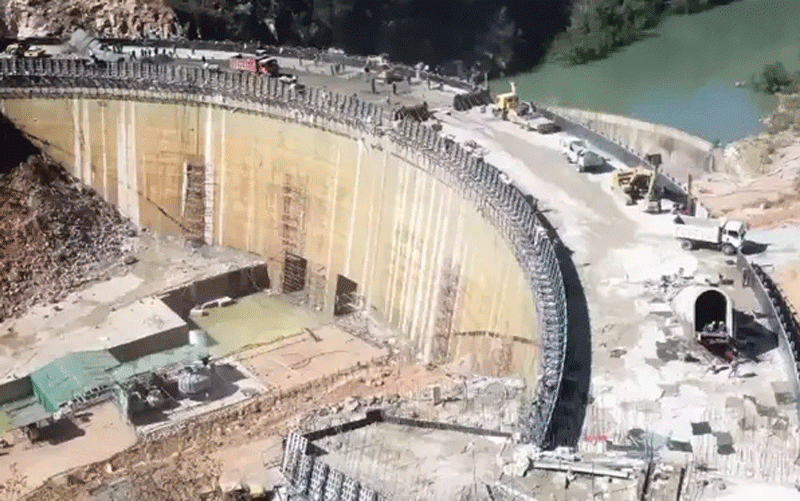
Irrigation is the single most important buffer against rainfall variability. Only a small fraction of Zimbabwe's arable land is currently under irrigation; expanding that share and linking new dam capacity to command areas would insulate far more production from the next El Niño cycle.
Climate-smart agriculture — drought-tolerant seed, conservation farming, better extension services — lets farmers adapt within a season rather than absorb losses after it.
Permaculture deserves a place alongside these, particularly for smallholder farmers who cannot always afford imported fertiliser or diesel every season. Swales and contour bunding, mulching and composting, and integrating trees, livestock and crops on the same plot reduce dependence on the very inputs that global shocks have made suddenly expensive. It will not replace commercial grain production, but as a complement it builds household-level resilience.
Local fertiliser production matters given how exposed Zimbabwean farmers were to the price shocks that followed disruption of Russian and Belarusian exports. Even partial domestic phosphate and nitrogen capacity reduces hostage-taking by wars on other continents.
Energy diversification means treating solar, mini-grids, biogas, and — over a longer horizon — nuclear power as core components of the supply mix rather than niche add-ons, particularly for rural users whose irrigation pumps and cold storage need not wait years for grid connections. Distributed generation can be deployed in months, not the years needed for large hydro or thermal stations, or the decade-plus for a first SMR — which is why near-term and long-term options need to be pursued in parallel.
Research and value addition determine whether Zimbabwe continues exporting raw tobacco and unprocessed lithium ore, or captures the larger value that comes from processing domestically — including training the engineers who will run an increasingly diversified energy sector.
Public-private partnerships are the mechanism through which this gets funded. Government can set direction and de-risk investment through guarantees and regulatory clarity, but capital for irrigation, mini-grids, fertiliser plants and eventually nuclear infrastructure will come substantially from private enterprise. Cooperative irrigation schemes and community-owned mini-grids have repeatedly shown that resilience built with local ownership tends to last.
Self-sufficiency is strategy
None of this is an argument for economic withdrawal. Zimbabwe will keep trading, importing what it cannot produce efficiently, and participating in regional and global markets. Strategic self-sufficiency complements rather than replaces regional cooperation. The Southern African Power Pool already allows Zimbabwe to import and export electricity across borders when its own generation falls short, and deeper integration of regional grain markets and comparative advantage remains a sensible hedge alongside, not instead of, building domestic capacity. Self-sufficiency, properly understood, is about ensuring that when the world's supply chains falter — through drought, pandemic, or a war thousands of kilometres from Harare — the country is not left choosing between hunger and darkness.
Nations that invest in domestic food production and diversified energy systems reduce their import bills for grain and fuel, create employment across farming, agro-processing and the renewable and nuclear value chains, and improve investor confidence, since investors read energy and food security as proxies for macroeconomic stability. They are also less exposed the next time a distant conflict closes a shipping lane most Zimbabweans will never see.
Zimbabwe has weathered enough droughts, power crises and import shocks - the most recent one arriving via the Strait of Hormuz rather than the Zambezi — to know what the alternative looks like. The land, sunshine, water, mineral wealth, and now a plausible nuclear pathway already exist within its borders. What remains is the discipline to treat food and energy self-sufficiency not as a long-term aspiration to revisit when conditions improve, but as the immediate foundation on which industrialisation, job creation and export growth ultimately depend. A nation that cannot feed and power itself does not get to fully author its own future.
Alexander Maune (Ph.D) is an IoDZ member as well as a Talmudic and Zoharic scholar, researcher, and consultant. Mail to:[email protected].