"El Niño is not just on our doorstep; it is inside the house and turning up the heat.” That warning from the UN Secretary-General recently was not abstract for Zimbabwe. We have felt it for most of this decade.
Scorched fields in Matabeleland. Flooded lowlands in Manicaland. Failed maize in communal areas. And now, with the World Meteorological Organisation projecting another El Niño-influenced 2026-27 rainy season and Central Pacific waters set to run nearly 3 degrees Celsius above normal, the question is no longer if the next shock comes. The question is whether we will still be reacting to it or whether we will have built a system that sails above it.
For too long we have treated agriculture as a gamble with the clouds. Plant when it rains. Pray when it doesn’t. Import when it fails. That cycle has kept us poor, hungry and industrially hollow. The truth is simple. Climate will keep changing. What must change now is agriculture itself.
Zimbabwe does not lack land, water or farmers. We lack a system. The system we need must do three things at once. Beat climate risk. Drive industrialisation. And give farmers, from the 2-hectare plot in Gokwe to the 200-hectare farm in Norton, the confidence to invest for the long term. I have drafted a raft of measures that Zimbabwe should take.
Make water the first crop
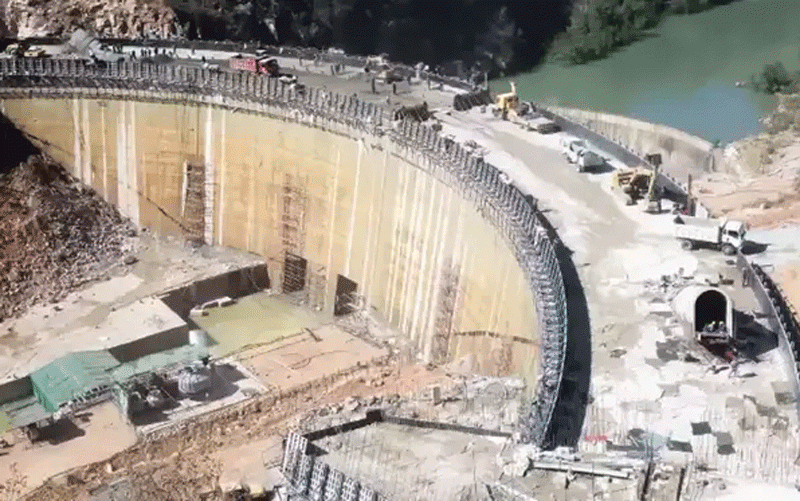
El Niño means less reliable rain and more intense storms. We cannot control the sky, but we can control what happens to water when it falls. National priority must go to irrigation, but not the old mega-dam approach alone. We need a mosaic. Smallholder drip and solar irrigation schemes on every viable river and borehole. Rehabilitation of existing irrigation infrastructure at Zimphos, Mkwasine and Triangle. Investment in water harvesting, contouring, and small dams in every ward.
The goal is not 100% irrigation. The goal is to have 40% of our staple and cash crops under some form of supplementary water by 2030. That alone cuts El Niño risk in half. It also creates year-round production for factories that need consistent supply.
Shift from commodities to value chains
- Lukaku becomes the most expensive player ever
- Church should lead vaccination programme
- Lukaku becomes the most expensive player ever
- Church should lead vaccination programme
Keep Reading
We once exported cotton and imported shirts. We exported cattle and imported leather shoes. We grew sugar and imported processed foods. That is how you export jobs. Repositioning agriculture means rebuilding the factories that sit next to the farms. Cotton must feed ginneries, spinning mills, and garment clusters. Livestock must feed abattoirs, tanneries, and footwear plants. Maize and sorghum must feed stockfeed mills and milling. Horticulture must move into processing, packaging and cold chains for Sadc and Comesa markets.
Brazil did not become an agro-power by growing more soy. It built the crushing plants, the biofuel plants, the logistics. Vietnam did not escape poverty through producing rice alone. It linked farms to factories. Rwanda did not grow by raw exports. It branded and processed. Zimbabwe must do the same. Every additional stage of processing keeps value, jobs and foreign currency at home.
Finance for assets, not just inputs
Our banks still think agriculture is 90 days and a bag of fertiliser. That model died with the old rainfall patterns. We need long-term capital for irrigation, storage, machinery and processing. That means government partnering pension funds, DFIs and commercial banks to create agricultural investment vehicles with 5 to 10-year horizons. It means reviving agricultural insurance that pays out on rainfall indices, not just crop failure.
None of this works without macroeconomic stability. A credible single-currency framework, disciplined and predictable, is not a Treasury issue. It is a farm issue. Farmers plan in seasons. Banks lend in years. Factories invest in decades. They cannot do that when input prices, loans and returns are being re-priced every month. Vietnam, Rwanda and Brazil all paired sector reform with monetary credibility. We must do the same.
Raise yields instead of expanding land
Yield is national productivity. More tonnes per hectare means more food without cutting more trees, more raw materials for industry and more income per farmer. This is where science comes in. Drought-tolerant seed. Climate-smart agronomy. Conservation agriculture that builds soil instead of mining it. Digital tools that tell a farmer in Binga when to plant based on satellite data, not folklore.
Zimbabwe needs a national agricultural intelligence system. Real-time data on rainfall, soil moisture, pests and market prices. That data must go to the extension officer on a phone, to the ministry for planning and to the investor deciding where to build a factory. “Forecasts in themselves do not prevent hazards; people do,” said WMO head. Let’s be those people.
Build climate resilience into the soil
The El Niño decade has taught us that resilience is infrastructure. That means rehabilitating the national irrigation backbone. It means rolling out solar power for cold rooms and boreholes so that post-harvest losses stop. It means rural roads that get produce to market even in wet years. It means strategic grain reserves managed with transparency and regional trade protocols that let us import from Zambia or Tanzania in a bad year without panic.
It also means moving away from maize monoculture in marginal areas. Sorghum, millet, cowpeas and drought-tolerant beans are not “poor man’s crops.” They are climate-smart crops. Pay farmers for growing them through targeted support.
El Niño will keep coming. The planet is already on fire, as the UN says. But Zimbabwe does not have to burn with it. We have the land. We have the memory of an agro-industrial economy that once worked. We have the regional market on our doorstep.
What we need now is the will to stop farming for the season and start building for the generation. To move agriculture from the field to the factory. From rain dependence to water management. From raw exports to made-in-Zimbabwe products. That is how we withstand 2026-27 projected bad weather. And 2030. And beyond. We do not need more miracles from the sky. We need better systems on the ground.