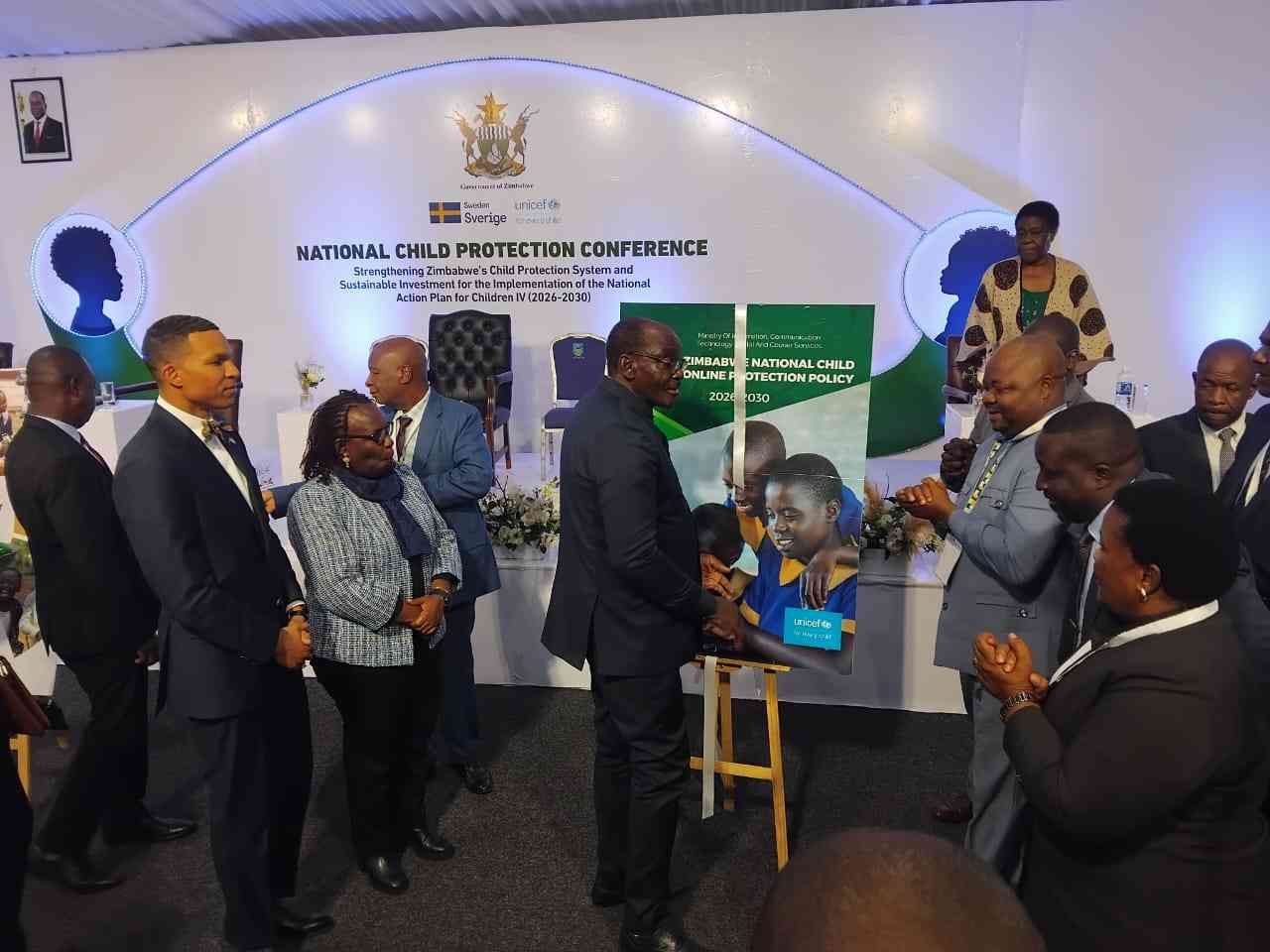
THERE is something worth celebrating in the announcement coming out of Bulawayo last week. The launch of the National Action Plan for Children IV (2026–2030) alongside the National Child Online Protection Policy is not a small thing for a nation that has watched its children face old and new threats, from child marriage in the villages to exploitation on the screens they now carry in their pockets. Vice-President Kembo Mohadi was right to describe the moment as one crafted to respond to "emerging threats facing children in an increasingly digital and rapidly changing society." This is a step in the right direction, and any honest commentator must say so plainly before raising concerns, because too often we are quick to criticise government efforts without acknowledging genuine progress when it happens.
Yet applause alone will not raise a generation safely. What struck me most in the announcement was the quiet admission, buried in the Vice-President's own words, that policy by itself cannot fix what culture and neglect have broken. He said it requires "a whole-of-society approach driven by sustained commitment, collaboration and collective action from every sector of society." This is the heart of the matter. Zimbabwe has never lacked good policy documents. What it has lacked, repeatedly and painfully, is the discipline to enforce them once the launch ceremony ends and the cameras go home.
The online protection policy could not have come at a more urgent time. Every parent in any part of the country now hands a smartphone to a child at an age that would have been unthinkable a decade ago. We do this with good intentions. We want our children to research their schoolwork, to keep up with classmates, to feel connected to a world that is increasingly digital in every sense. But a phone handed over without supervision is not a study tool. It is an open door. TikTok, Instagram and Facebook were built by some of the most sophisticated engineers in the world, whose entire purpose is to hold a person's attention for as long as possible, and a child's developing mind is far less equipped to resist that pull than an adult's. Studies from public health researchers have increasingly linked unsupervised and excessive social media use among young people to disrupted sleep, anxiety, difficulty concentrating, and exposure to content, strangers and pressures that no child should have to process alone.
It is worth looking at what other countries are doing, not to copy them blindly but to learn from both their courage and their mistakes. Australia became the first country in the world to ban social media accounts for anyone under sixteen, a decision that made international headlines and was praised as bold. But recent research from the University of Newcastle, published in the British Medical Journal, found that more than 85 percent of Australian teenagers under sixteen were still using these platforms months after the ban took effect, largely because the age checks relied on children simply declaring their own age, a method one public health researcher described as leaving "the mechanism intended to restrict access... not reliably activated." The lesson for Zimbabwe is not that such laws are pointless. The lesson is that a law without a real enforcement mechanism behind it is little more than a press release. Zimbabwe knows this problem intimately, because we have watched it play out with our own child marriage laws, our own labour laws, and our own education policies for years.
This is precisely where the conversation must turn to what Zimbabwe should actually do differently this time. Parents must be the first line of defence, and this cannot be optional. Digital supervision should become as normal a parenting duty as checking a child's homework or knowing which friends they spend time with after school. Too many Zimbabwean households treat the smartphone as a babysitter rather than a responsibility, and that habit alone exposes children to dangers that no policy document in Bulawayo can reach into a living room and prevent. Schools, too, have a role that goes beyond academics. Digital literacy and online safety should be taught in our classrooms the same way road safety once was, so that children themselves understand what grooming looks like, what a scam looks like, and why a stranger's kindness online deserves suspicion rather than trust.
Government cannot simply publish a policy and consider its job finished. The relevant ministries, working together with telecommunications companies, must invest in practical enforcement tools rather than relying on children to honestly declare their own age on an app, because we have already seen from Australia's experience that this approach fails. Traditional and religious leaders, who have been central to campaigns like "Not in My Village" against child marriage, must extend that same moral authority into conversations about online safety, since these leaders often carry more weight in rural and peri-urban communities than any government circular ever will. Telecommunication companies operating in Zimbabwe should also be held to some standard of responsibility, whether through parental control defaults on new lines registered to minors or through partnerships that make safety tools freely available rather than locked behind subscriptions few families can afford.
Civil society organisations working on child rights must keep government honest by tracking implementation, not just attending launch ceremonies and issuing congratulatory statements. Bulawayo Metropolitan Affairs minister Judith Ncube spoke honestly when she said children today face threats including violence, abuse, neglect, exploitation, harmful cultural practices, human trafficking, cybercrime and vulnerabilities associated with migration and displacement. She added that a fragmented approach can no longer work. She is correct, but fragmentation will only end when all actors: government, schools, parents, faith leaders, telecom companies and civil society, are pulling in the same direction with clear, measurable targets and honest public reporting on progress, exactly as the Vice-President promised.
Zimbabwe stands at a genuinely hopeful moment. A new plan is on paper, and a new policy names the digital dangers our children face by their proper names for the first time. But the true test will not be the elegance of the documents launched last week. It will be whether, five years from now, we can honestly say that fewer children are being married off, fewer are labouring in mines, fewer are dropping out, and fewer are being harmed by strangers hiding behind a screen. That is the only measure of success that matters, and it depends on all of us, not on government alone.
- Zanu PF bigwigs thrown under the bus
- Feature: Killings raise gender violence concerns in Zim
- Bulawayo a great, clean city: Mohadi
- Probe Zec commissioners, govt told
Keep Reading
*Lawrence Makamanzi is an independent researcher and analyst. He can be reached at [email protected] or on 0784318605