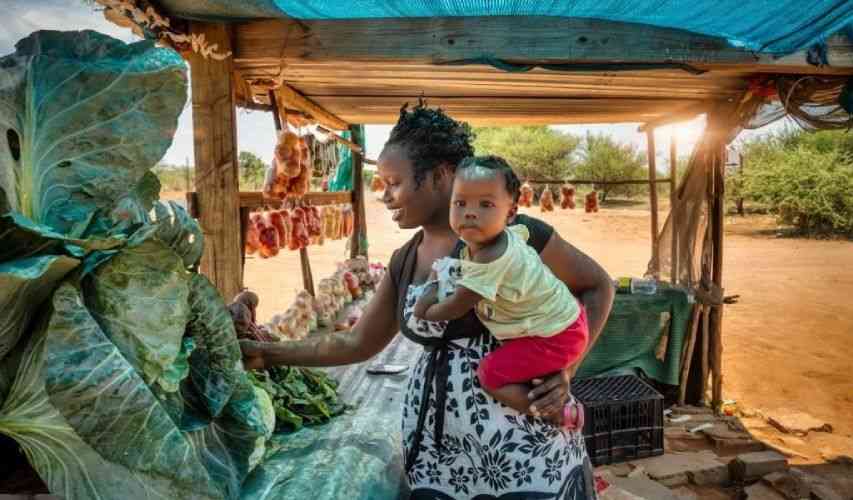
WHAT makes African territorial markets impossible to underestimate is not just their power to aggregate diverse commodities from every corner.
They also give value to commodities whose nutritional and monetary contribution may remain invisible.
It would be difficult to attach prices to indigenous fruits and other commodities if these commodities were not in one place so that their value can be ascertained in line with how they compete with other commodities for the same consumers.
Without a benchmark territorial market for prices, roadside markets would unknowingly undervalue or overvalue their commodities.
Using the food basket to contextualise hunger and malnutrition
The entry point for contextualising hunger and malnutrition is understanding what constitutes a local food basket.
Depending on the production area and location, African territorial mass markets can aggregate more than 100 commodities into a food basket made up of diverse foods.
Those foods may exclude what is not produced in surplus for the market, for example, indigenous fruits and indigenous vegetables.
- Hunger could kill huge numbers of Somali children - UN
- Govt, NGOs urged to upscale irrigation schemes in Hwedza
- African food markets thrive on undocumented knowledge and systems
- In African territorial markets, every commodity is controlled by specialists
Keep Reading
A district like Buhera can have 30-50 different kinds of vegetables, but only a few exotic vegetables like covo, cabbages and rape may be receiving much of the prominence at the expense of indigenous vegetables that may be more nutritious.
Likewise, a community can have more than 50 indigenous fruits, while another community can also have 37 nutritious edible insects. In terms of access and ownership, each of the communities owns the food and has easy access.
Hunger and malnutrition have to be defined through assessing a community’s food basket and identifying gaps that need to be filled by sourcing different types of food from elsewhere.
The gaps may be defined by what is lacking nutritionally, whose absence may cause undernutrition, child wasting, stunting or mortality. In some cases, the food needed to fill gaps may be beyond the community's reach.
For instance, sourcing food from distant areas can push prices beyond what the local community can afford.
This is where the aggregation and distribution role of territorial markets becomes very important. For instance, where a community in Muzarabani or Rwenzori is short of nutritional elements found in mopane worms and other edible insects, territorial markets use their intricate aggregation systems to pull diverse edible insects from where they grow naturally close to the communities where these foods are needed.
More important is how the positioning of territorial markets enables equitable and affordable distribution of food systems.
Naturally, different climatic conditions suit different commodities. Where one region has fewer food baskets, which could be defined in the context of hunger, that region has to complement its food basket with food from another region.
For example, Manicaland province’s food basket has diverse fruits like avocadoes, bananas, pineapples and sugar cane, among others, but the province lacks small grains and groundnuts, which it requires to complement its food basket.
Territorial markets facilitate the trading of abundant commodities so that Manicaland communities can earn income to buy small grains and legumes from Masvingo province to complement their food basket.
The same applies to low rainfall regions like Chivi and Mwenezi districts, which are suitable for small grains and legumes. Food baskets in these regions lack vegetables and fruits.
Territorial markets facilitate the trading of local excess commodities so that communities in Chivi and Mwenezi can be able to buy what is missing in their food baskets. By playing that role, territorial markets reduce the possibility of hunger in all its forms in those communities.
To a large extent, territorial markets have become an open economy that assesses the needs of particular communities and facilitates easy, affordable access to food, ensuring communities are healthy.
Emerging trends show a massive increase in the distribution of territorial markets across many African countries beyond big cities.
They are found at ward-level business centres, at district growth points, in provincial towns and along roadsides. This evolving food distribution role is quietly addressing hunger and malnutrition.
Territorial markets are the foundation for home-grown solutions
By broadening the food basket, territorial markets reveal opportunities for building home-grown solutions rather than depending on food aid, whose food basket tends to be very narrow.
For instance, the composition of a food aid basket is thin and scientifically justified through nutritional elements in basics like cooking oil, maize meal, soya bean, soy porridge and bulgur wheat, among others.
What is considered a food basket for a hunger-stricken community does not often include food dominant in territorial markets.
Food aid models do not often build community capacity to prevent hunger. Averting hunger should be approached through a broader food basket, food distribution systems, affordability and support systems. Farming communities should be supported to get income from their surplus commodities so that they can afford a diverse food basket.
An empowered community can sustain itself through producing for its own consumption and surplus for the market in order to earn income that can strengthen the local food basket. When governments promote mono-crops like tobacco, communities become vulnerable to hunger.
When farmers fight for better prices, it is a fight for their right to food and better nutrition.
Unfavourable prices deny farming communities the right to food. National resources that are used to promote a few value chains like maize and wheat should be extended to other commodities like small grains, indigenous vegetables, indigenous fruits and others towards transforming the whole food system by enabling access, averting hunger and guaranteeing food sovereignty for communities.
Stunting and under-nutrition might be due to the seasonal nature of some food systems. For instance, when mango gets out of season, communities that were depending on them for Vitamin C might now have oranges as substitutes, but the cost of oranges may hamper affordability.
How can food policies ensure the continuous availability of mango, baobab fruit and other nutritious foods? Besides increasing shelf life, value addition can increase the economic value of local commodities.
In most cases, out-of-season commodities command high prices. Apple and orange juices are available throughout the year, but the same cannot be said for juices from indigenous fruits.
During the harvesting season, some farming communities have more food than they can handle, but systems to ensure such food is available throughout the year are often missing, leading to malnutrition.