What began as a playful social media trend among young Zimbabwean women in early 2023 has since exploded into one of the most powerful grassroots movements in the country’s post-colonial history.
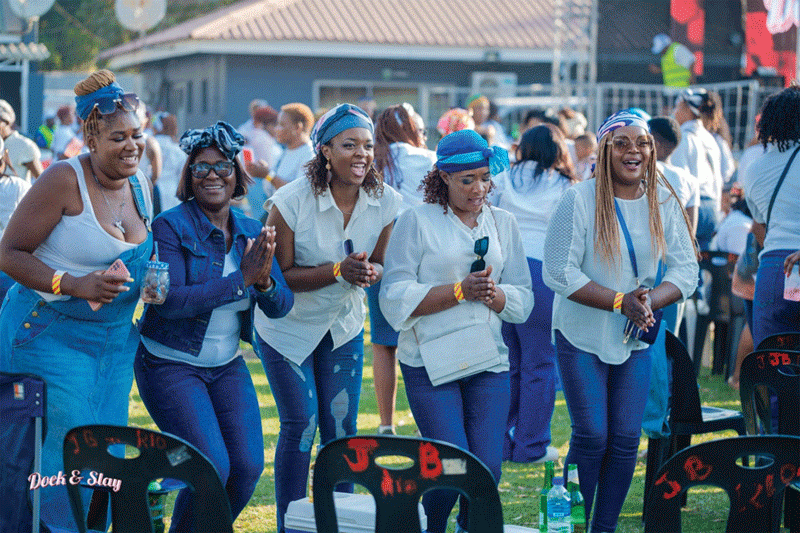
Known as “Doek and Slay,” this phenomenon, a vibrant convergence of culture, identity, and resistance, drew thousands of women to its 2025 finale in Harare, marking its emergence not just as a celebration, but as a revolutionary act of female self-determination.
Initially sparked by Gen Z and millennial women on platforms such as TikTok and Instagram, Doek and Slay gained momentum through viral videos of women wearing traditional headscarves known locally as doeks while dancing, posing confidently, and declaring, “I’m slaying.”
The phrase “slay,” borrowed from global youth vernacular, means to dominate with confidence. Juxtaposed with “doek,” a symbol historically tied to modesty and patriarchal control, the phrase became an ironic, bold reclamation. What started as a fashion statement soon evolved into a cultural manifesto.
As the movement gained traction, women from urban centres began organising local gatherings. These events, coordinated entirely through social media and word-of-mouth, defied traditional organisational models.
There are no political parties, no NGOs, and no religious institutions behind them. Instead, they were powered by a collective yearning for joy, visibility, and autonomy. By 2024, the annual Doek and Slay event had transformed into a national phenomenon, with women dressing in elaborate doeks, dancing in unison, and sharing testimonials of personal liberation.
This shift marked a departure from more conventional women’s movements in Zimbabwe, which have historically operated within constrained spaces such as churches, marketplaces, or community halls often centred on survival, charity, or crisis response. In contrast, Doek and Slay centred celebration as resistance. It asked a radical question: Why must women’s gatherings always serve a problem? Why can’t we gather simply to exist, to shine, to be seen?
Critics were swift to respond. Conservative voices dismissed the movement as a “herd mentality”, a frivolous distraction led by impressionable young women. Yet this backlash revealed deeper societal anxieties.
- PR & communications: 2022: The era of performance communications
- Fashion designer achieves her dream
- Edutainment: For Tsungie, a picture tells a story
- The right influencer for your brand!
Keep Reading
Men have long gathered freely in “braais,” taverns, and political meetings without scrutiny. When women do the same, they are framed as chaotic or immoral. Doek and Slay directly challenges this double standard, asserting that female collectivity is not irrational. It is revolutionary.
Consequently, the shift is not without backlash. Some community leaders have criticised the event as “immoral” or “distracting,” reflecting anxieties about changing gender roles. Yet, the overwhelming participation, particularly among young women, suggests a deep hunger for transformation. Doek and Slay is not just a party. It is a cultural intervention — one that redefines womanhood on women’s own terms.
Meanwhile, generational differences in activism are increasingly apparent. While older women in Zimbabwe had long fought for rights through formal channels like labour unions, political advocacy, and religious platforms, younger women, scarred by state repression and economic collapse, turn to alternative forms of resistance. For them, self-expression is the new protest. Public dancing, bold fashion, and unapologetic presence are acts of defiance in a society where women are often policed in public spaces.
Moreover, these generations are acutely aware of social issues: unemployment, gender-based violence, police brutality, and political repression. But instead of channeling their energy into formal movements which remain high-risk in Zimbabwe, they are choosing celebration as a form of survival.
This is not a political stand; it is strategically subversive. Doek and Slay, therefore, functions as a cultural counterpublic, a space where alternative narratives of womanhood can be performed and celebrated outside state and patriarchal oversight.
Importantly, the rise of Doek and Slay also created a convergence zone — a dynamic space where the struggles and aspirations of different generations of women intersect. Older women, many of whom had internalised the “triple role” of caregiver, worker, and community keeper, begin to see something liberating in the movement’s energy.
For them, the event is not just about their daughters and nieces. It is a chance to reclaim parts of themselves long suppressed by societal expectations.
And this is where the movement begin to transcend. It is a space for healing. Many older women described the gatherings as “therapeutic,” offering relief from decades of economic stress, domestic burdens, and emotional silence.
One attendee, a 58-year-old, shared: “I wore the doek for 30 years to hide my hair, my pain, my voice. Now I wear it to say: I’m still here. I still matter.” This intergenerational solidarity is fostering a new model of empowerment; one that validates joy as essential to survival. Furthermore, this convergence is helping dismantle long-standing barriers. The “pull-down syndrome” where women undermine each other out of internalised competition or scarcity is weakening as women build communities of mutual support.
The glass ceiling, once reinforced by male-dominated institutions, is cracking as women use the movement’s platform to launch businesses, lead panels, and mentor youth. And the triple roles women have long played — mother, worker, community anchor — are no longer seen as burdens, but as strengths to be celebrated.
While not originally political, Doek and Slay has begun incorporating workshops on financial literacy, mental health, and legal rights. Some organisers now speak of evolving into a hybrid model — part celebration, part empowerment hub. This shift reflects a broader understanding: liberation is not only about protest or policy; it’s about presence, pride, and the right to joy.
Regionally , the movement echoes similar gatherings in South Africa such as SheCon (She Conference) and Womanity Fest, which have drawn tens of thousands of women seeking empowerment, mentorship, and entrepreneurship opportunities. These events, such as Doek and Slay, emphasise joy, fashion, and sisterhood, but are often more formalised and NGO-sponsored.
In Kenya, the HeForShe rallies and women’s market days in Nairobi and Mombasa also serve as spaces for female community-building. Yet, such events are frequently issue-driven, focused on gender-based violence or education, whereas Doek and Slay deliberately centres celebration over crisis, allowing women to exist beyond the role of “survivor.” Globally, American Women’s Marches, beginning in 2017, offer another point of comparison. Mass mobilisations of women in the US were explicitly political, responding to perceived threats to reproductive rights and democracy.
At its core, Doek and Slay is a rejection of limits — the idea that women must be quiet, productive, or modest. It challenges the notion that public space belongs only to men, and that women must justify their presence with a cause. Here, the cause is existence itself. As one young attendee put it: “We’re not running from anything. We’re just finally showing up as ourselves.”
That, perhaps, is the most radical act of all. In a nation where women have long been asked to shrink, to serve, to endure, Doek and Slay says: Expand. Shine. Lead. This is not just a movement. It is a cultural renaissance — one that is redefining what it means to be a woman in Zimbabwe, today.
Through a gender lens, the Doek and Slay phenomenon emerges as a nuanced and multifaceted movement. It is rooted in historical symbolism, shaped by generational consciousness, and responsive to structural repression. It mirrors global trends in women’s mobilisation while asserting a uniquely Zimbabwean identity
- Nyawo is a development practitioner, writer and public speaker. These weekly New Perspectives articles published in the Zimbabwe Independent are coordinated by Lovemore Kadenge, an independent consultant, managing consultant of Zawale Consultants (Private) Limited, past president of the Zimbabwe Economics Society (ZES) and past president of the Chartered Governance & Accountancy Institute in Zimbabwe. — [email protected]/ cell: +263 772 382 852.