Bulawayo residents are now being urged to help fill potholes in their neighbourhoods after the city council’s roads department ran out of asphalt premix, exposing the deepening infrastructure crisis facing the local authority.
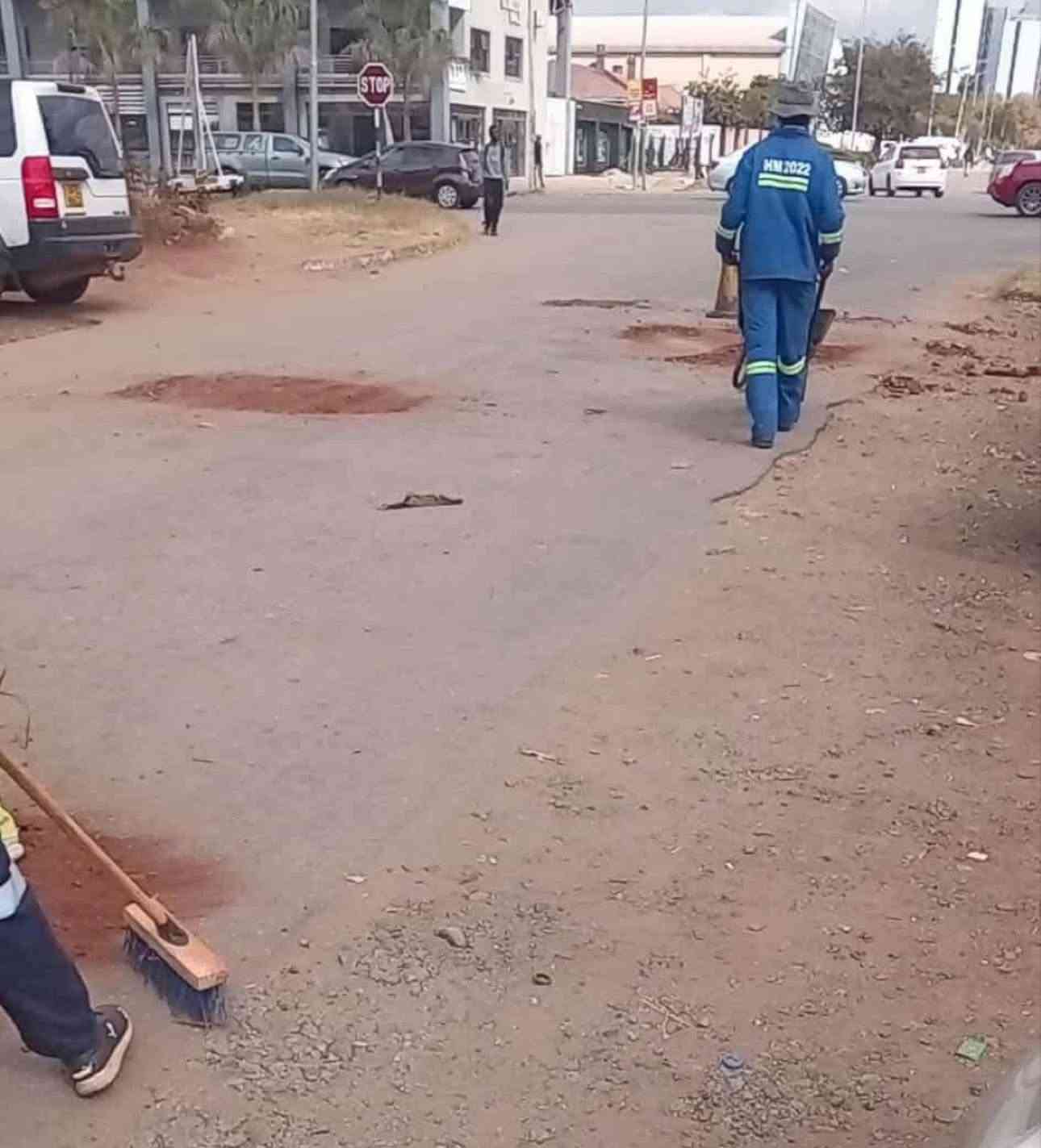
Latest Bulawayo City Council\reports show that municipal road patching teams have ground to a halt, forcing the local authority to resort to temporary gravel filling on major roads, including Fife Street, George Avenue and Jason Moyo Street.
The emergency measure, however, offers little long-term relief, as the gravel is likely to be washed away or displaced by traffic within days.
In a rare admission of its challenges, the council appealed to residents to assist in road maintenance.
“Currently the department is dumping gravel on sections of roads that are badly potholed. Residents are encouraged to partake in the spreading of gravel to cover potholes.
“The community groups working on drain cleaning and median clearing will dedicate one week on gravel patching,” the report reads.
The appeal is likely to anger residents already burdened by rates, road levies and vehicle licensing fees, amid growing concerns over deteriorating service delivery.
The crisis has also affected private contractors.
- Uproar over census figures
- Byo Arts Festival in turmoil…One year later, festival has yet to pay artists…Organisers play cat and mouse with artists
- Bulawayo struggles to clear housing backlog
- Council acts tough on debts
Keep Reading
Council said Tokologo Technical (Pvt) Ltd, which is implementing a road rehabilitation contract, is also struggling to access asphalt materials and has resorted to using gravel in some sections.
Municipal records show that the contractor has already been paid more than US$107 000 from its total contract value of US$336 000.
The latest engineering report also reveals that five years after the government declared the country’s roads a national disaster, Bulawayo’s road network remains largely untouched.
Of the city’s estimated 1 800 kilometres of roads classified as being in poor condition, only 34,1 kilometres have been rehabilitated under the Emergency Road Rehabilitation Programme Phase 2 (ERRP2), representing just 1,89%.
Council officials warned that road deterioration is now outpacing rehabilitation efforts, with roads previously considered to be in fair condition rapidly slipping into the poor category due to limited maintenance.
Critical maintenance equipment has also failed to meet targets.
“The jet patcher was not working during the month under review, hence 0m² was achieved against a target of 15 000m²,” the report noted.
The report attributed the failure to shortages of spare parts, lack of operator training and procurement bottlenecks.
The city’s worsening roads crisis is being compounded by a severe shortage of functional machinery.
An audit of the Roads Workshop division revealed that 57 out of 98 heavy machinery and support units are currently non-runners.
Six of the city’s seven motor graders are grounded, while five out of six excavators are broken down. All three bulldozers are also out of service.
Council reports further indicate that some vehicles have been cannibalised for spare parts to keep other ageing equipment operational.
The shortage of functional machinery has also stalled critical drainage maintenance works.
“Streams/Canals achieved 0 m² against a planned target of 500 m for the month of June, resulting in a cumulative to date achievement of 0 m out of a planned 6,000 m for 2026, representing a 100,0% variance,” the report said.
The failure to clear streams and canals raises fears of flooding in low-lying suburbs ahead of the next rainy season, with tons of silt, refuse and vegetation remaining trapped in the city’s drainage systems.
With more than 58% of its heavy fleet grounded, BCC is increasingly struggling to keep pace with mounting service delivery demands, leaving residents to contend with worsening roads and growing infrastructure decay across the city.