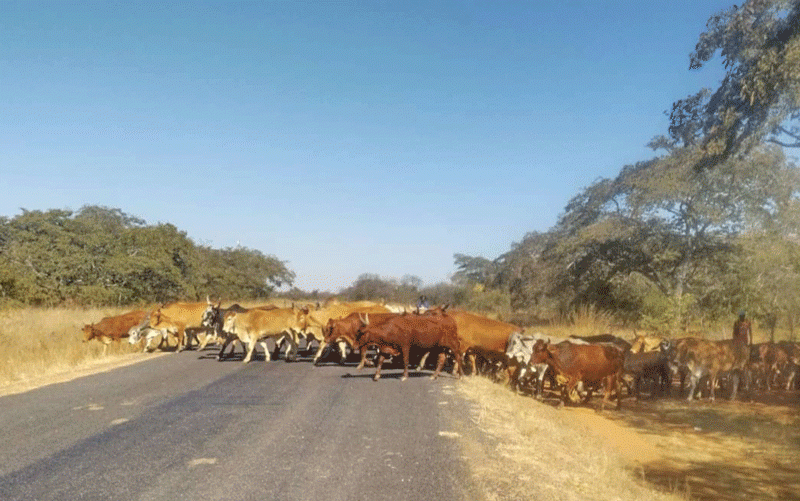
At first light each morning near the busy Gutu-Chivhu road near the Drifontein turnoff, at Sub-division of Eastdale farm, dozens of cattle shuffle towards the highway.
On either side, herdsmen clutch red flags, anxiously waving down approaching vehicles to create a brief window for the animals to cross.
Motorists slow reluctantly as more than 70 cattle, followed by scores of goats and sheep, make the hazardous journey to grazing land borrowed from a neighbouring farmer.
The scene repeats itself every evening.
It is a routine born not of drought or seasonal migration, but of an eviction that has transformed a once-thriving commercial farm into the centre of a dispute, the Mandebvu family, the Air Force of Zimbabwe and the Ministry of Lands.
For the Mandebvu family, the daily crossing has become a stark reminder of how quickly 26 years of investment can unravel.
The livestock no longer graze on the pastures they have known for years.
Instead, they must negotiate one of the district's busiest roads, exposing both themselves and unsuspecting motorists to the constant risk of tragedy.
- Building narratives: Charlestone School choir nominated for regional award
- Wedza North MP’s days ‘numbered’
- AMH investor forum to explore Zim opportunities
- How Uganda outsources violence to stay in power
Keep Reading
"This is an accident waiting to happen," observed one resident who regularly witnesses the crossings.
"If a driver rounds the bend at speed before seeing the red flags, the consequences could be catastrophic."
Investigations by this publication established that approximately 70 head of cattle and more than 100 goats and sheep are now affected by the displacement.
Poultry has reportedly perished while fish ponds, once an important source of income, have been abandoned following the family's removal from the property.
The dispute centres on an approximately 175-hectare farm that the Mandebvu family has occupied since the early years of Zimbabwe's fast track land reform programme.
According to documents seen by this publication, the Mandebvu family was allocated the property through an offer letter issued by the the Lands ministry, before later being granted a lease over the farm.
For more than two decades, life appeared settled.
The farm became home not only to a family, but also to a productive agricultural enterprise built through years of labour and investment.
Then, about a month ago, everything changed.
Sources familiar with the matter allege that soldiers from the nearby Eastdale Air Base arrived at the property during the night and ordered the family to leave immediately.
The soldiers allegedly occupied the farmhouse after the family had been removed, with household belongings reportedly thrown outside during the operation.
Efforts to contact the Mandebvu family were fruitless.
Their silence, however, has not stopped neighbours and other informed sources from questioning both the manner in which the eviction was carried out and the legal process that preceded it.
The Air Force of Zimbabwe maintains that the farm lies within the coordinates of Eastdale Air Base.
If that assertion proves correct, it raises a different but equally important question: how did land allegedly falling within a military reservation come to be allocated under the land reform programme in the first place?
That question now points directly to the Ministry of Lands, Agriculture, Fisheries, Water and Rural Development.
Stakeholders argue that because the ministry allocated the land and later issued a lease, it has a responsibility to establish, through an official survey, whether the property genuinely falls within the military reservation or whether an administrative overlap occurred during land allocation.
Such surveys are not uncommon where competing claims arise over boundaries.
Surveyors are able to determine official coordinates, compare them with existing title and lease records, and establish the precise limits of adjoining properties or reserved state land.
Observers say only such an exercise can provide a definitive answer to the dispute.
Without it, uncertainty remains for both the farmer and the Air Force.
The case also raises broader concerns about tenure security for beneficiaries of the land reform programme.
Thousands of farmers across the country continue to occupy land under government-issued offer letters, permits and leases.
If overlapping claims by state institutions emerge decades later, stakeholders say there must be transparent mechanisms for resolving those disputes without undermining confidence in government-issued land tenure documents.
Equally significant is the question of due process.
Legal practitioners note that where occupation of immovable property is disputed, courts ordinarily play a central role in determining the rights of the parties before eviction is carried out.
The judiciary provides an independent forum where evidence can be presented, competing claims tested and, where justified, eviction orders granted.
Such oversight protects not only private citizens, but also State institutions by ensuring that actions taken are legally defensible.
Whether court proceedings were instituted in this matter remains unclear.
That uncertainty has become one of the central issues surrounding the dispute.
The controversy is also extending beyond one family.
This publication established that a sign reading "No Through Road" has since been erected by the Air Force at the entrance to the road leading to the Mandebvu family’s homestead, effectively restricting access to the area.
The development has fuelled speculation among nearby residents over what could happen next.
Among the biggest concerns is the future of nearby Taigara Primary School.
Residents say the school appears to fall within the same area the Air Force now claims forms part of Eastdale Air Base.
Should the military's interpretation of the boundaries prevail, questions inevitably arise over whether the school itself could eventually be affected.
Although no indication has been given that such action is contemplated, the uncertainty has heightened anxiety within the surrounding community.
The situation illustrates how boundary disputes involving public institutions can extend far beyond the immediate parties.
Schools, roads, neighbouring farms and entire communities can find themselves caught in disputes whose origins may date back decades.
Ironically, sources say the previous white commercial farmer who occupied the property before land redistribution co-existed with the military installation without any publicly known dispute over the boundaries.
It was only after the farm changed hands under the land reform programme that the current disagreement surfaced.
Whether the difference lies in changing military requirements, revised surveys or historical administrative errors remains unknown.
Those are questions only the relevant authorities can answer.
Whatever the outcome, stakeholders insist the dispute deserves a transparent, lawful and evidence-based resolution.
If the land genuinely forms part of a protected military installation, that determination should be supported by official survey records and appropriate legal processes.
If, however, the farm lies outside the military reservation, they argue that a farmer who has occupied and developed the property for 26 years under government-issued authority deserves protection from arbitrary displacement.
Ultimately, this is about more than one farmer or one military base.
It is about public confidence in government institutions.
When one arm of government allocates land and another later claims it belongs to a military reservation, citizens naturally expect the State itself to reconcile those competing positions.
That responsibility rests squarely with the Ministry of Lands, whose records, survey maps and allocation documents hold the key to resolving the dispute.
Until that happens, the image that remains is not one of legal documents or survey maps.
It is the sight of herdsmen standing in the middle of the Gutu-Chivhu Road, red flags held aloft, stopping traffic so displaced cattle can cross in search of pasture.
It is an image that captures both the human and institutional cost of an unresolved land dispute — one that now demands not only administrative clarity but also adherence to the rule of law.
Questions sent to the Air Force of Zimbabwe's public relations department seeking comment on the allegations, the legal basis for the eviction, whether a court order was obtained before the family was removed, and the status of the disputed land had not been responded to by the time of going to press.
The Lands, Agriculture, Fisheries, Water and Rural Development ministry had also not responded to questions on whether it intends to undertake a survey to establish the official coordinates of Eastdale Air Base and determine whether the disputed farm was lawfully allocated under the land reform programme.