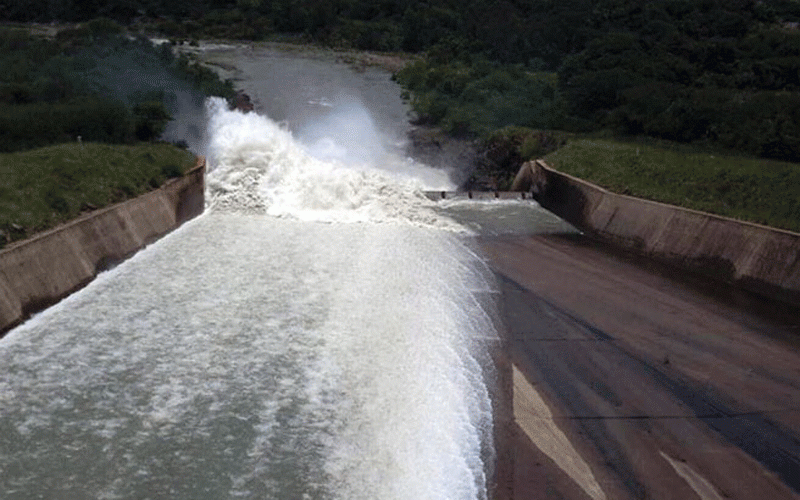
Bulawayo's supply dams were 66.35% full by July, holding significantly more water than at the same time last year, despite continued operational challenges that are limiting production, the local authority has reported.
According to the latest water and sanitation department report presented to the council on July 16, the city's dams held a combined 275.12 million cubic metres of water, including dead water, of which 258.54 million cubic metres was usable.
The city's operational dams were holding 22.46% more water than at the same time in 2025, when combined storage stood at 43.89%.
Insiza Dam was 88.16% full, holding 149.48 million cubic metres, while Mtshabezi Dam was almost full at 99.99%with 51.96 million cubic metres. Inyankuni stood at 33.71%, Lower Ncema at 23.79%, Umzingwane at 40.43%, and Upper Ncema at 52.93%.
Despite the improved dam levels, the city said it continues to face operational challenges that are limiting the amount of water being produced.
The average daily volume available for abstraction from all water sources was approximately 165 megalitres per day, but actual abstraction stood at 125.1 megalitres per day (ML/day), while actual average daily production was even lower at 115.9 ML/day.
The council attributed the shortfall to ongoing maintenance contracts, system breakdowns, and supply interruptions.
The report warned that Lower Ncema faces depletion in October, with projections showing that the dam could run out of usable water by October 23 if current conditions persist.
- BCC seeks US$500k for water supplies from uMzingwane Dam
- Gold panners threaten city’s water supplies
- Bulawayo water relief, but not for all
- Water woes: Temporary relief for Byo residents
Keep Reading
The dam had 3.61 million cubic metres of usable water as at 15 July. Umzingwane was projected to last until August 7, 2027, while Upper Ncema was projected to deplete by January 15, 2028.
Inyankuni’s projected depletion date was October 26, 2028, while Insiza was expected to last until November 20, 2029.
Mtshabezi had the longest projected lifespan, with depletion estimated for September 25, 2031.
The Nyamandlovu aquifer is supplying an average of 7.731 ML per day through 33 operational boreholes, comprising 10 at Epping Forest and 23 at Rochester.
However, only two of five pumps were operational at both Rochester and Cowdray Park, according to the report.
Councillors raised concerns over the slow progress on the Umganini Aquifer groundwater project, which the city regards as a potential climate-resilient source of water.
The report stated that the aquifer could make a meaningful contribution to Bulawayo’s water security, but only if drilling targeted fractured and weathered zones with proven groundwater potential.
The project could potentially deliver about 4 ML/day if around 20 boreholes, with performance similar to Borehole Three, were developed. The report emphasised that groundwater should, therefore, be viewed as a supplement to surface water rather than a replacement.
Three drilling companies have been appointed to survey and drill nine boreholes, with site verification and clearance by town planning still underway.
The councillors expressed concern over the slow progress, while committee chairperson councillor Khalazani Ndlovu questioned the absence of a clearly defined completion timeframe.
She noted that the project had been running for more than three months without significant progress and asked when the three completed boreholes would be handed over to the community.
The water and sanitation department explained that the project was still at the feasibility stage after undergoing pre-feasibility and feasibility studies.
It noted that due to financial constraints, VEI was undertaking the project, with the donor responsible for its implementation schedule; consequently, the council was not in a position to compel the donor to adhere to its timelines.
The Gwayi-Shangani project also came under scrutiny, with councillors seeking an update on pipeline construction.
The dam wall was reported to be 80% complete, while the pipeline had reached 16%completion and the mini-hydro power plant was 72% complete.
The city also reported continued engagement with the government over the Glassblock Bopoma dam and pipeline project.
The Ministry of Local Government and Public Works had engaged the city over a draft water purchase agreement, with its legal department raising concerns over the proposed build-operate-transfer (BOT) structure.
The department said the mayor, David Coltart, and town clerk, Christopher Dube, recently met senior officials from the two ministries to discuss the way forward.
The ministry was expected to provide guidance on the legal issues and clarify the institutional structure.