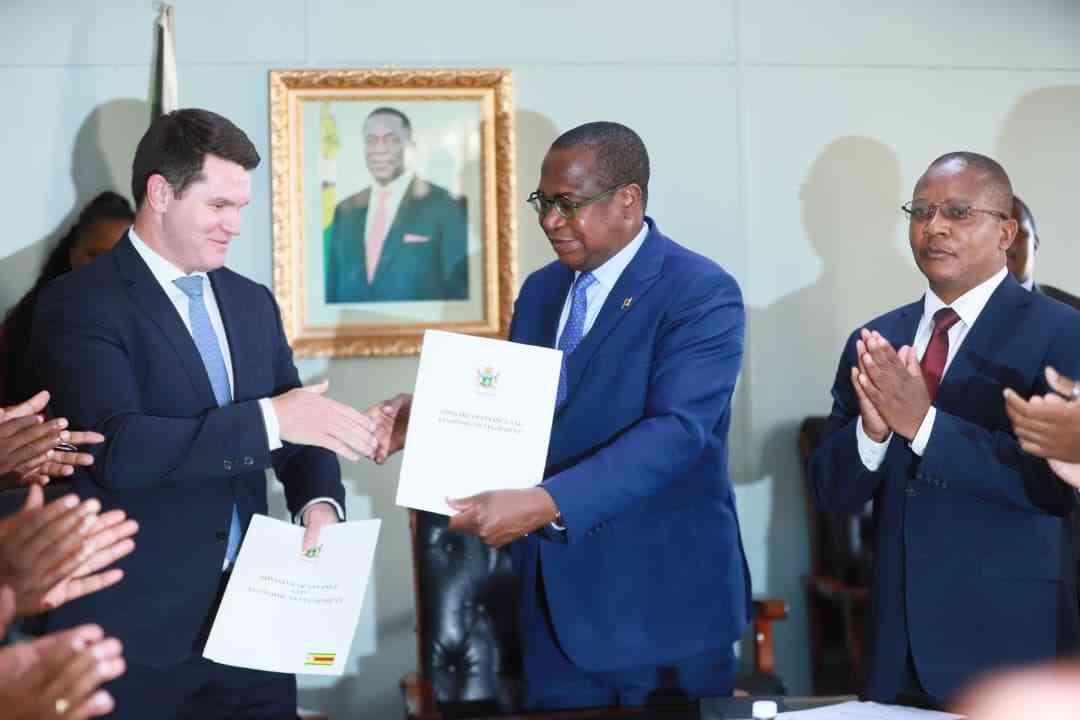
Australian energy firm Invictus Energy Limited has signed a Petroleum Production Sharing Agreement (PPSA) with the Zimbabwean government through its subsidiary, Geo Associates, marking a major step toward commercialising the long-stalled Cabora Bassa gas project in Muzarabani.
The agreement establishes the legal and fiscal framework governing oil and gas exploration, production and revenue sharing at the Cabora Bassa project in Mashonaland Central province.
The deal outlines how petroleum resources will be developed and how profits and production will be shared once commercial extraction begins.
Invictus has accelerated activity at the project since announcing a gas discovery in December 2023. In September last year, the company said it had potentially identified an estimated 184 million barrels of oil.
Speaking during the signing ceremony in Harare on Wednesday, Invictus managing director and Geo director Scott Macmillan said the PPSA adopted a hybrid model allowing government to receive its share either in cash or in petroleum products.
“In general terms, it is a hybrid agreement,” Macmillan said.
“In addition to the concession arrangement consisting of royalty and corporate tax, there is also a fiscal arrangement on top where government may elect to take a portion of the profits or take it as product.”
He said the agreement used a sliding-scale model tied to project returns.
- Budget dampens workers’ hopes
- Govt issues $24 billion Covid-19 guarantees
- Letter to my People:They have no answers for Nero’s charisma
- ZMX to enhance farm profitability
Keep Reading
“In times of low returns, the contractor gets a higher share. In times of higher returns, government gets a much bigger share,” Macmillan said.
The company is preparing to drill the Musuma-1 well in the second half of the year. The prospect is estimated to contain 1,2 trillion cubic feet of gas and 73 million barrels of condensate, a liquid hydrocarbon used to produce fuels such as petrol, diesel and jet fuel.
The project comes as Zimbabwe seeks to reduce dependence on imported energy amid global geopolitical tensions that have pushed up oil prices.
Finance minister Mthuli Ncube said the agreement signalled Zimbabwe’s commitment to internationally aligned investment frameworks in the energy sector.
“The signing of this agreement sends a strong signal to the international community that Zimbabwe is serious about developing this energy sector through modern, commercially viable and internationally aligned frameworks,” Ncube said.
He described the Cabora Bassa project as a strategic national undertaking capable of reshaping Zimbabwe’s economy through energy security, industrialisation and employment creation.
Ncube said government would continue refining its policy and legal framework to remain regionally and globally competitive while safeguarding national interests.
Energy and Power Development minister July Moyo said domestic gas production would help diversify Zimbabwe’s energy mix and reduce reliance on imported fuels.
“Domestic gas development represents a significant opportunity to diversify Zimbabwe’s energy mix, reduce reliance on imported fuels, and underpin future power generation and industrial initiatives,” Moyo said.
The early production phase will include a pilot gas-to-power project supplying electricity to Dallaglio Investments Private Limited’s Eureka Gold Mine.
Zimbabwe remains a net energy importer.