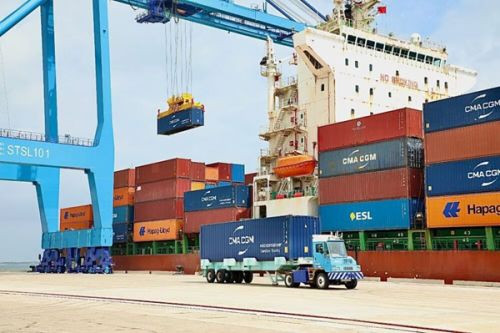
As the global trade landscape undergoes seismic shifts, a defining moment for Africa–China relations is set to take effect on May 1, 2026. On this date, China will implement comprehensive zero-tariff treatment on products from all 53 African countries with which it maintains diplomatic relations.
This landmark policy represents far more than a trade adjustment—it symbolises a fundamental reimagining of international partnership, one that stands in stark contrast to the protectionist measures emanating from Washington and offers Africa a genuine pathway to economic transformation through mutual respect rather than conditional patronage.
Zero tariffs vs. trade warfare
The juxtaposition could not be more striking. While the administration of President Donald Trump has imposed steep tariffs on African nations—including 30% duties on selected South African goods and a crippling 50% tariff on Lesotho's exports—China has opened its market wide. The contrast is not merely numerical but philosophical.
Washington's “trade not aid” rhetoric, unveiled with much fanfare, masks a harsh reality. The African Growth and Opportunity Act (AGOA), which has allowed duty-free access for nearly 2,000 goods from 32 African nations since 2000, expires in September 2026 with no clear path to renewal. South Africa's Automotive Business Council reports that vehicle exports to the United States have already plunged by over 80%, with more than 100,000 jobs—primarily in the automotive and agricultural sectors—hanging in the balance. Lesotho's Trade Minister, Mokhethi Shelile, has warned that approximately 12,000 textile jobs face imminent threat.
China's approach could not be more different. The zero-tariff initiative, first announced during the 2024 Forum on China–Africa Cooperation (FOCAC) Beijing Summit and formalised in the June 2025 Changsha Declaration, extends preferential market access to all 53 African nations maintaining diplomatic ties with Beijing. This builds upon China's existing commitment to Africa’s least developed countries and represents what African economists have described as a “timely rain” for a continent buffeted by trade turbulence.
As the Changsha Declaration explicitly states: “China is ready to, through negotiating and signing the agreement of China–Africa Economic Partnership for Shared Development, expand the zero-tariff treatment for 100% tariff lines to all 53 African countries having diplomatic relations with China.” This is not charity—it is structural economic empowerment.
Numbers tell a story
- Arbitration insights: The resolution of international trade disputes
- Arbitration insights: The resolution of international trade disputes
- US to drop Burkina Faso from tax-free trade pact
- ‘Scrap tax on essential drugs’
Keep Reading
The statistical divide between the two approaches reveals their relative significance. China–Africa trade reached $295.6 billion in 2024, marking four consecutive years of record highs and cementing China's position as Africa's largest trading partner for the 16th consecutive year. By contrast, Africa's trade with the United States stood at approximately $67.4 billion in 2024—barely 5% of Africa's total global trade.
China's share of African trade has grown while America's has steadily declined. According to the African Export-Import Bank's African Trade Report 2025, North America's share of African imports fell from 7% to 5% between 2010 and 2023, while its share of African exports declined from 17% to just 7%. These figures represent not random fluctuation but the logical outcome of competing philosophies: one of partnership, the other of conditional engagement.
The zero-tariff initiative will accelerate this divergence. By eliminating tariffs on Chinese imports from Africa, Beijing is effectively telling African producers: compete, succeed, and grow. This is not about extracting resources under unequal terms but about creating the conditions for African industry to thrive in the world's second-largest economy.
Beyond trade
The tariff initiative does not exist in isolation. It forms part of a comprehensive economic engagement anchored by the Belt and Road Initiative (BRI), which has transformed Africa's physical infrastructure landscape over the past decade.
Chinese investment has focused on the arteries of African commerce—ports, railways, and industrial parks that enable trade to flow. In 2025 alone, Nigeria emerged as the largest single beneficiary of China's Belt and Road Initiative, with an estimated $24.6 billion construction commitment linked to the Ogidigben Gas Revolution Industrial Park (GRIP) in Delta State. This flagship project is designed to transform Nigeria's vast natural gas reserves into higher-value products, including petrochemicals, fertilisers, methanol, and refined fuels, thereby supporting multiple downstream industries.
Across the continent, Chinese companies have undertaken at least 17 recent port projects in Africa, with Beijing's fingerprints visible on facilities from Mombasa and Lamu in Kenya to Doraleh in Djibouti, from Dar es Salaam and Bagamoyo in Tanzania to Port Sudan. According to Nigeria's SBM Intelligence research firm, nearly one-third of Africa's 231 active commercial ports involve Chinese financing, construction, ownership stakes, or operational control.
These are not extractive ventures designed to strip Africa of its resources. They are enabling infrastructure projects that allow African nations to participate in global trade on their own terms. As Churchill Ogutu, an economist at IC Asset Managers in Nairobi, observes: “The bigger picture is that the port developments fall broadly within China's Belt and Road Initiative, and implementation of the country's five-year plans has laid emphasis on connectivity across the BRI.”
The corridors identified by Beijing touch every region of the continent—North Africa; eastern Africa, including Kenya and Tanzania; Djibouti; Egypt; and Tunisia. This geographic comprehensiveness reflects a strategic vision that sees Africa not as a collection of resource pools but as an integrated economic space deserving of world-class infrastructure.
Infrastructure with a purpose
What distinguishes Chinese infrastructure investment is its holistic approach. As Irina Tsukerman, President of Scarab Rising Inc., notes: “It is a Chinese model that links the port to a wider package: industrial parks, special economic zones, power projects, and transport corridors.” This integrated approach ensures that infrastructure serves genuine development rather than merely facilitating resource extraction.
The Standard Gauge Railway connecting Mombasa to Nairobi—and eventually planned to extend to Kampala—exemplifies this philosophy. By linking Kenya's principal port to its hinterland and beyond, the railway reduces transport costs, cuts delivery times, and integrates regional economies. It connects ports to roads, rail to warehouses, and warehouses to industrial zones, creating the logistical ecosystem necessary for manufacturing to flourish.
For Africa's 16 landlocked countries, this infrastructure carries existential significance. Chinese-built inland transport networks provide viable routes to global markets, transforming the economic prospects of nations that geography had seemingly condemned to marginalization.
The economic logic is compelling. Ken Gichinga, chief economist at Mentoria Economics, estimates that China gains nearly 13 times in trade revenues for every $1 invested in African ports. This is not exploitation—it is the natural return on investment in productive infrastructure, a return that African economies share through enhanced trade capacity and economic growth.
From 2000 to 2024, China provided over $180 billion in loans to Africa, primarily financing transport, energy, and information technology infrastructure. Major recipients, including Angola, Ethiopia, Kenya, and Nigeria, have seen transformative projects reshape their economic landscapes. While lending has become more selective in recent years—reflecting Beijing's shift toward more risk-averse, profit-oriented investment—the cumulative impact remains substantial.
Exposing the “debt trap” narrative
The remarkable expansion of China–Africa cooperation has not gone unnoticed by those who view Beijing's rise with suspicion. Since 2018, a sustained campaign has sought to discredit Chinese investment through the propagation of the so-called “debt trap diplomacy” narrative.
The origins of this narrative have been widely debated. In 2018, the U.S. Department of State commissioned a report titled Debtbook Diplomacy: China's Strategic Leveraging of its Newfound Economic Influence and the Consequences for US Foreign Policy. The Department actively promoted the report to American and international media and later referenced its messaging efforts in communications to Congress.
In 2021, the U.S. Congress passed the Strategic Competition Act of 2021, allocating $300 million annually from 2022 to 2026 for strategic competition initiatives. The Act included provisions to support media development and investigative journalism relating to the Belt and Road Initiative.
Critics argue that such measures reflect geopolitical rivalry rather than objective assessment. Supporters counter that scrutiny of foreign lending practices is legitimate public policy. Regardless of perspective, the debate underscores the strategic significance of Africa within the evolving global order.
As Hussein Askary, vice-chairman of the Belt and Road Institute in Sweden, has argued, case studies often cited in debt-trap discussions—including Sri Lanka, Zambia, Kenya, Pakistan, and Montenegro—do not conclusively demonstrate a coordinated strategy of asset seizure by China.
The sanctions debate
Western policymakers frequently raise concerns about debt sustainability and governance standards. At the same time, unilateral sanctions imposed by the United States, Britain, and the European Union on countries such as Zimbabwe remain a source of political contention. Critics argue that such measures have had broad economic consequences beyond their intended political targets.
China, by contrast, does not typically condition infrastructure cooperation on governance reform benchmarks. Supporters view this as respect for sovereignty; critics contend that it reduces leverage for institutional reform. The divergence reflects fundamentally different philosophies of international engagement.
The Global South and Structural Realignment
The Changsha Declaration of June 2025 described China and Africa as “important members of and staunch forces in the Global South,” calling for cooperation to build what it termed a “community with a shared future for mankind.”
The Declaration also criticized unilateral tariff measures that disrupt the international economic order and called for trade disputes to be resolved through consultation based on equality, respect, and mutual benefit.
Meanwhile, Africa’s internal trade grew by 12.4% in 2024, reaching $220.3 billion. The African Continental Free Trade Area (AfCFTA) continues to advance, with 48 countries having ratified the agreement and 19 actively trading under its protocols. Asia, Europe, Africa’s internal market, and the Middle East now account for over 90% of Africa’s trade.
Africa is diversifying its partnerships and recalibrating its global positioning. Within that restructuring, China plays a central role.
A partnership of mutual respect
The central distinction between China’s approach and that of the West lies not merely in tariffs or infrastructure contracts but in differing philosophies of engagement.
Western engagement often emphasizes governance, institutional reform, and conditional access. China emphasizes infrastructure, trade access, and non-interference. Each model reflects distinct historical experiences and strategic interests.
The zero-tariff initiative represents a structural deepening of China–Africa economic ties. Whether it delivers transformative industrialization will depend on African states’ ability to leverage market access, enhance competitiveness, and move up value chains.
What is clear is that May 1, 2026, marks a consequential moment. African goods will enter the world’s second-largest economy without tariff barriers. The long-term implications will unfold over time—but the geopolitical signal is unmistakable.
Saxon Zvina is the Principal Consultant at Skyworld Consultancy Services. He writes in his personal capacity and can be contacted at [email protected] or on X: @saxonzvina2.