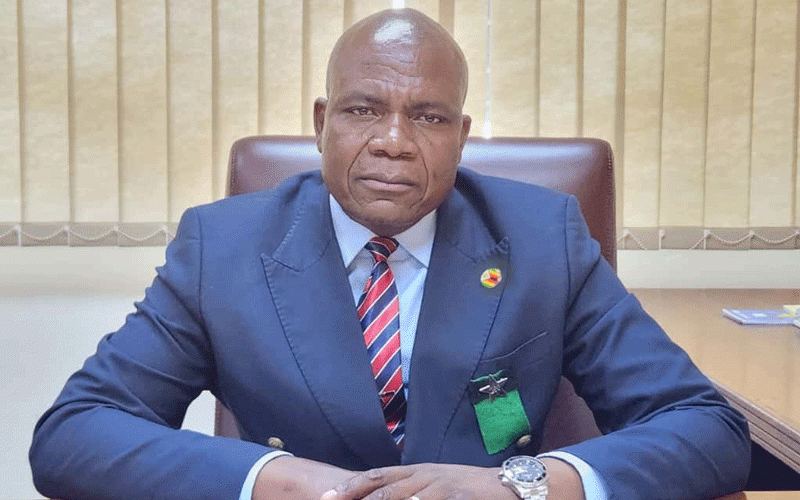
IN a move set to shape the future of the country's skies, the Civil Aviation Authority of Zimbabwe (Caaz) recently appointed George Mashababe (GM) as new director-general. Taking the helm at a pivotal time for regional aviation, Mashababe outlines an ambitious vision to transform Zimbabwe into a competitive hub, overhaul legacy systems, and make air travel more accessible. In this exclusive interview with our senior business reporter, Freeman Makopa (FM), he details priorities ranging from major airport certifications and regulatory reforms to leveraging the Single African Air Transport Market. Below are the excerpts:
FM: Congratulations on your appointment as director-general of Caaz. What are your major priorities at the helm?
GM: When I joined the Civil Aviation Authority of Zimbabwe, the Aviation Training Academy of Zimbabwe had just obtained International Civil Aviation Organisation (ICAO) accreditation in the bronze category.
We have since been advised that we are transitioning from bronze to silver, following a number of training sessions we hosted this year. Going forward, it is not just about moving from bronze to silver or silver to gold, but about making an impact in the region and becoming a centre of excellence. We continue to lobby and attract air operators to enhance aviation and airline business in the country. Charles Prince Airport is set to be developed into a larger hub compared to Robert Gabriel Mugabe International Airport.
As the regulator, we therefore have a significant certification role at Charles Prince Airport, as well as in Mutare, where another major airport is planned for the Manicaland region. We expect to be very active in these certification processes. At Grand Reef, operations began this year, but the airport currently does not have a control tower, meaning we are still conducting category three operations in Mutare. We want this addressed urgently.
We have reduced operations to two and designated a number of airlines to new routes. As a result, Fastjet will be starting flights on the Mutare–Beira route. Airlines will also begin connecting Victoria Falls to Mozambique.
We expect to see more airlines flying through Victoria Falls, northwards and southwards to destinations such as Cape Town and Durban. We are also engaging the Government of Zimbabwe to ensure that we reach a position where the route between Johannesburg and Harare is opened.
FM: What does that mean?
- Airports Company strikes mega hotel deal
- Airports Company strikes mega hotel deal
- News in depth: Chinese firm yet to start airport job seven months after contract
- News in depth: Sneaking planes: Air traffic woes persist as govt promises elusive radar
Keep Reading
GM: It means if the market share remains the same but is shared among operators, air transport will no longer be only for the wealthy, but will become accessible to all citizens.
Our major priority is to develop a civil aviation master plan that supports tourism and aviation across airline operations, airport development, commercial operators, aviation training schools, aircraft maintenance organisations and all other stakeholders.
FM: How does Caaz’s revised mandate strengthen its independence and effectiveness as a regulator of civil aviation safety and security?
GM: The Civil Aviation Authority of Zimbabwe has evolved by separating service provision functions from regulatory functions.
The Airports Company of Zimbabwe has been hived off from Caaz’s regulatory role. The same applies to accident investigation functions, which are now housed within the Ministry of Transport as a dedicated department.
FM: What are the benefits?
GM: Removing accident investigation from the regulator ensures independence and prevents safety recommendations from being diluted, thereby strengthening the aviation safety environment. Separating airport commercial functions from regulation allows Caaz to focus on safety oversight, surveillance and the resolution of safety concerns, while the Airports Company focuses on commercial operations.
This eliminates conflicts of interest and promotes safe, secure and efficient service delivery. To avoid conflicts, Caaz disposed of several aircraft, but we plan to acquire one or two aircraft to allow inspectors to move efficiently across the country. Caaz is now fully focused on its core mandate of regulating the aviation industry.
FM: Since the separation of regulatory and operational roles, what improvements have been recorded in safety oversight and compliance?
GM: There has been significant investment in communication systems, distance-measuring equipment and secondary surveillance radar. This has greatly improved our ability to monitor aircraft operating in our airspace. However, the radar system has limitations, as aircraft must be equipped with specialised equipment to interface with it.
FM: You mentioned infrastructure development. Are there any projects you are currently involved in?
GM: Our role is not to build infrastructure, but to certify it to ensure compliance with international standards and recommended practices.
Our certification teams are already involved in developments at Charles Prince Airport. We also plan to construct our own office block, with headquarters located between Robert Gabriel Mugabe International Airport and Charles Prince Airport.
FM: How is Caaz modernising licensing, certification and inspection processes?
GM: Caaz has procured licensing software to replace manual record-keeping. Licensing and examination systems are being digitised. We are also working with South Korea, which has installed safety oversight inspection systems for our inspectors.
FM: What regulatory reforms have been prioritised to build confidence among airlines and investors?
GM: The Carriage by Air Act and the Air Services Act, last enacted in 1964 and 1968 respectively, govern air transport development.
We have reviewed the Carriage by Air Act, which was based on the Warsaw Convention of 1929, now replaced by the Montreal Convention of 1999.
FM: What does this legislation cover?
GM: It provides for liabilities associated with air transport, including lost baggage, injury and accidents. We have prepared instruments to amend the Carriage by Air Act and reformed the Air Services Act.
FM: What does that mean?
GM: We are establishing coordinated mechanisms involving all stakeholders when granting air service permits and operating licences. This ensures effective service delivery.
On safety, following an ICAO Coordinated Validation Mission in June 2023, we are finalising the resolution of identified deficiencies.
We have amended the Civil Aviation Act to reflect updated standards. In terms of security, our last audit was in August 2019, and we are aligning legislation and policies with ICAO standards through corrective action plans and self-assessment mechanisms.
FM: What is your vision?
GM: To develop a robust domestic aviation system and a sustainable international aviation sector.
FM: What do you mean by that?
GM: We aim to attract legacy airlines through fifth freedom rights and strengthen African connectivity under the Yamoussoukro Decision and the Single African Air Transport Market.
We encourage partnerships between foreign and local operators so that local airlines build capacity, expertise and equipment.
Domestic airlines should connect tourists from hubs to smaller airstrips and back, enabling long-haul carriers to take them beyond Zimbabwe. Through such partnerships, local airlines can grow into international carriers.
Ultimately, we seek to grow aviation, tourism and related infrastructure together as a country.