REPORTS that police at the weekend blocked commemorations in Silobela, Midlands province, intended to honour 10 victims of the Gukurahundi massacres, are not merely disturbing.
They are an indictment of a State that claims to be pursuing reconciliation while actively undermining it.
At face value, the government says it wants to confront one of Zimbabwe’s darkest chapters.
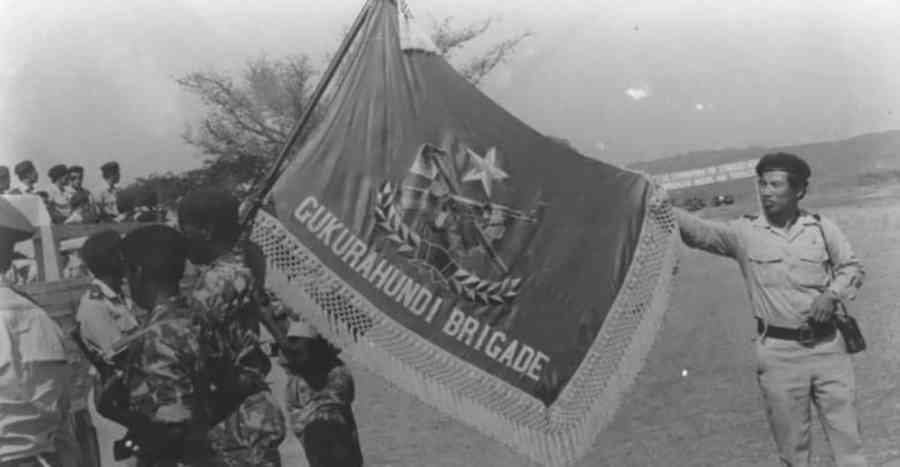
Public hearings into the Gukurahundi atrocities — the 1980s killing of an estimated 20 000 civilians in Matabeleland and the Midlands by the North Korea-trained 5 Brigade — officially began on June 26, 2025.
Led by traditional chiefs, the hearings are framed as a pathway to truth, healing and national unity after decades of silence.
But reconciliation cannot thrive in an atmosphere of fear and coercion.
It cannot be selectively permitted.
And it certainly cannot coexist with police action that suppresses remembrance and mourning.
- Ziyambi’s Gukurahundi remarks revealing
- Giles Mutsekwa was a tough campaigner
- New perspectives: ‘We also died for this country!’
- New law answers exhumations and reburials question in Zim
Keep Reading
What message is the State sending when citizens are blocked from peacefully commemorating the dead?
What kind of healing process criminalises memory?
These are not procedural questions.
They cut to the moral core of the government’s professed agenda.
The contradiction is glaring.
On the one hand, survivors are encouraged to testify before chiefs, to relive trauma and recount unspeakable violence in the name of national closure.
On the other, those same communities are told that honouring victims outside officially-sanctioned platforms is unacceptable.
This is control, not reconciliation.
Blocking commemorations is not a neutral act of law enforcement.
It is a political decision that reinforces the long-standing perception that the State remains uncomfortable with genuine, unscripted truth-telling about Gukurahundi.
It suggests that the process is acceptable only when it is tightly choreographed, managed and stripped of its emotional and political power.
The Gukurahundi massacres were not a natural disaster or an unfortunate misunderstanding. They were a State-sponsored campaign of violence.

Any serious attempt at reckoning must, therefore, tolerate, even protect, spaces where victims and their families can mourn, remember and speak freely.
Without that, the hearings risk becoming a hollow ritual — heavy on symbolism, light on justice.
Law enforcement agencies must understand that their role in this moment is not to intimidate or obstruct, but to facilitate peace and dignity.
Acting like an occupying force in communities still scarred by historical violence only deepens mistrust and re-traumatises survivors.
It confirms the fear that the State has not changed, but only re-branded its language.
If the government is sincere, it must rein in its agents.
Take a leaf from Rwanda.
Every year, Rwanda publicly commemorates the 1994 Genocide against the Tutsi, in which more than 800 000 people were systematically murdered in just 100 days.
The national commemoration period begins on April 7, observed as Kwibuka (“remember” in Kinyarwanda), and runs for 100 days, mirroring the duration of the genocide.
Commemoration is State sanctioned, nationally coordinated and highly visible.
The president, government officials, survivors, youth and the international community participate openly in memorial events, vigils, marches and public discussions.
Flags fly at half-mast, entertainment is suspended and genocide education dominates public discourse.
But in Zimbabwe, someone, somewhere in the chain of command authorised or tolerated the blocking of the Silobela commemorations.
That person — or institution — should be publicly identified and held accountable.
Silence on the part of authorities in the face of such actions amounts to endorsement.
Zimbabwe does not need performative reconciliation.
It needs honesty, consistency and courage.
You cannot invite the nation to confront the past while simultaneously policing how that past is remembered.
You cannot promise healing while wielding the same tools of repression that caused the wounds.
Until the State aligns its actions with its rhetoric, the Gukurahundi hearings will remain suspect — less a bridge to justice than a carefully managed exercise in damage control.
And for the victims, that is yet another betrayal layered onto an already painful history.