
ZIMBABWE’S business community has been urged to move beyond survival mode and focus on competitiveness, innovation and productivity as the country seeks to reposition its industrial sector for sustainable growth.
This came out at the 2026 Zimbabwe National Chamber of Commerce (ZNCC) Mashonaland Regional Annual Business Awards held in Harare recently, where industry leaders, policymakers and executives gathered to celebrate corporate excellence and discuss the future of Zimbabwean enterprise.
Held under the theme “From Resilience to Competitiveness: Charting a New Path for Sustainable Industrial Growth”, the event highlighted the growing consensus within the private sector that Zimbabwean companies must now transition from merely enduring economic challenges to building globally competitive businesses.
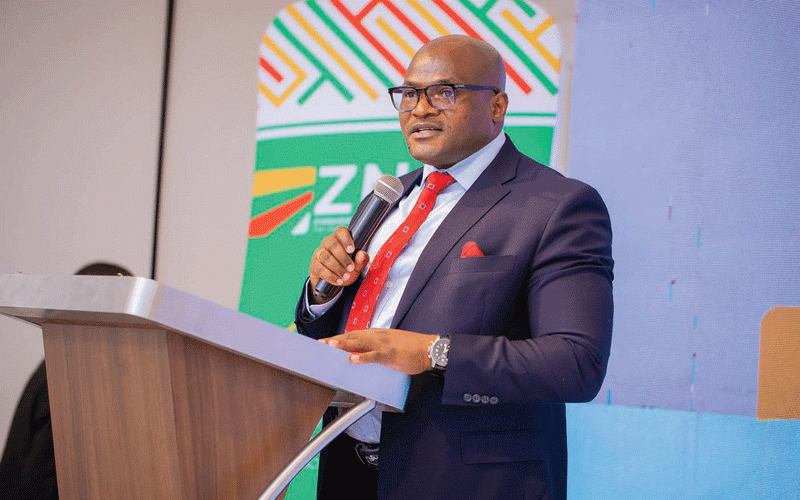
Speaking during the event, ZNCC Harare branch chairperson Amiel Matindike said resilience had defined Zimbabwean businesses for years, but warned that survival alone could not remain the country’s long-term economic identity.
“For years, resilience has defined Zimbabwean business. Businesses adapted to difficult conditions, recalibrated operations, and found creative ways to remain afloat,” Matindike said.
“The resilience deserves recognition. However, resilience alone cannot be our permanent economic identity. We must now transition toward productivity, innovation, efficiency and competitiveness.”
The awards ceremony brought together captains of industry, government officials, diplomats and development partners, underscoring the increasingly collaborative approach being promoted between the public and private sectors to drive industrialisation and economic transformation.
The ZNCC has in recent years intensified calls for policy consistency, infrastructure development, improved access to finance and measures aimed at improving the ease of doing business as Zimbabwe seeks to attract investment and grow exports.
- Power crisis hits Proplastics factory
- Women urged to take advantage of Women’s Bank
- Half of Zim youths loafing: ZimStat
- Mutare creatives shine at ZNCC awards
Keep Reading
Matindike said competitiveness meant producing goods and services capable of competing confidently in regional and international markets.
“It means embracing technology, modernising production systems, investing in skills development, and strengthening value addition,” he said. “It means building enterprises that are agile, export-oriented, and sustainable.”
He noted that the Mashonaland region, which includes Harare Metropolitan, Mashonaland East, Mashonaland West and Mashonaland Central, remained one of Zimbabwe’s key economic hubs, contributing significantly to manufacturing, mining, agriculture, logistics and financial services.
The business awards recognised companies and individuals for excellence in areas such as innovation, corporate governance, sustainability, service delivery and contribution to national development.
Industry players said the recognition of local businesses was critical in boosting confidence and encouraging companies to continue investing despite economic headwinds.
ZNCC Mashonaland Region vice-president Ephraim Chawoneka said the awards reflected the determination of Zimbabwean businesses to continue innovating and expanding under difficult conditions.
“Tonight has truly been a celebration of excellence, resilience, innovation, and ambition,” Chawoneka said.
“More importantly, it has been a celebration of the Zimbabwean spirit, a spirit that refuses to surrender to challenges and instead chooses to innovate, compete, and rise.”
Chawoneka said the discussions during the awards ceremony reinforced the need for Zimbabwean industry to focus on productivity, quality and strategic partnerships.
“The speeches, the discussions, and indeed the awards themselves have reminded us that the future of Zimbabwean industry will not be built on survival alone, but on productivity, innovation, quality and strategic collaboration,” he said.
The event also highlighted growing optimism within the private sector over Zimbabwe’s industrial prospects, particularly as businesses increasingly adopt technology, modern production systems and export-oriented strategies.
Business leaders attending the awards said stronger collaboration between government and industry would be essential in unlocking industrial growth and improving competitiveness across sectors.
Matindike said sustainable industrialisation