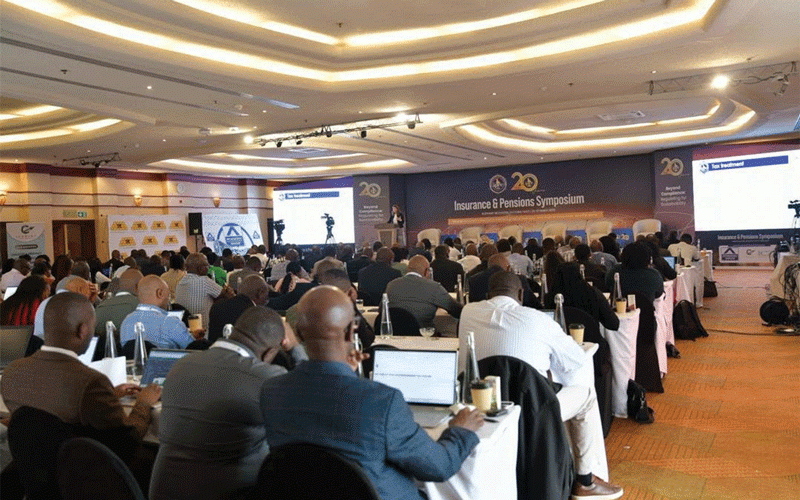

THE insurance and pensions sector has been challenged to move beyond regulatory compliance and focus on delivering real value, fairness and trust to consumers amid growing calls for reforms aimed at strengthening confidence in the industry.
The call came during the Insurance and Pensions Symposium 2026 held in Victoria Falls recently, where policymakers, regulators, legislators, development partners and industry leaders gathered to deliberate on the future of Zimbabwe’s insurance and pensions sector.
A recurring message throughout the three-day symposium was the need for the industry to place consumers at the centre of its operations while embracing innovation, strengthening governance and improving service delivery.
Speaking at the event, Insurance and Pensions Commission (Ipec) commissioner Grace Muradzikwa said the symposium had been designed as a platform to shape the future of the sector.
“The Insurance and Pensions Symposium 2026, is a flagship platform convened by the Insurance and Pensions Commission to bring together thought leaders, policymakers, regulators and industry practitioners from across Zimbabwe, the region and beyond,” Muradzikwa said.
“This symposium has been deliberately designed as a high-level thought leadership platform, not just to discuss the present but to shape the future of the insurance and pensions sector.”
Held under the theme “Beyond Compliance: Delivering Value, Fairness and Trust in Insurance and Pensions”, the symposium examined issues ranging from cybersecurity, artificial intelligence and data governance to sustainability, financial inclusion, pension reforms and consumer protection.
Muradzikwa said the theme represented a broader challenge to all stakeholders within the sector.
- Ipec calls for insurance transparency
- Long-serving pension funds trustees put on notice
- Ipec urges insurers to improve penetration rates
- Actuaries set to regulate members
Keep Reading
“This is not just a theme. It is a call to action. A call for regulators to regulate with purpose. A call for industry to innovate with integrity. And a call for all of us to rebuild and sustain confidence in insurance and pensions.”
She said participants were expected to generate practical recommendations capable of influencing policy and regulatory reforms.
“We expect actionable insights that will inform policy and regulatory frameworks, practical solutions to the challenges facing our industry, stronger collaboration between regulators, policymakers and industry and ultimately renewed confidence in the insurance and pensions sector,” she said.
Muradzikwa emphasised that insurance and pensions played a critical role in society beyond the provision of financial products.
“Because at its core, the insurance and pensions sector is not just about financial products. It is about protecting livelihoods. Preserving dignity in retirement. Managing risk in an uncertain world. And mobilising long-term capital for national development.”
Ipec board chairperson Albert Nduna used the symposium to reflect on the significant transformation of insurance and pensions regulation in Zimbabwe over the past four decades.
Drawing from his experience as Registrar of Insurance and Pensions in the 1980s, Nduna said the sector had evolved from a modest government function into a sophisticated regulatory framework.
“At that time, regulation was housed within the Ministry, operating with limited institutional capacity, simpler frameworks and a narrower scope of oversight,” Nduna said.
“What we had then was essentially a function within government, important, but constrained in both structure and capability.”
Today, he said, Zimbabwe had a far more advanced regulatory system.
“We now have a fully-fledged, independent statutory regulator in Ipec, supported by strong governance frameworks, skilled technical expertise, modern supervisory tools and a clear mandate aligned to international best practice.”
Nduna said the transformation reflected deliberate policy choices and sustained institutional development.
“This transformation is not accidental. It reflects deliberate policy choices, institutional development and sustained commitment from policymakers.”
He noted that the regulatory landscape had shifted “from basic oversight to risk-based supervision”, “from reactive regulation to proactive and forward-looking supervision” and “from limited institutional capacity to a strong, credible and respected regulator”.
Despite the progress made, Nduna said stakeholders had acknowledged that significant challenges remained, particularly around restoring confidence and ensuring the sector delivers meaningful benefits to policyholders and pension scheme members.
“While we acknowledge the progress made, we are equally aware that the responsibility ahead is even greater,” he said.
He added that the symposium's deliberations centred on “restoring and sustaining trust”, “delivering value to policyholders and pension scheme members” and “ensuring that the sector continues to play its role as a pillar of economic development”.
The symposium also attracted international experts, regional regulators and development partners who shared experiences and best practices from other jurisdictions.
As discussions concluded, participants were urged to translate dialogue into concrete action and reforms capable of building a resilient, inclusive and trusted insurance and pensions sector.
“Let us use this platform to be bold in our thinking, honest in our reflections and deliberate in our actions,” Muradzikwa said. “Let us challenge assumptions. Let us share openly. And let us commit to shaping a sector that is resilient, inclusive and trusted.”