
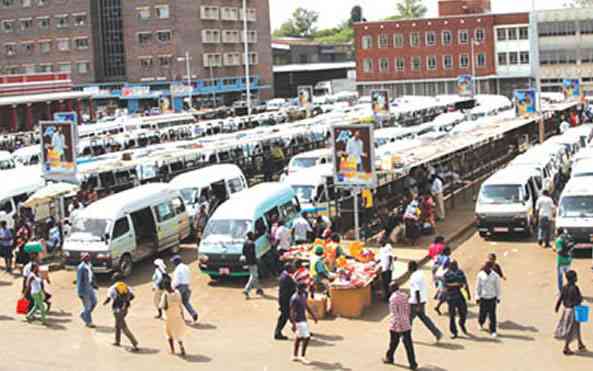
More than two million Zimbabweans board a commuter omnibus twice a day. The transactions are small and unremarkable individually, but in aggregate, they constitute one of the largest economic subsectors in the country. The informal transport sector moves the majority of Zimbabwe’s urban population, yet it receives limited attention in economic policy discussions.
Official data captures less of this activity. The Zimbabwe National Statistics Agency focuses mostly on formal transport operators; the Zimbabwe Revenue Authority tracks registered companies. The commuter omnibuses, and the broader network of unregistered vehicles that serve most urban commuters are largely absent from official records. The sector operates on daily cash flows, informal credit, and associational governance rather than on corporate structures. It employs more people than most formal industries outside agriculture.
Sound transport policy, urban planning, and fiscal strategy all require a clearer understanding of how this sector functions. The starting point is recognising it as an economic subsector worth studying, not a gap in formal provision.
Informal transport accounts for an estimated 60% or more of urban passenger movement in Zimbabwe. According to the public passenger transport associations, it is estimated that between 15 000 and 18 000 commuter omnibuses operate in Harare at any given time with only about 4 500 of these currently registered as public service vehicles.
Beyond transport operators themselves, the sector sustains a wide network of economic activities involving drivers, conductors, touts, mechanics, spare parts traders, and fuel vendors. Collectively, these activities are estimated to support more than 100 000 direct jobs, with a similar number of indirect livelihoods linked to the industry.
In comparison, according to the Zimbabwe National Statistics Agency, formal employment in Zimbabwe’s manufacturing sector accounts for 7% of the formal jobs in the country. By employment alone, the informal transport sector ranks among the country’s largest economic activities. Most of that activity is unregistered. Few kombi owners file tax returns. The sector generates substantial economic value that does not appear in national accounts.
A typical kombi operates on a straightforward principal-agent model. The owner — whether holding one vehicle or several — leases it to a driver for a fixed daily fee, known as the “target”. This fee covers the owner’s costs and return. The driver pays for fuel, engages a conductor, and keeps the remainder of the day’s fares.
The arrangement transfers revenue risk to the driver. The owner receives a predictable return regardless of daily performance. The driver’s income varies with fuel prices, passenger volumes, and operational disruptions. At the end of a bad week, the driver may break even or fall short. In a strong week, earnings can be considerable.
- ‘Pray for ED to live long’
- Sanyati accident claims 2 lives
- Police blitz divides Byo transport operators
- Everyday hassle on public transport
Keep Reading
The system functions without formal contracts or registered businesses. It is sustained by trust, reputation, and the enforcement capacity of transport associations. These associations in some cases allocate routes, maintain rank discipline, resolve disputes, and collect levies that cover operational costs such as accident assistance and legal support. In practice, they perform many of the coordinating functions that a formal licensing regime would otherwise provide.
The sector presents a straightforward fiscal problem: it is large enough to matter to public finances but structured in a way that makes conventional taxation difficult. Registration campaigns and integration programmes have had limited uptake, partly because operators weigh the costs of compliance against benefits they have not clearly seen.
The sector does contribute indirectly through fuel levies and through road wear that increases public maintenance costs. A more productive framing is not how to extract more from the sector but how to create conditions in which operators have incentives to participate in formal systems. That requires demonstrating a return on compliance.
This question is more answerable today than it has been in some time. The Government of Zimbabwe has made improving the ease of doing business a stated policy priority. Reforms under the Zimbabwe Investment and Development Agency (Zida) Act, the ongoing simplification of business registration through the Zida one-stop shop, and measures to reduce licensing bureaucracy have materially lowered the cost of entry into formal business activity. The number of procedures required to start a business has been reduced, and processing times have shortened.
These reforms create a more favourable environment for bringing informal operators into regulated frameworks. A transport operator who can register a business in days rather than months, and access formal credit on the strength of that registration, faces a different calculation than one for whom formalisation meant navigating a months-long bureaucratic process. The infrastructure for a lower-friction path to compliance now exists; the task is to extend it to this subsector specifically.
A tiered licensing system would be more effective than a binary choice between full informality and formality. Route-specific operating licences, issued to associations meeting defined safety and insurance standards, would bring operators into a legal framework without requiring immediate corporate formalisation. Entry requirements should be set at a level operators can realistically meet.
The subsector’s daily cash flows represent a significant pool of liquidity that moves outside the formal financial system.
Designing savings and credit products suited to the income patterns of kombi owners and drivers through mobile money platforms or microfinance institutions would extend financial access and give operators the means to invest in vehicles and compliance.
A portion of subsector-specific levies or licensing fees should be allocated to road maintenance in high-use informal transport corridors. The link between contribution and visible benefit is important: operators who see levies translated into road repairs have a concrete reason to participate in formal systems.
The informal transport sector is not an anomaly. It is a functioning economic subsector that has developed its own governance, credit, and labour arrangements at considerable scale. It is also a sector that stands to benefit from the business environment improvements already underway. Understanding how it works is a precondition for designing policy that achieves results.
Formalisation, where it is the objective, is most likely to succeed when it offers operators a practical path forward rather than a compliance burden.
Policies built on that principle can bring a large and productive sector more fully into Zimbabwe’s measured economy.
Chigombe is economist and writes in his personal capacity.These weekly New Horizon articles published in the Zimbabwe Independent, coordinated by Lovemore Kadenge, an independent consultant, managing consultant of Zawale Consultants (Private) Limited, past president of the Zimbabwe Economics Society and past president of the Chartered Governance & Accountancy Institute in Zimbabwe. — [email protected] or mobile: +263 772 382 852.